
Celebrities When They Were Young Quiz
How the Scales are Structured
Who Usually Takes This Test?
See How You Compare
Below is a preview of how scores are typically distributed across each scale.
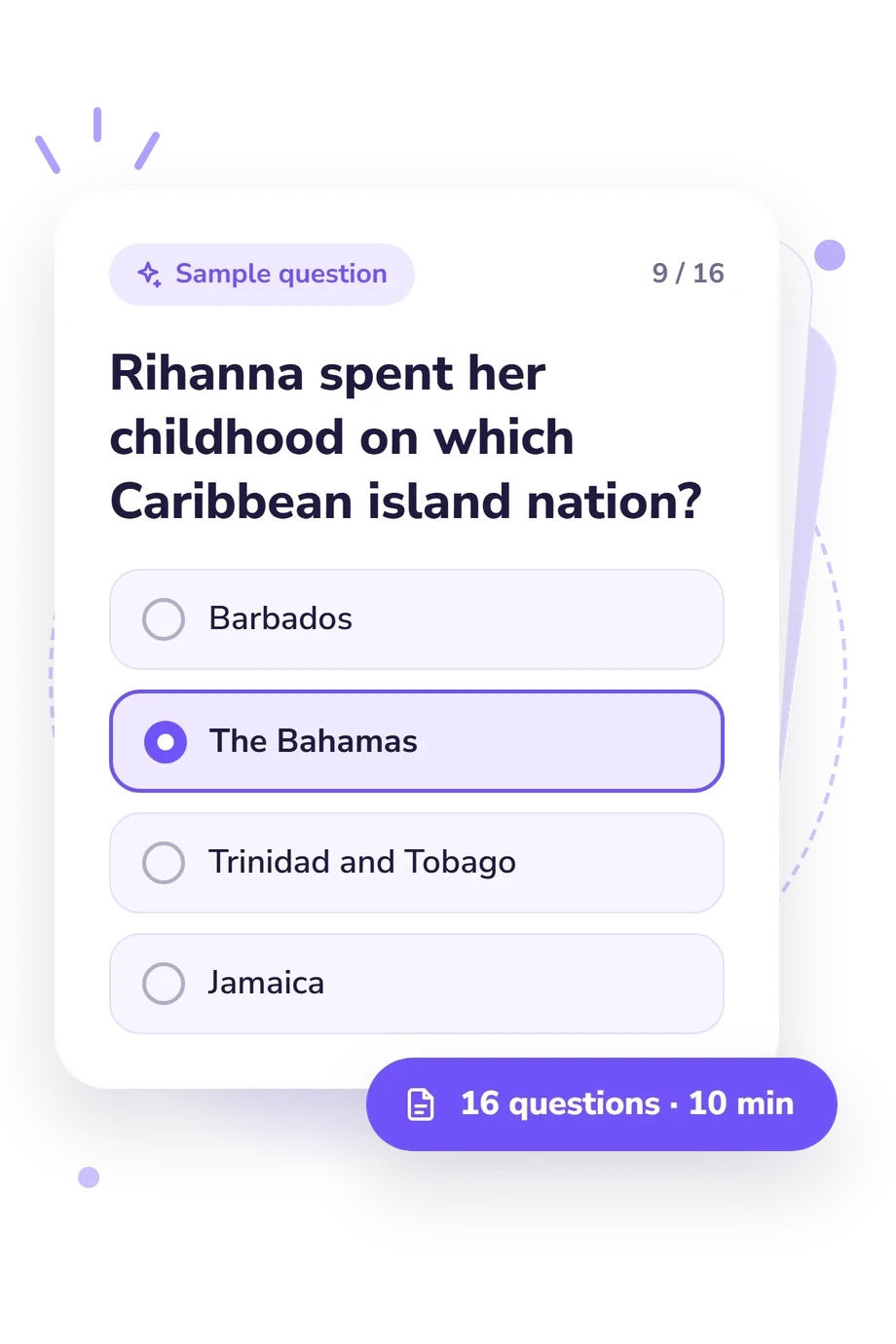
Example Questions From the Test
- Dream
- 3LW
- The Cheetah Girls
- Girl’s Tyme
- All That
- The Amanda Show
- Barney & Friends
- Zoom
- University of Miami
- Pennsylvania State University
- University of Southern California
- University of Alabama
Celebrities When They Were Young Quiz - Description and methodology of the test
Designed for readers who enjoy entertainment history, the celebrities when they were young quiz offers a compact challenge for testing how readily familiar names bring associated facts to mind. It suits trivia fans who like tracing public careers through memorable details and want a clear snapshot of their recall. As a quiz about celebrities when they were younger, it shows how confidently you connect names with formative details.
What This Quiz Measures
The assessment asks whether you can connect a well-known person with formative facts, early roles, places, and turning points. Clues span music, film, television, sport, and broadcasting, so performance reflects broad entertainment knowledge rather than one specialist subject. Rather than relying on photographs, this written-clue version of a when they were young picture quiz tests recognition and biographical recall.
The questions revisit several themes:
- Early-life milestones show whether you recognize childhood performances, training, and first public appearances.
- Career pathways show whether you can place early jobs, auditions, broadcasts, and breakthrough steps in context.
- Identity and origins show whether you remember birth names, hometowns, family settings, and formative locations.
The single Celebrities When They Were Young Knowledge (0-16) scale summarizes the total number of correct answers: 0-6 is Early-Life Explorer, 7-12 is Backstory Buff, and 13-16 is Celebrity Origins Expert.
Methodology and Evidence Base
Each item offers four answer choices. A written clue identifies an early event, role, place, sequence, or identity detail, and the respondent selects the best answer. This objective format counts correct recognitions rather than agreement or symptom ratings.
Each correct response adds one point; the total matches a band. The logic is transparent, but this questionnaire is not a standardized adaptation of a published instrument.
The quiz’s biographical recall focus is conceptually consistent with Haslam et al. (2004), who examined biographical knowledge, but that study is not its instrument, method, or validation source. It also relates to Langlois et al. (2009) on famous-face recognition and biographical knowledge, and Darling and Valentine (2005) on semantic memory for famous people. Those studies support factual memory’s relevance, but they do not validate this online quiz.
This unstandardized online measure yields a descriptive, non-norm-referenced total. As a celebrity childhood trivia quiz, it is best read as a focused snapshot of recall shaped by media exposure, cultural familiarity, memory, and guessing.
- Haslam, Catherine, Janice Kay, J. Richard Hanley, and Frances Lyons. "Biographical knowledge: Modality-specific or modality-neutral?" Cortex 40, no. 3 (2004): 451-466. 10.1016/S0010-9452(08)70139-4
- Langlois, Roxane, Francine Fontaine, Caroline Hamel, and Sven Joubert. "The impact of aging on the ability to recognize famous faces and provide biographical knowledge of famous people." Canadian Journal on Aging 28, no. 4 (2009): 337-345. 10.1017/S0714980809990183
- Darling, Stephen, and Tim Valentine. "The categorical structure of semantic memory for famous people: A new approach using release from proactive interference." Cognition 96, no. 1 (2005): 35-65. 10.1016/j.cognition.2004.03.007
Updated: