
Car Insurance Quiz
How the Scales are Structured
Who Usually Takes This Test?
See How You Compare
Below is a preview of how scores are typically distributed across each scale.
Example Questions From the Test
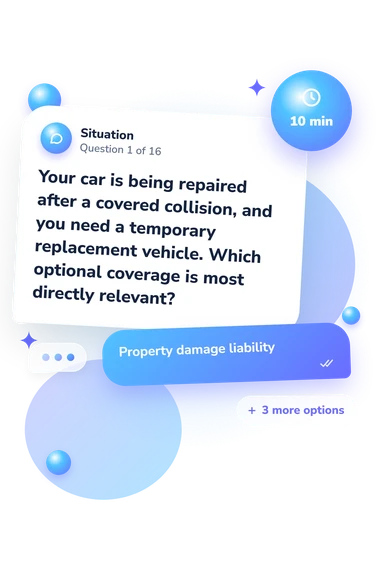
- Property damage liability
- Medical payments coverage
- Uninsured motorist bodily injury coverage
- Rental reimbursement or transportation expense coverage
- Bodily injury liability
- Comprehensive coverage
- Rental reimbursement coverage
- Collision coverage
- The vehicle maintenance schedule
- The repair shop estimate
- The vehicle title
- The policy declarations page
Car Insurance Quiz - Description and methodology of the test
People seeking a clearer grasp of everyday coverage can use this car insurance quiz to check how confidently they recognize policy terms and common claim situations. It is intended for readers reviewing a policy, comparing options, or preparing questions for an insurer. The auto insurance quiz format centers on practical questions, showing which concepts appear secure and which deserve closer attention.
What This Assessment Explores
Practical insurance literacy is the focus: items ask readers to distinguish liability from physical-damage coverage, interpret deductibles and limits, find policy information, and choose sensible actions after losses.
The car insurance knowledge test suits self-review before reading a declarations page or discussing coverage. It measures applied understanding while recognizing exclusions, jurisdiction, and limits can affect outcomes.
One educational scale, Car Insurance Knowledge (0-16), reports three bands: Foundational (0-6) signals basic recognition and topics to review; Developing (7-12) shows growing practical understanding; Strong (13-16) indicates solid knowledge of typical concepts. Recurring areas addressed by the questions include:
- Coverage choices show what liability, comprehensive, collision, and rental reimbursement generally address.
- Policy mechanics explain how premiums, deductibles, limits, lapses, and declarations pages affect decisions.
- Claim situations show how knowledge applies to theft, collisions, weather losses, and changing drivers or vehicle use.
Methodology and Evidence Base
Each item has four answer choices, and some questions use brief scenarios. The choices test recognition and application: selecting coverage, interpreting limits or deductibles, locating policy information, or choosing a prudent next step. The questionnaire reports one educational result; no additional weighting rule is stated beyond its displayed interpretation.
The closest conceptual reference is Tennyson’s 2011 insurance-literacy study, which treats insurance literacy as understanding and using basic insurance information. This questionnaire is conceptually consistent with that work, not an adaptation of it. Allodi, Bocchino, and Stella’s 2021 measure and NAIC guidance offer related context for insurance knowledge and consumer decisions; these works do not establish this questionnaire’s authorship, adaptation, or validation.
As a car insurance test, it is a structured self-administered knowledge check whose educational interpretation can vary with prior experience, current circumstances, and scenario understanding; state law and policy wording differ, so it cannot establish that a particular policy suits you or predict every claim outcome. Use it to identify terms to review in your documents and verify limits, exclusions, endorsements, and legal requirements against authoritative policy information.
- Sharon Tennyson. Consumers’ insurance literacy: evidence from survey data. Financial Services Review, 2011, 20(3), 165-179. 10.61190/fsr.v20i3.4701
- Evita Allodi, Enrico M. Bocchino, and Gian P. Stella. Understanding Insurance Knowledge: A Brief 7-Item Measure. International Journal of Business and Management, 2021, 16(2), 65-74. 10.5539/ijbm.v16n2p65
- National Association of Insurance Commissioners. A Shopping Tool for Auto Insurance. 2023.