
Cadaver Lab Quiz
How the Scales are Structured
Who Usually Takes This Test?
See How You Compare
Below is a preview of how scores are typically distributed across each scale.
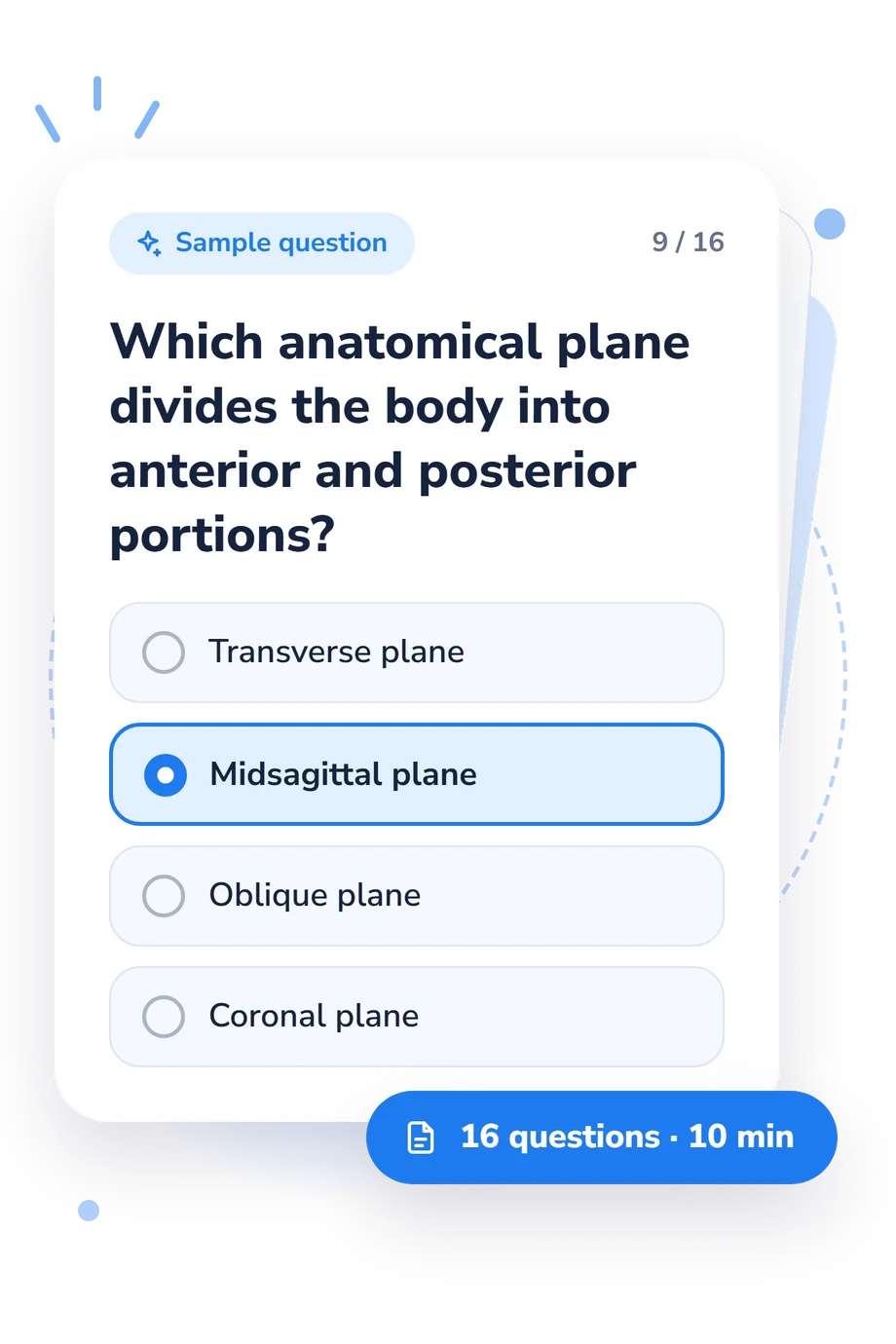
Example Questions From the Test
- Cranial and vertebral cavities
- Pleural and pericardial cavities
- Abdominal and pelvic cavities
- Thoracic and abdominopelvic cavities
- It is closer to the trunk than the incision
- It is above the incision
- It is on the opposite side of the body from the incision
- It is on the same side of the body as the incision
- A ligament
- A tendon
- A nerve
- A vein
Cadaver Lab Quiz - Description and methodology of the test
Students entering or revisiting anatomy lab work can use this assessment to check whether their conceptual knowledge matches the decisions expected during supervised dissection. The cadaver lab quiz focuses on practical recognition, anatomical language, respectful donor care, and routine laboratory safety rather than memorization alone. The human cadaver quiz format emphasizes responsible observation and applied terminology, making it useful before lab, during revision, or when identifying topics for instructor-guided review.
What This Assessment Measures
This questionnaire brings together applied anatomy and conduct in the dissection room. Questions ask learners to distinguish structures by location and appearance, interpret directional terms and anatomical planes, and recognize relationships among cavities, vessels, nerves, muscles, skin, and connective tissues. Alongside muscle-related anatomy, the cadaver muscle quiz asks learners to transfer textbook knowledge into lab-relevant choices.
The thematic groups represented in the result include:
- Anatomical terminology shows how accurately you apply directions, planes, and positional relationships.
- Structural identification indicates whether you can distinguish tissues from described features.
- Dissection technique reflects understanding of gentle exposure, tissue preservation, instrument use, and contamination control.
- Professional conduct and safety show how you respond to donor-care expectations, sharps risks, and fluid exposure.
The result uses one scale, Cadaver Lab Knowledge (0-16). Its bands are Foundations to build (0-6), Developing lab fluency (7-12), and Strong core knowledge (13-16). These labels describe educational progress and point to review priorities.
Methodology and Evidence Base
Each item presents a short anatomy or laboratory scenario with four answer choices and asks for the best response. The format combines factual recognition with judgment about sharps handling, contamination, donor coverage, eyewash response, and tissue preservation. Results summarize selected knowledge and decision-making.
As a cadaver anatomy quiz, the assessment supports structured revision before supervised practice and helps learners prioritize review.
Dalmau-Pastor et al. (2024) emphasize quality systems, safety, and consistent dissection-room practice. Palmer, Reddy, and Laughey (2021) connect dissection teaching with professionalism, while Ghosh (2017) emphasizes respect for donors in anatomical education. The questionnaire is an educational online tool rather than a published standardized measure; these publications provide conceptual context but do not validate this version or supply its score bands.
Because responses are selected in a particular study context, performance can vary with recall, attention, and confidence. The educational score is not a competency certification, and any cut, splash, exposure, or other concern still requires action under local laboratory procedures.
- Dalmau-Pastor M, Alvarez Toledo N, Valdivia-Gandur I, Tubbs RS, Vázquez-Osorio T, de Anta JM, Simon de Blas C, Prats-Galino A, Loukas M, Manzanares-Cespedes MC. International consensus for a dissection room quality system (DRQS): A Delphi panel study. Clinical Anatomy. 2024;37(1):54-72. 10.1002/ca.24086
- Palmer EG, Reddy RK, Laughey W. Teaching Professionalism to Medical Students Using Dissection-Based Anatomy Education: a Practical Guide. Medical Science Educator. 2021;31(1):203-213. 10.1007/s40670-020-01137-2
- Ghosh SK. Paying respect to human cadavers: We owe this to the first teacher in anatomy. Annals of Anatomy. 2017;211:129-134. 10.1016/j.aanat.2017.02.004
Updated: