
BSD Kin Quiz
How the Scales are Structured
Who Usually Takes This Test?
See How You Compare
Below is a preview of how scores are typically distributed across each scale.
Example Questions From the Test
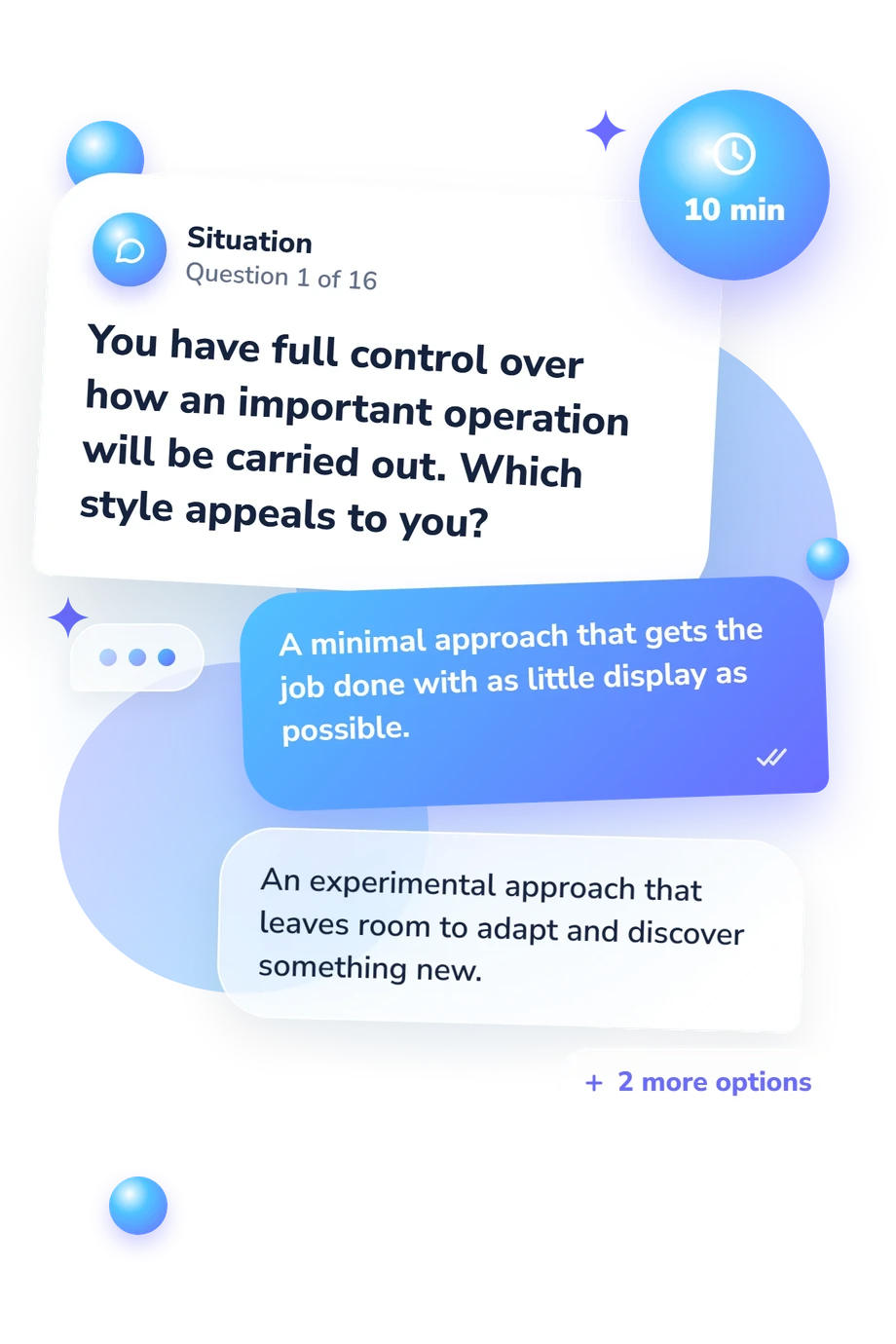
- A minimal approach that gets the job done with as little display as possible.
- An experimental approach that leaves room to adapt and discover something new.
- A reliable, efficient plan built around clear responsibilities.
- A bold, polished execution that demonstrates command from beginning to end.
- One where I can build mastery without depending heavily on the group.
- One that lets me move between independence and connection as circumstances change.
- A trusted role where my contribution clearly matters to the team.
- A role where I can protect people and know they genuinely need me beside them.
- Disengage; their opinion does not deserve more of my time.
- Laugh it off unless the comment affects something that matters.
- Let my next result provide a controlled and undeniable answer.
- Challenge the insult immediately and make it clear that I will not be diminished.
BSD Kin Quiz - Description and methodology of the test
For fans who want to examine how they respond to loyalty, recognition, pressure, and uncertainty, the BSD Kin Quiz offers a structured reflection on character resonance. It is suited to readers who enjoy Bungou Stray Dogs and want a focused comparison with familiar fictional patterns. As a character affinity quiz, it highlights the profile that feels most recognizable without treating the result as a fixed identity.
What This Assessment Explores
This assessment compares responses to belonging, criticism, promises, danger, hidden motives, goals, and rivalry. A Bungou Stray Dogs character quiz can show which fictional motives feel familiar without making the result a fixed identity.
The four result dimensions are:
- Atsushi Nakajima Affinity (0-12) measures compassion, belonging, judgment sensitivity, and courage; Distant resonance 0-4, Partial resonance 5-8, Strong resonance 9-12.
- Chuuya Nakahara Affinity (0-12) measures loyalty, competence, decisive energy, and bold action; Distant resonance 0-4, Partial resonance 5-8, Strong resonance 9-12.
- Osamu Dazai Affinity (0-12) measures humor, social strategy, flexible rules, and concealed motives; Distant resonance 0-4, Partial resonance 5-8, Strong resonance 9-12.
- Ryunosuke Akutagawa Affinity (0-12) measures ambition, recognition, confrontation, and persistence; Distant resonance 0-4, Partial resonance 5-8, Strong resonance 9-12.
The highest score is your strongest affinity; totals within one point form a blended result.
Methodology and Scientific Basis
Each item presents a fictional dilemma with four response choices. The alternatives vary between restraint, adaptation, direct confrontation, loyalty, observation, social care, and achievement. Selecting the response that feels most like your likely reaction creates four comparable profile totals rather than a single global score.
Scores are interpreted relationally. The highest total represents strongest affinity, while totals within one point indicate a blended result. This makes the outcome a snapshot of familiar motives, not a fixed label or population ranking. As a fictional character quiz, it uses comparative self-report and depends on honest choices, current context, self-awareness, and familiarity with the characters.
Conceptually, it aligns with Nguyen et al. (2023) on fictional-character identification in fandom. Rarity et al. (2022) associated character identification with perceived personality similarity, and Huang and Fung (2024) developed a narrative-character identification scale. These studies support the relevance of character resonance, but this questionnaire is not an adaptation or validation of their instruments. It has no stated norms for clinical interpretation, so its bands are best used for personal reflection rather than diagnosis.
- Nguyen, Trisha M., Mohammed Khadadeh, and David C. Jeong. “Shippers and Kinnies: Re-conceptualizing Parasocial Relationships with Fictional Characters in Contemporary Fandom.” Proceedings of the 18th International Conference on the Foundations of Digital Games (FDG ’23), Article 32, pp. 1-12. Association for Computing Machinery, 2023. 10.1145/3582437.3582476
- Rarity, Erica C., Matthew R. Leitao, and Abraham M. Rutchick. “Identification With Characters in Parasocial Relationships Predicts Sharing Their Personality Traits.” Psychology of Popular Media, vol. 11, no. 2, 2022, pp. 111-116. 10.1037/ppm0000389
- Huang, Kate Y., and Helene H. Fung. “Measuring identification with narrative characters: The development and validation of a new scale.” Current Psychology, vol. 43, 2024, pp. 24835-24849. 10.1007/s12144-024-06191-2
Updated: