
Bridge Quiz
How the Scales are Structured
Who Usually Takes This Test?
See How You Compare
Below is a preview of how scores are typically distributed across each scale.
Example Questions From the Test
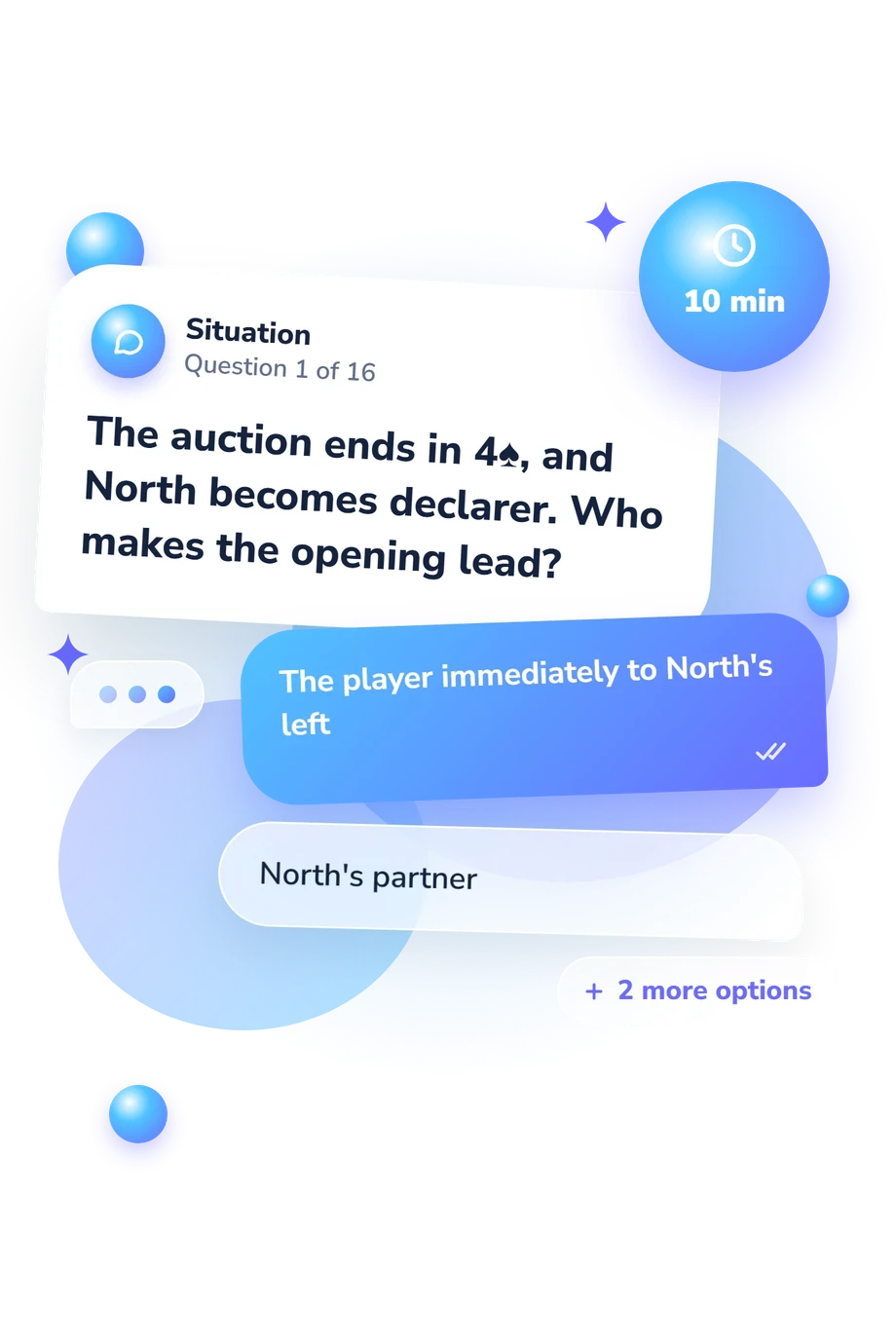
- The player immediately to North's left
- North's partner
- The player immediately to North's right
- North, as declarer
- Play a trump if you have one
- Play a club
- Play your lowest card in any suit
- Discard from your longest suit
- Three no-trump, requiring nine tricks
- Four diamonds, requiring ten tricks
- Five clubs, requiring eleven tricks
- Four hearts, requiring ten tricks
Bridge Quiz - Description and methodology of the test
Players who want a practical check of contract-bridge fundamentals can use the bridge quiz to review how confidently they handle common rules, auction decisions, and table situations. It suits learners, returning players, and curious partners who want a clear starting point for study. Questions about bridge place these skills in familiar deal scenarios and lead to a focused knowledge result.
What This Assessment Explores
Rather than measuring personality or partnership style, this questionnaire checks practical contract-bridge knowledge. It suits learners and players who want to understand the rules that make a deal intelligible at the table. A daily quiz on bridge can support revision between study sessions.
The questions sample dimensions:
- Table procedure shows whether you recognize opening-lead responsibility, dummy, partnerships, and passing.
- Bidding and contracts measure links between the auction, denomination, level, target, and doubles.
- Trick-taking rules test following suit, trump priority, card rank, finesses, and revokes.
- Scoring concepts show whether you understand overtricks, vulnerability, bonuses, and penalties.
Bridge Knowledge runs from 0-16. Foundational (0-6) means some concepts are recognized but review would help; Developing (7-12) means many essentials apply in familiar situations, although some bidding, play, or scoring needs reinforcement; Strong (13-16) means reliable command of standard fundamentals and practical table reasoning.
Methodology and Evidence Base
Each item presents a bridge situation or rule with four answer choices. Choosing the best response tests recognition and application rather than playing habits. Responses combine into one knowledge score; this version does not report separate subscores for bidding, play, or scoring.
As a quiz focused on bridge bidding, it emphasizes auctions, contracts, and trick requirements while sampling rules needed to interpret a deal. Its evidence base is conceptually consistent with the Assessing Bridge Skill Questionnaire, which organizes bridge competence. Charness’s 1979 analysis supports a view of skill broader than card knowledge, while the World Bridge Federation laws and Grant’s introductory treatment support procedural and foundational content. This questionnaire is not presented as an adaptation or validation of those works.
The result is descriptive rather than norm-referenced: no population norms or reliability estimates are stated for this version, so the bands function as practical learning descriptors. Honest responding, previous instruction, terminology familiarity, and concentration can influence performance. One score cannot capture judgment, partnership communication, or strategic flexibility across all situations.
- Croatian Bridge Federation. Assessing Bridge Skill: Questionnaire for Teachers & Coaches. n.d.
- Charness, Neil. Components of skill in bridge. Canadian Journal of Psychology/Revue Canadienne de Psychologie 33, no. 1 (1979): 1-16. 10.1037/h0081698.
- World Bridge Federation Laws Committee. 2017 Laws of Duplicate Bridge. World Bridge Federation, 2017; revised 2024. Committee members: Max Bavin, Maurizio Di Sacco, David Harris, Alvin Levy, Chip Martel, Howard Weinstein, John Wignall, Adam Wildavsky, Laurie Kelso, Ton Kooijman. ISBN 978-0-6480678-0-1.
- Grant, Audrey. Bridge Basics 1: An Introduction. Baron Barclay Bridge, 2006. ISBN 978-0-939460-90-8.
Updated: