
Best Friend Quiz Questions
How the Scales are Structured
Who Usually Takes This Test?
See How You Compare
Below is a preview of how scores are typically distributed across each scale.
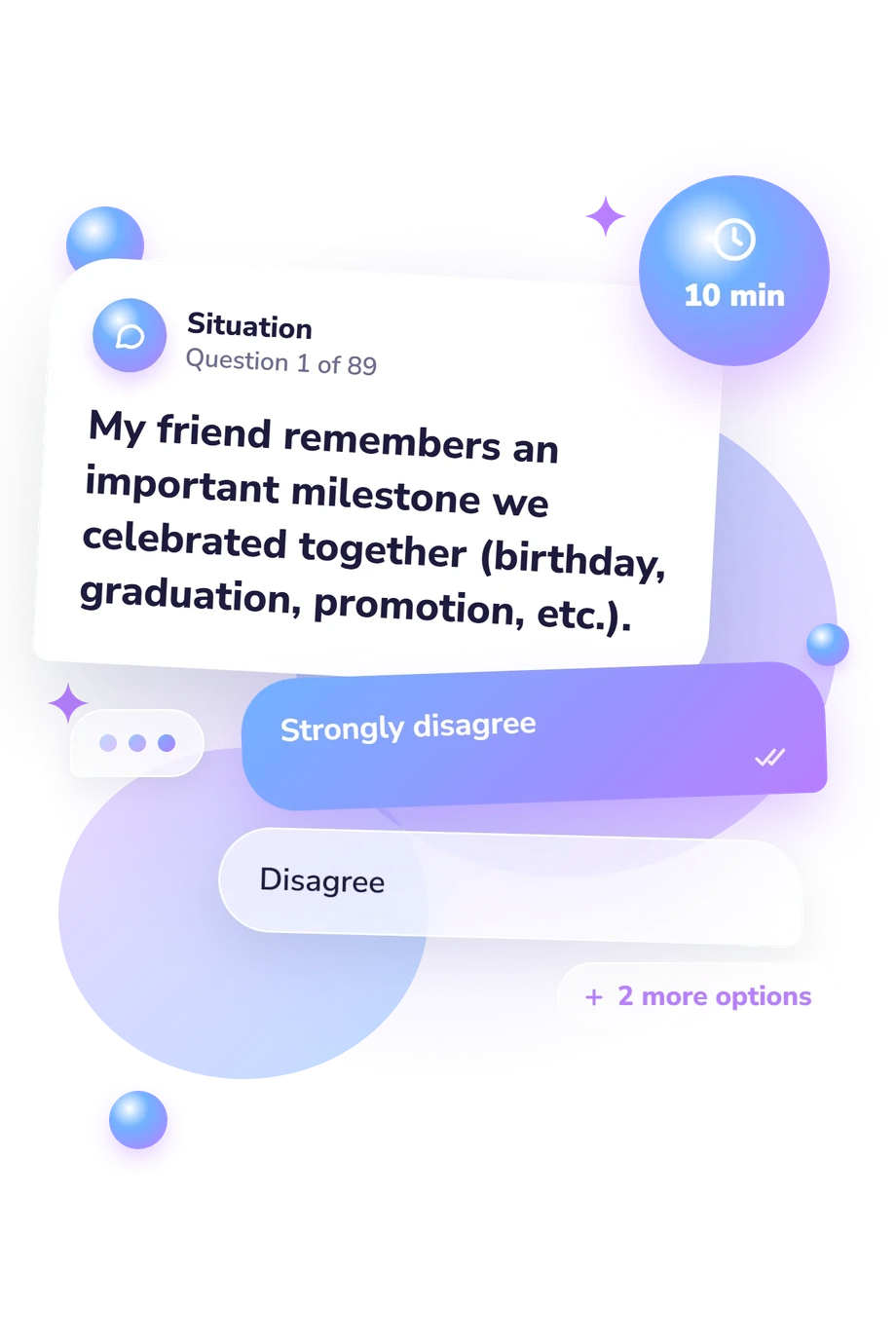
Example Questions From the Test
- Strongly disagree
- Disagree
- Not sure
- Agree
- Not at all confident
- Slightly confident
- Mostly confident
- Completely confident
- Not at all confident
- Slightly confident
- Mostly confident
- Completely confident
Best Friend Quiz Questions - Description and methodology of the test
For friends who want to examine one person's knowledge of the other, Best Friend Quiz Questions offers a structured set of prompts about preferences, routines, personality, important memories, and shared references. Its friendship test questions ask one friend to answer about the respondent, so the result profiles that friend's knowledge and shared-history recall rather than the relationship as a whole.
What This Assessment Explores
This assessment examines how accurately a friend recognizes personal details. Prompts cover favorites, fears, humor, coping habits, communication preferences, social style, routines, values, milestones, and shared references. It is intended for friends seeking a profile of one person's knowledge of the other.
The best friend test questions in this assessment combine everyday knowledge with memories and inside references, asking about personal details and experiences shared by the pair.
The three displayed result dimensions are:
- Bestie Rank (1-5) summarizes overall matching as Getting to Know You (1-2), Solid Bestie (3-4), or Top-Tier Bestie (5).
- Friendship Knowledge Score (0-20) measures correct details across categories, from Still Learning (0-7) to Pretty In Sync (8-14) and Knows You Well (15-20).
- Inside-Joke & Memories Match (0-10) tracks shared-history overlap: Few shared callbacks (0-3), Some shared memories (4-7), or Strong shared history (8-10).
Methodology and Evidence Base
Representative items use four-option agreement or confidence scales. They cover milestones, shared stories, meaningful places, usual orders, preferences, fears, humor, coping, and social tendencies. This format combines recall with personal confidence without requiring written answers.
Responses are aggregated into three range-based summaries, so the result describes agreement and recall rather than one verdict. Higher values indicate more accurate knowledge or stronger overlap; lower values indicate mismatches, guesses, or fewer shared reference points. Answers to the friend quiz questions in this questionnaire can give friends specific differences to discuss, such as an overlooked preference or a shared memory recalled differently.
The questionnaire is conceptually consistent with Friesen and Kammrath (2011), whose work examines how people understand a close other's situation-dependent patterns. This supports the personal-knowledge dimension without establishing this questionnaire's development or scoring. The displayed ranges are descriptive labels for these results, not clinical thresholds or population norms. These friendship quiz questions produce an informal profile: answers depend on memory, honesty, confidence, and the current relationship, so the result is best read as one friend's knowledge and shared recall.
- Bowker, Anne. (2004). Predicting Friendship Stability During Early Adolescence. The Journal of Early Adolescence, 24(2), 85-112. 10.1177/0272431603262666
- Friesen, Charity A., and Lara K. Kammrath. (2011). What It Pays to Know About a Close Other: The Value of If-Then Personality Knowledge in Close Relationships. Psychological Science, 22(5), 567-571. 10.1177/0956797611405676
Updated: