
Aussie Quiz
How the Scales are Structured
Who Usually Takes This Test?
See How You Compare
Below is a preview of how scores are typically distributed across each scale.
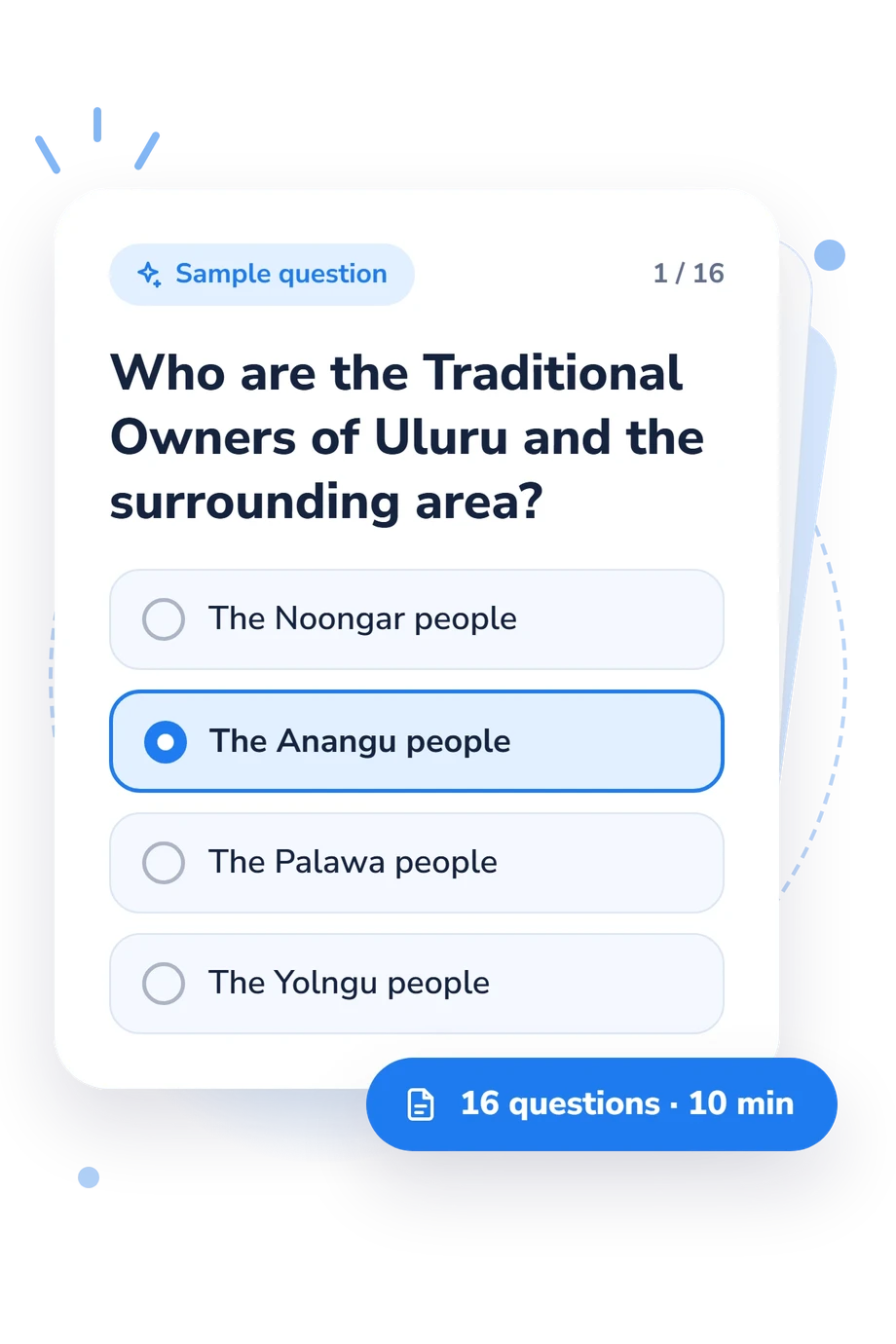
Example Questions From the Test
- The Noongar people
- The Anangu people
- The Palawa people
- The Yolngu people
- Brisbane
- Sydney
- Melbourne
- Canberra
- Along the eastern side
- Across the tropical north only
- Through the central desert
- Along the western interior
Aussie Quiz - Description and methodology of the test
Visitors preparing for life in Australia, people interested in national culture, and learners building general knowledge may find this aussie quiz useful. As an Australian knowledge quiz, it offers a broad knowledge profile across Australian life rather than a personal attitude measure. Geography questions sit alongside civic knowledge, landmarks, history, symbols, seasons, and practical everyday information, giving the respondent one structured view of these connected areas.
What This Assessment Explores
The questions ask you to recognize and apply information about Australia rather than report personal attitudes. As an Australian culture quiz, it brings together places, institutions, symbols, history, and everyday conventions. The resulting profile summarizes performance across these areas rather than producing separate subject scores.
The item themes contributing to the overall profile are:
- Geography shows recognition of regions, cities, features, directions, and destinations.
- Government and civics cover institutions, voting, constitutional change, and emergency services.
- History and public occasions test dates and significant national events.
- Indigenous heritage and symbols examine Traditional Owners and national emblems.
- Everyday culture includes seasons, animals, music, and familiar references.
Your result appears on the Aussie Knowledge scale, from 0-16, with Getting Oriented (0-6), Developing Knowledge (7-12), or Strong Aussie Knowledge (13-16). The bands indicate how broadly and accurately you performed across the set.
Methodology and Scientific Basis
Each item presents a short factual scenario or direct question with four answer choices. The format tests recognition of places, civic structures, dates, symbols, practical facts, and cultural references. It is a knowledge check, not a personality inventory, so the result reflects what you identify at the time of completion.
The questionnaire displays one overall performance scale, not separate subscores for geography, civics, or culture. It does not specify how individual answers contribute to the total, so the named bands should be read as broad summaries of performance across the set.
Content is conceptually consistent with Our Common Bond, which presents civic knowledge, national identity, history, symbols, and responsibilities for citizenship education. This is a separate online questionnaire, not a reproduction or adaptation of that resource. Fozdar and Spittles’ 2009 study contextualizes citizenship testing but does not validate the questionnaire.
As an Australian trivia quiz, this assessment can support review and conversation, but performance can vary with prior study, language familiarity, memory, and current context. Missed answers are therefore best treated as prompts for further learning rather than fixed judgments about ability.
- Australian Government, Department of Home Affairs. Australian Citizenship: Our Common Bond. Canberra: Commonwealth of Australia, 2020.
- Fozdar, Farida, and Brian Spittles. “The Australian Citizenship Test: Process and Rhetoric.” Australian Journal of Politics and History 55, no. 4 (2009): 496-512. 10.1111/j.1467-8497.2009.01529.x
Updated: