
Are You a Mermaid Quiz
How the Scales are Structured
Who Usually Takes This Test?
See How You Compare
Below is a preview of how scores are typically distributed across each scale.
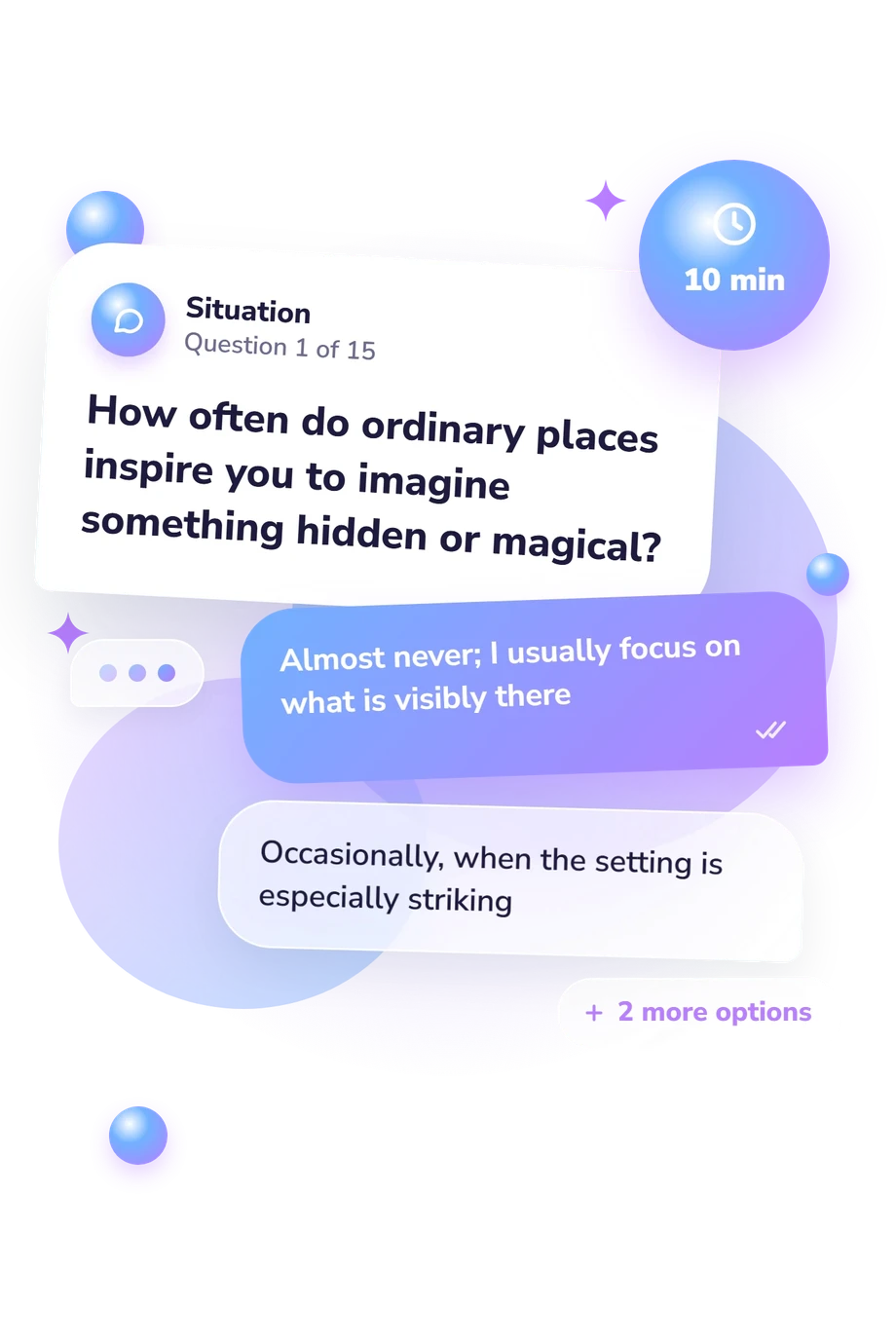
Example Questions From the Test
- Suggest a dry-land activity instead
- Go along but probably stay on shore
- Join if the weather and timing feel right
- Agree immediately and look forward to getting in the water
- Very little; other attractions determine my choice
- It is a welcome bonus, but not a priority
- It is one of the main features I look for
- It is usually the starting point for my plans
- I do not particularly notice their absence
- I enjoy seeing water again, although I rarely miss it
- I begin wishing I could spend time beside water
- I feel a persistent pull to return to a watery setting
Are You a Mermaid Quiz - Description and methodology of the test
Curiosity about the mermaid archetype can appeal to people who enjoy folklore, water, creativity, and identity without taking fantasy literally. In that spirit, the Are You a Mermaid Quiz offers a playful profile of imaginative habits and personal preferences, not a claim about biology or supernatural ability. Readers wondering how to know if you're a mermaid quiz can use this quiz's three dimensions to notice whether imagination, water, or independence feels most prominent.
What This Assessment Explores
Rather than testing literal identity, the questionnaire explores resonance with imagination, water, and independence. It suits anyone who enjoys fantasy as a language for self-reflection; water-oriented prompts explore how strongly watery places and activities draw the respondent, while the mermaid quiz results describe preferences rather than prove an identity.
The result dimensions are descriptive; together, they distinguish imaginative style, aquatic connection, and preferred autonomy without ranking one preference above another:
- Mythic Imagination (0-15) reflects attraction to folklore and symbolism: Reality-Anchored (0-5), Wonder-Aware (6-10), and Enchantment-Seeking (11-15) mark increasing imaginative emphasis.
- Ocean Affinity (0-15) reflects the pull of water: Land-Centered (0-5), Tide-Curious (6-10), and Ocean-Drawn (11-15) mark increasing aquatic connection.
- Tidal Independence (0-15) reflects freedom across settings: Harbor-Oriented (0-5), Flexible Voyager (6-10), and Boundary-Crossing (11-15) mark increasing autonomy.
Methodology and Evidence Base
Each item offers four ordered choices, moving from lower to stronger alignment with the preference explored. The three displayed result dimensions provide the profile; no item-level allocation is stated, so the bands are descriptive categories rather than a pass-or-fail outcome.
The mermaid archetype frames the mermaid quiz questions, so respondents should answer from ordinary preferences rather than an idealized persona. Mood, memory, self-presentation, and self-awareness can shape self-report, so the profile is a snapshot of current interpretation rather than a fixed identity.
The framework is conceptually consistent with Müller, Halls, and Williamson (2022), whose treatment of mermaids emphasizes symbolism, transformation, and movement across boundaries. The water dimension parallels ocean connectedness discussed by Nuojua, Pahl, and Thompson (2022), while the imaginative items sit alongside the fantasy-proneness focus of the Creative Experiences Questionnaire associated with Merckelbach, Horselenberg, and Muris (2001). These are conceptual parallels, not evidence that this questionnaire was adapted from or validated by those works.
No population norms, reliability estimates, or diagnostic cutoffs are presented, so this online self-reflection tool uses descriptive bands rather than clinical classifications.
- Müller, Axel, Christopher Halls, and Ben Williamson. Mermaids: Art, Symbolism and Mythology. Exeter: University of Exeter Press, 2022. 10.47788/DIJI2771.
- Nuojua, Sohvi, Sabine Pahl, and Richard Thompson. "Ocean connectedness and consumer responses to single-use packaging." Journal of Environmental Psychology 81 (2022), 101814. 10.1016/j.jenvp.2022.101814.
- Merckelbach, Harald, Robert Horselenberg, and Peter Muris. "The Creative Experiences Questionnaire (CEQ): a brief self-report measure of fantasy proneness." Personality and Individual Differences 31(6) (2001): 987-995. 10.1016/S0191-8869(00)00201-4.
Updated: