
Apostrophe Quiz
How the Scales are Structured
Who Usually Takes This Test?
See How You Compare
Below is a preview of how scores are typically distributed across each scale.
Example Questions From the Test
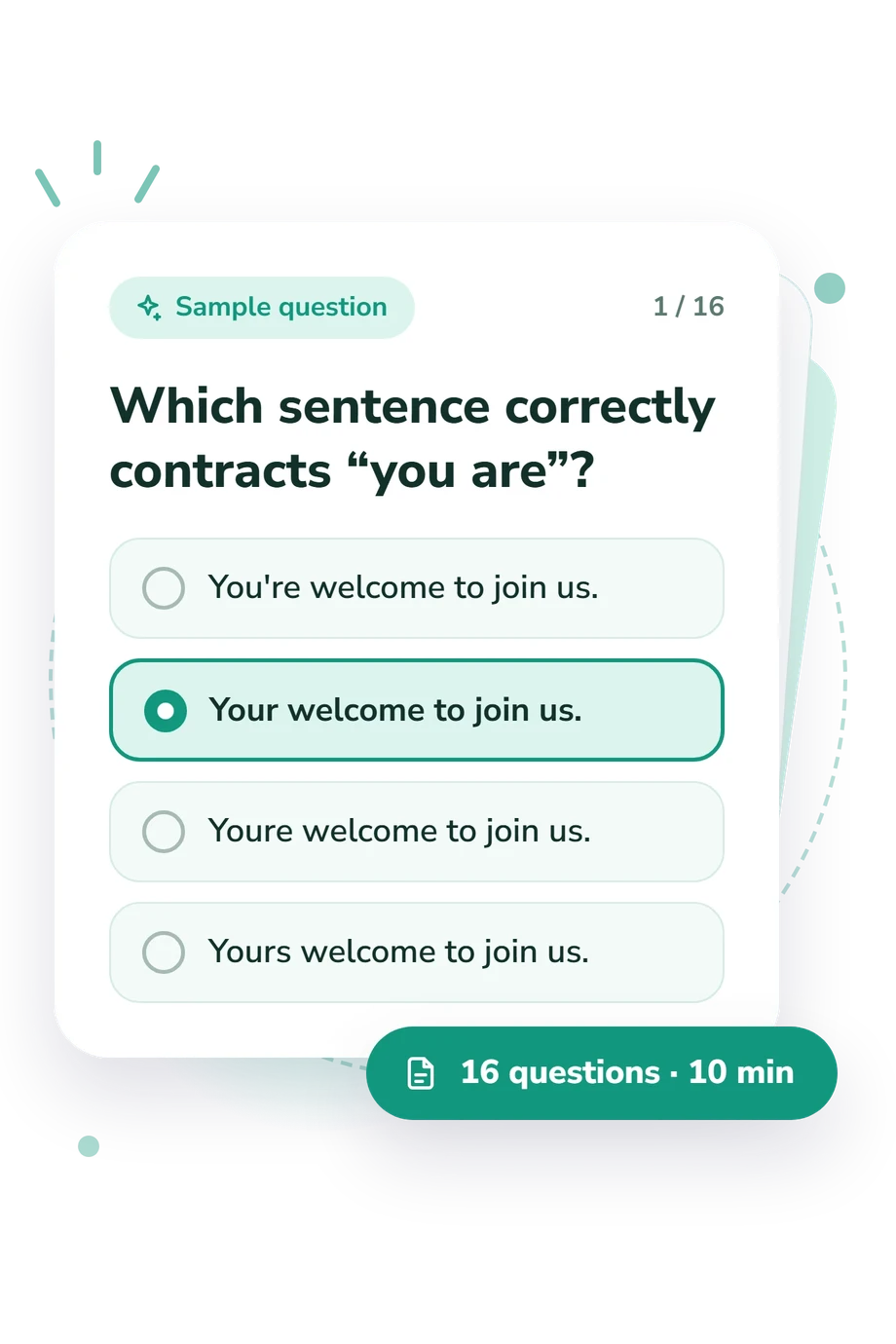
- You're welcome to join us.
- Your welcome to join us.
- Youre welcome to join us.
- Yours welcome to join us.
- Teachers' Lounge
- Teacher's Private Lounge
- Lounge for Teachers
- Teachers's Staff Lounge
- The cats' bowls are in the kitchen.
- Each cat's bowl is in the kitchen.
- The cats's dishes are in the kitchen.
- The cat's bowls are beside the door.
Apostrophe Quiz - Description and methodology of the test
Readers who want to check everyday punctuation can use the apostrophe quiz to examine choices that often change meaning. It suits students, writers, and anyone reviewing English grammar before editing schoolwork, messages, or professional prose. As an apostrophe practice quiz, it shows which conventions feel secure and which distinctions deserve focused review.
What This Assessment Explores
It examines apostrophes in context. Readers distinguish contractions such as it’s and they’re from possessive forms such as its, and separate ownership from ordinary plurals. The possession items make it useful as a quiz on possessive apostrophes for learners who confuse singular, plural, shared, and separate ownership.
The item themes are:
- Contractions show whether you can mark omitted letters in forms such as doesn’t and who’s.
- Possessive nouns show whether you can mark ownership for one, several, or shared owners.
- Ordinary plurals show whether you can leave an apostrophe out when naming more than one item.
- Confusable forms show whether you can distinguish its from it’s and their from they’re.
These themes feed the displayed Apostrophe Knowledge scale (0-16). Foundations to review covers 0-6 and indicates areas for practice; Developing control covers 7-12 and reflects some inconsistency; Strong mastery covers 13-16 and reflects accurate use across contexts.
Methodology and Scientific Basis
Each item presents a sentence or phrase with four alternatives, creating a quiz with multiple-choice apostrophe questions. The respondent selects the form that best fits the meaning, so the task tests recognition in context: punctuation may mark omitted letters, ownership, or neither.
The displayed total summarizes performance across the responses. Because the questionnaire states no separate weighting, penalty, or reverse-scoring rule, the result should be interpreted through its supplied bands rather than an invented calculation.
Conceptually, the content is consistent with Bryant et al. (1997), the closest research match because it connects apostrophe spelling with understanding possession; this questionnaire is not presented as an adaptation of that research. Hokanson and Kemp (2013) address the related relationship between possession and plurality in adult spelling, while Garner’s 2016 grammar guide provides a reference point for standard usage.
These sources support the selected situations but do not establish norms for this online version. The result is a descriptive skills profile, not a population percentile or clinical threshold. Attention, prior instruction, and familiarity with wording can influence answers, so use the result to identify conventions for further practice.
- Bryant, Peter, Michael Devine, Andrea Ledward, and Terezinha Nunes. (1997). Spelling with apostrophes and understanding possession. British Journal of Educational Psychology, 67(1), 91-110. 10.1111/j.2044-8279.1997.tb01229.x
- Hokanson, Lesli, and Nenagh Kemp. (2013). Adults’ spelling and understanding of possession and plurality: An intervention study. Reading and Writing, 26(2), 241-261. 10.1007/s11145-012-9366-7
- Garner, Bryan A. (2016). The Chicago Guide to Grammar, Usage, and Punctuation. University of Chicago Press.
Updated: