
AP Bio Unit 1 Quiz
How the Scales are Structured
Who Usually Takes This Test?
See How You Compare
Below is a preview of how scores are typically distributed across each scale.
Example Questions From the Test
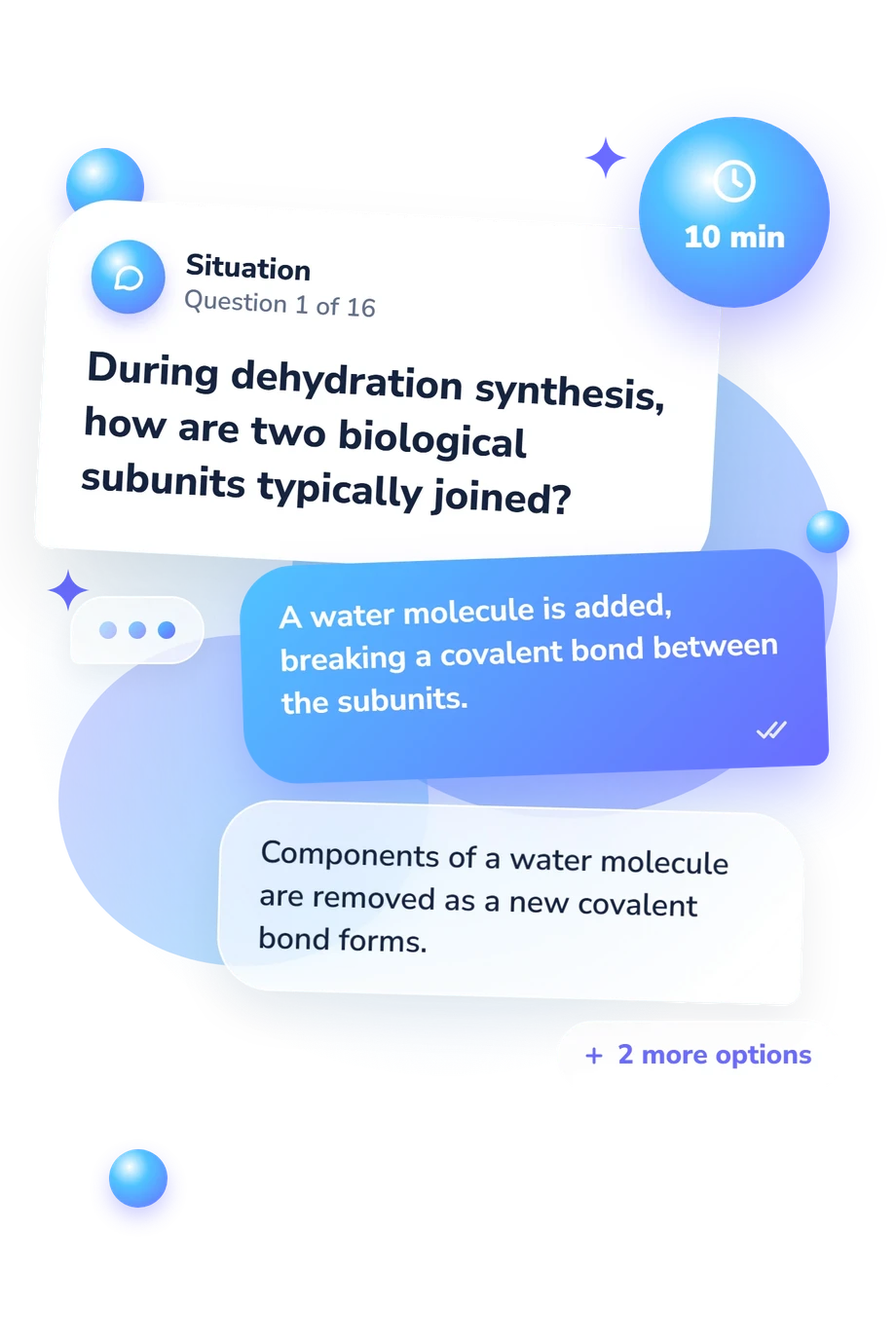
- A water molecule is added, breaking a covalent bond between the subunits.
- Components of a water molecule are removed as a new covalent bond forms.
- Both subunits gain phosphate groups and become ions.
- Hydrogen bonds permanently replace all covalent bonds between the subunits.
- It is a polymer made entirely from repeating glucose monomers.
- It contains an amino group, a carboxyl group, and a variable R group.
- It has a polar phosphate-containing region and nonpolar fatty-acid tails.
- It consists of a nitrogenous base attached to two amino acids.
- A five-carbon sugar, a phosphate group, and a nitrogenous base
- An amino group, a carboxyl group, and an R group
- Glycerol, a phosphate group, and a fatty acid
- A six-carbon sugar, a peptide group, and a nitrogenous base
AP Bio Unit 1 Quiz - Description and methodology of the test
For students revising the first AP Biology unit, the AP Bio Unit 1 Quiz provides a focused check of whether essential molecular ideas can be recognized and applied to unfamiliar biological examples. It suits learners using AP Biology Unit 1 study materials who want to gauge confidence before classwork or an assessment. The knowledge bands frame confidence with molecular concepts, helping learners judge readiness for the next stage of study.
What This Assessment Explores
The questions examine foundational chemistry rather than overall performance. They cover water’s polarity and hydrogen bonding, carbon, dehydration synthesis and hydrolysis, monomers and polymers, the four major macromolecule groups-carbohydrates, lipids, proteins, and nucleic acids-and DNA/RNA distinctions. Several items apply these principles to unfamiliar examples involving enzymes, digestion, evaporation, or membrane fluidity.
The result covers:
- Water and bonding show how molecular interactions produce effects such as cooling and ice density.
- The four major macromolecule groups show whether you distinguish monomers, polymers, functional groups, and linkages.
- Protein, lipid, and nucleic-acid examples show how structure relates to function in enzymes, membranes, RNA, and DNA.
The AP Biology Unit 1 Knowledge score (0-16) places the result in Foundations to review (0-6), Developing knowledge (7-12), or Strong knowledge (13-16). It supports AP Biology Unit 1 review while describing current knowledge, not overall achievement.
Methodology and Scientific Basis
This is a 16-item multiple-choice knowledge check. Each question presents a biological scenario or definition with four choices, and the respondent selects the option that best explains the mechanism. The wording tests both recognition and transfer: items ask how polarity, bonding, side-chain charge, or molecular shape affects a biological outcome.
The result is a study score derived from the selected answers; the questionnaire does not assign an official AP conversion or norm-referenced standing. It can support AP Bio Unit 1 practice by showing which tested concepts merit review. Performance may also reflect prior instruction, familiarity with textbook phrasing, attention, and guessing.
Its content is conceptually consistent with the College Board’s AP Biology framework, especially Unit 1 chemistry of life and macromolecular structure. That framework supports content alignment, not validation of this questionnaire. Uminski and colleagues’ 2024 study of undergraduate biology assessments describes an emphasis on factual knowledge over scientific practices; it offers context for this quiz’s knowledge focus rather than evidence that the quiz is validated. The score is an unvalidated study score and is not an official AP result.
- College Board. AP Biology Course and Exam Description, Effective Fall 2025. New York, NY: College Board, 2025. AP Biology Development Committee contributor: Elizabeth A. Cowles.
- College Board. AP Biology Investigative Labs: An Inquiry-Based Approach Teacher Lab Manual, Effective Fall 2019. New York, NY: College Board, 2019. Lab authors and major contributors include Elizabeth A. Cowles.
- Uminski, Crystal, Sara M. Burbach, and Brian A. Couch. “Undergraduate Biology Lecture Courses Predominantly Test Facts about Science Rather than Scientific Practices.” CBE-Life Sciences Education 23, no. 2 (2024): ar19. 10.1187/cbe.23-12-0244
Updated: