
Ancient History Quiz
How the Scales are Structured
Who Usually Takes This Test?
See How You Compare
Below is a preview of how scores are typically distributed across each scale.
Example Questions From the Test
- A military formation using overlapping shields
- A festival shared by all Greek-speaking peoples
- A province administered directly by Persia
- A self-governing city-state and its surrounding territory
- The Narmer Palette
- The Behistun Inscription
- The Rosetta Stone
- The Cyrus Cylinder
- Hatshepsut
- Nefertiti
- Cleopatra VII
- Tiye
Ancient History Quiz - Description and methodology of the test
People who want to check or refresh their understanding of early societies can use this ancient history quiz to review links among cultures, rulers, institutions, beliefs, conflicts, and technologies. It is intended for curious learners, students, and history enthusiasts seeking a broad snapshot of what they recognize securely and where further study may help. An ancient civilizations quiz can make that review more structured.
What This Assessment Explores
The questionnaire samples broad knowledge across periods and regions. It asks readers to identify civilizations, rulers, institutions, beliefs, conflicts, technologies, and links among historical developments. This ancient quiz works best for broad self-checking rather than specialist study.
The questions fall into three useful thematic groups:
- Civilizations and regions connect Egypt, Phoenicia, the Maya, Mauryan India, Greece, Persia, Rome, and the Indus Valley with distinctive developments.
- Rulers and institutions cover law codes, political systems, reforms, and administration.
- Beliefs, conflicts, and connections place ideas, wars, trade, communication, agriculture, and cultural exchange in context.
The result is Ancient History Knowledge (0-16), which summarizes recognition of the people, places, ideas, events, and relationships represented by the items. Foundations to Build (0-6) signals blurred key details; Developing Knowledge (7-12) shows useful understanding with room to connect regions and periods; Strong Command (13-16) indicates accurate recognition across a broad range.
Methodology and Evidence Base
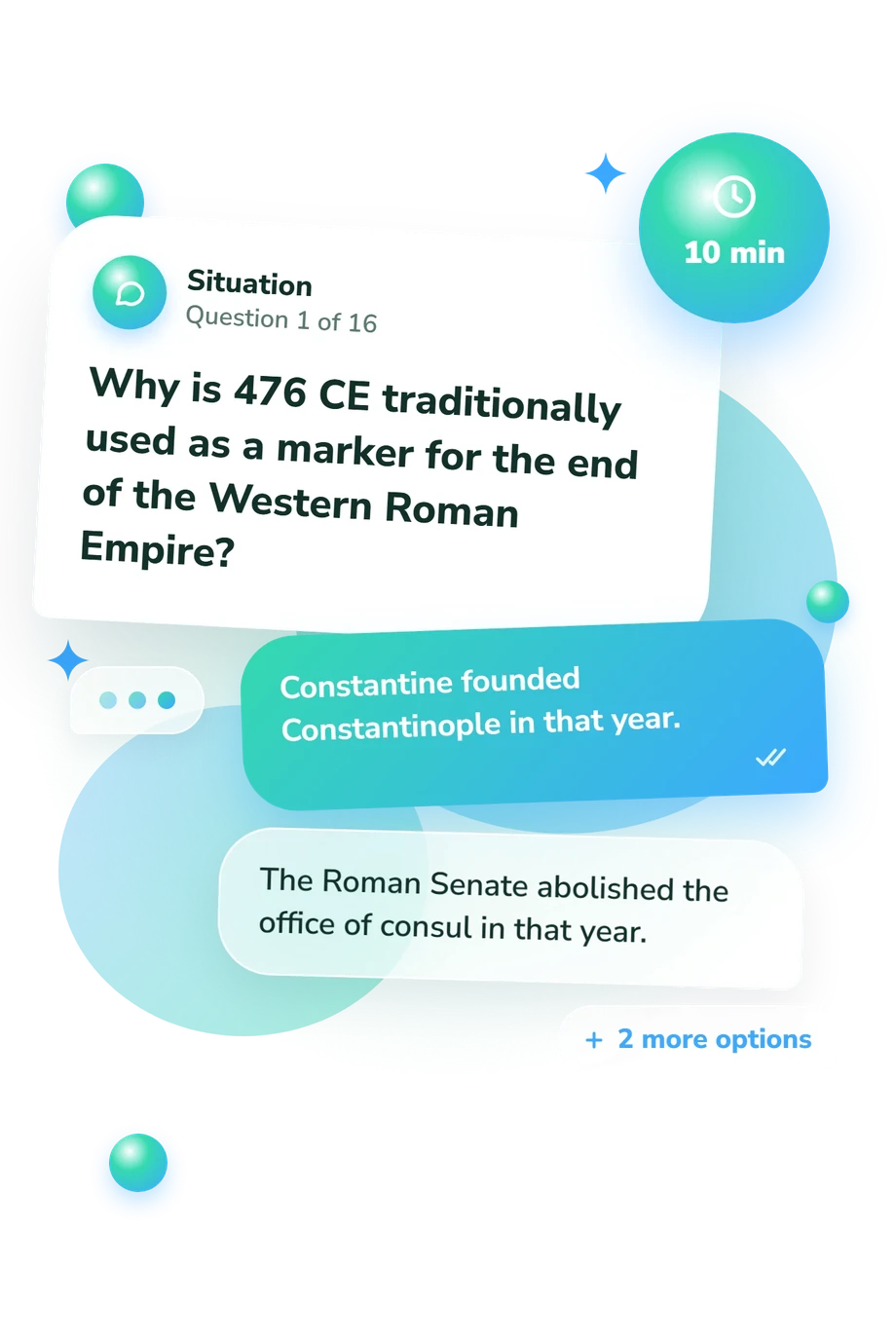
Each item presents a short historical scenario or direct question with four answer choices. The format tests recognition and contextual reasoning: a respondent may connect a ruler with a reform, match an artifact to a civilization, identify an institution’s purpose, or distinguish one conflict from another. The score is item-based; no extra weighting or separate subscale calculation is stated.
The questionnaire is conceptually consistent with Burstein (2017), whose framework connects societies across regions and periods, but it is not presented as an adaptation of that work. Reich (2013) is relevant because multiple-choice history tests can reflect factual knowledge alongside wording, distractor quality, and guessing. Smith, Breakstone, and Wineburg (2019) support a careful distinction between recognizing information and evaluating evidence or constructing a historical argument.
This ancient history test is an online knowledge check, not a standardized instrument with stated norms, reliability estimates, or validation study for the exact questionnaire. Results can reflect prior coursework, reading, language, attention, and familiarity with quiz formats. Use the score to guide review and curiosity, not to represent complete historical understanding or overall expertise.
- Burstein, Stanley M. (2017). The World from 1000 BCE to 300 CE. Oxford University Press. 10.1093/oso/9780199336142.001.0001
- Reich, Gabriel A. (2013). Imperfect models, imperfect conclusions: An exploratory study of multiple-choice tests and historical knowledge. The Journal of Social Studies Research, 37(1), 3-16. 10.1016/j.jssr.2012.12.004
- Smith, Mark D., Joel Breakstone, and Sam Wineburg. (2019). History Assessments of Thinking: A Validity Study. Cognition and Instruction, 37(1), 118-144. 10.1080/07370008.2018.1499646
Updated: