
Am I Special Quiz
How the Scales are Structured
Who Usually Takes This Test?
See How You Compare
Below is a preview of how scores are typically distributed across each scale.
Example Questions From the Test
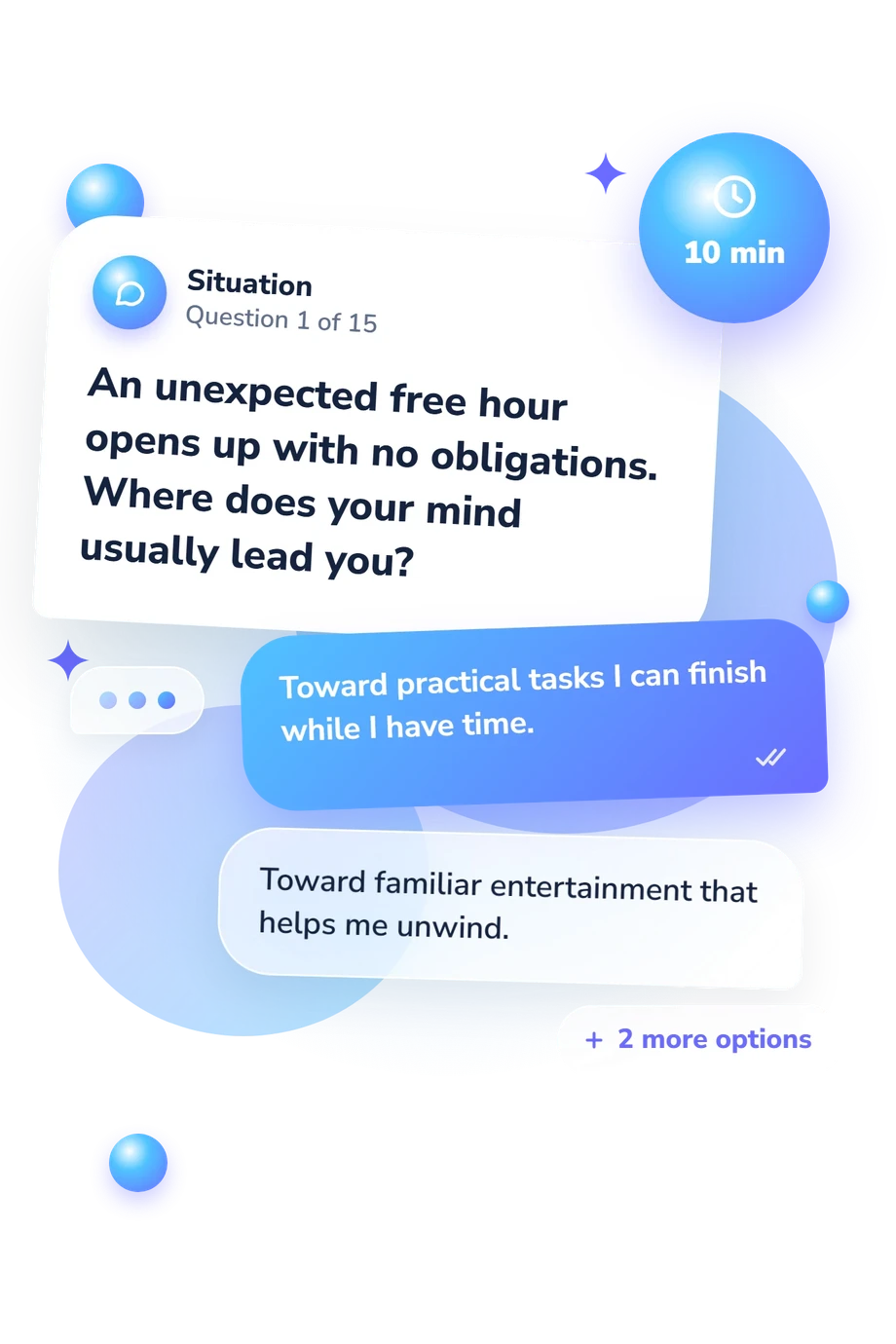
- Toward practical tasks I can finish while I have time.
- Toward familiar entertainment that helps me unwind.
- Toward writing, thinking, or exploring something that has been on my mind.
- Into an idea, question, or imagined world that may absorb the whole hour.
- I observe first and remain comfortably in the background.
- I participate when someone invites me into a task or conversation.
- I offer a skill or perspective once I understand how the group works.
- I look for an unmet need and initiate a contribution that reflects what I uniquely bring.
- I keep imagining possibilities long after the story ends.
- I would have preferred a clear resolution and soon move on.
- I enjoy the mood even if I do not analyze the ending.
- I compare interpretations and consider what each one would mean.
Am I Special Quiz - Description and methodology of the test
People who want to reflect on how their everyday choices relate to a sense of individuality can use this assessment to examine recurring patterns. The Am I Special Quiz is suited to readers who want a nuanced profile rather than a verdict about whether they stand out. It also works as a quiz about what makes me unique, giving the result a practical focus without reducing uniqueness to popularity or attention.
What This Assessment Explores
It examines three dimensions rather than a verdict about being special: visible expression, depth of engagement, and intentional contribution. This questionnaire uses the am i unique quiz format to present recurring tendencies rather than a yes-or-no judgment.
The dimensions are:
- Authentic Self-Expression (0-15) measures preferences, perspective, and style, not genuineness or value: Quietly adaptive (0-5) keeps individuality mostly private; Selectively expressive (6-10) reveals it when fitting; Distinctly expressive (11-15) shows it readily.
- Inner Depth and Curiosity (0-15) reflects appetite for reflection, complexity, and imagination; Grounded focus (0-5) favors the concrete, Selective reflection (6-10) explores engaging topics, and Deep explorer (11-15) pursues meaning. Practical focus is not lack of depth.
- Meaningful Presence (0-15) reflects intentional contribution, not popularity: Low-key presence (0-5) contributes quietly; Situational contributor (6-10) responds to a role or need; Intentional imprint (11-15) seeks a personal, connecting contribution.
Methodology and Scientific Basis
Each item presents an everyday situation with four responses. Four choices represent different response styles or approaches rather than a fixed progression. This format compares styles of engagement without forcing a fixed personality label.
Responses produce the three displayed dimension scores and bands. The display does not state how many points each option contributes, so ranges cannot supply a hand-calculation rule. Rather than ranking people, the profile acts as a what makes you unique quiz: it highlights patterns in expression, exploration, and contribution without objectively defining you.
Conceptually, the closest reference is the Need for Uniqueness Scale (Snyder & Fromkin, 1977), which treats distinctiveness as a tendency rather than superiority. Brewer's social self model addresses the balance between individuality and belonging, while Kashdan, Rose, and Fincham link curiosity with exploration and growth. This questionnaire is conceptually consistent with those sources, not a standardized administration or adaptation of them.
As an online self-report profile rather than a standardized administration of the reference instruments, it can reflect current context, self-awareness, and response style; read it as reported tendencies, not an objective definition of uniqueness.
- Snyder, C. R., & Fromkin, H. L. (1977). Abnormality as a positive characteristic: The development and validation of a scale measuring need for uniqueness. Journal of Abnormal Psychology, 86(5), 518-527. 10.1037/0021-843X.86.5.518
- Brewer, M. B. (1991). The social self: On being the same and different at the same time. Personality and Social Psychology Bulletin, 17(5), 475-482. 10.1177/0146167291175001
- Kashdan, T. B., Rose, P., & Fincham, F. D. (2004). Curiosity and exploration: Facilitating positive subjective experiences and personal growth opportunities. Journal of Personality Assessment, 82(3), 291-305. 10.1207/s15327752jpa8203_05
Updated: