
Am I Insulin Resistant Quiz
How the Scales are Structured
Who Usually Takes This Test?
See How You Compare
Below is a preview of how scores are typically distributed across each scale.
Example Questions From the Test
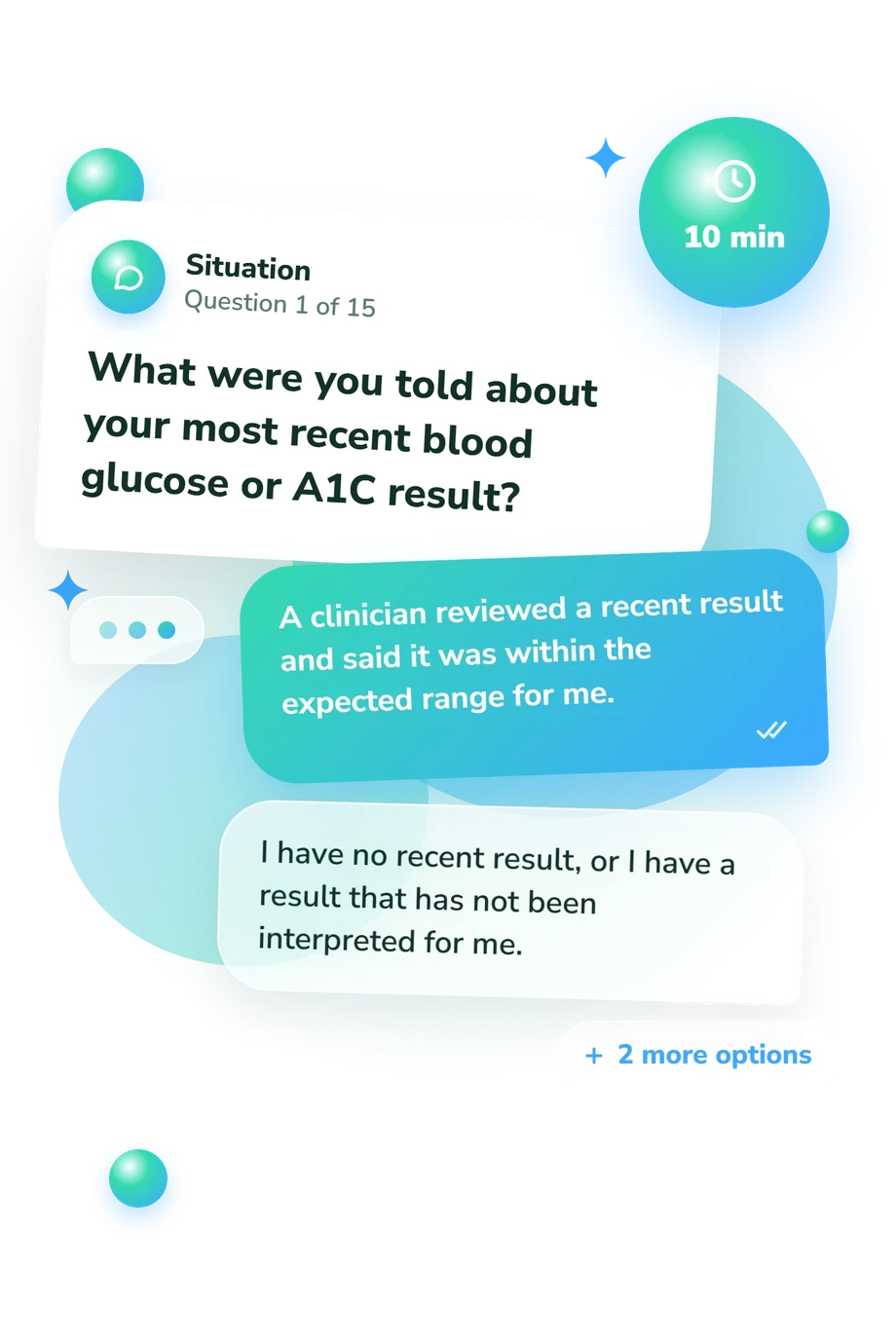
- A clinician reviewed a recent result and said it was within the expected range for me.
- I have no recent result, or I have a result that has not been interpreted for me.
- I was told the result was borderline or that it should be repeated.
- I was told the result was high and needed prompt follow-up or treatment.
- Recent results were reviewed and neither was flagged as concerning for me.
- These have not been checked recently, or I have not received an interpretation.
- One result was described as borderline or worth rechecking.
- Results have repeatedly been outside my targets or require active clinical follow-up.
- I have been assessed recently, and neither was identified.
- I have not been assessed recently or do not have an interpreted result.
- A clinician said I may have increased likelihood and recommended repeat assessment.
- A clinician has diagnosed prediabetes or diabetes, or has asked me to follow up promptly on a clearly high result.
Am I Insulin Resistant Quiz - Description and methodology of the test
People considering whether metabolic concerns warrant a healthcare conversation can use the Am I Insulin Resistant Quiz to prepare for that decision. This insulin resistance quiz helps organize the details needed to choose between routine discussion, prompt follow-up, or gathering more information first. It is intended for anyone wanting a practical starting point before speaking with a qualified clinician.
What This Assessment Explores
Questions connect metabolic history with experiences and screening. They cover glucose and lipid results, prediabetes or diabetes, PCOS, fatty liver, pregnancy, medicines, family history, blood pressure, sleep, thirst, urination, skin, energy, and body changes. Anyone asking whether they have insulin resistance can use this questionnaire as a do i have insulin resistance quiz, particularly when records are incomplete.
The result is divided into three unvalidated displayed summary scales:
- Background Risk Context (0-15) summarizes selected history; Baseline pattern: 0; Worth noting: 1-2; Follow-up indicated: 3-15.
- Body and Energy Patterns (0-15) groups nonspecific changes with many possible causes and cannot identify insulin resistance; Baseline pattern: 0; Worth noting: 1-2; Follow-up indicated: 3-15.
- Clinical Screening Signals (0-15) organizes clinical information, whose meaning depends on laboratory test and personal context; Baseline pattern: 0; Worth reviewing: 1-2; Prompt follow-up: 3-15.
Methodology and Scientific Basis
Each item offers four ordered choices tailored to its subject, distinguishing absent, unknown, occasional, borderline, established, or urgent patterns where relevant. Separating “not assessed” from “normal” preserves gaps in follow-up rather than treating them as reassuring answers.
Responses contribute to a separate total for each displayed scale, and the result is shown in the listed bands. A concerning response matters independently, and a red-flag choice overrides its overall band. This insulin resistance self-assessment highlights which responses may warrant routine or prompt follow-up.
Einhorn et al. (2003) supplies the closest framework, treating insulin-resistance syndrome as a cluster of related metabolic risk features. This questionnaire is conceptually consistent with that work, not an adaptation of it. Wongwananuruk et al. (2012) adds PCOS context, and the American Diabetes Association’s 2026 standards reinforce clinical interpretation of glucose history and testing.
As an unvalidated self-report, recall, context, incomplete records, and self-awareness can shape the result; it cannot establish insulin resistance, and severe thirst or urination with vomiting, confusion, deep breathing, fainting, or severe weakness requires urgent medical help.
- Einhorn D, Reaven GM, Cobin RH, et al. American College of Endocrinology position statement on the insulin resistance syndrome. Endocrine Practice. 2003;9(3):237-252. 10.4158/EP.9.S2.5
- Wongwananuruk T, Rattanachaiyanont M, Indhavivadhana S, et al. Prevalence and clinical predictors of insulin resistance in reproductive-aged Thai women with polycystic ovary syndrome. International Journal of Endocrinology. 2012;2012:529184. 10.1155/2012/529184
- American Diabetes Association Professional Practice Committee for Diabetes. 2. Diagnosis and Classification of Diabetes: Standards of Care in Diabetes-2026. Diabetes Care. 2026;49(Supplement 1):S27-S49. 10.2337/dc26-S002
Updated: