
Am I Desperate for Love Quiz
How the Scales are Structured
Who Usually Takes This Test?
See How You Compare
Below is a preview of how scores are typically distributed across each scale.
Example Questions From the Test
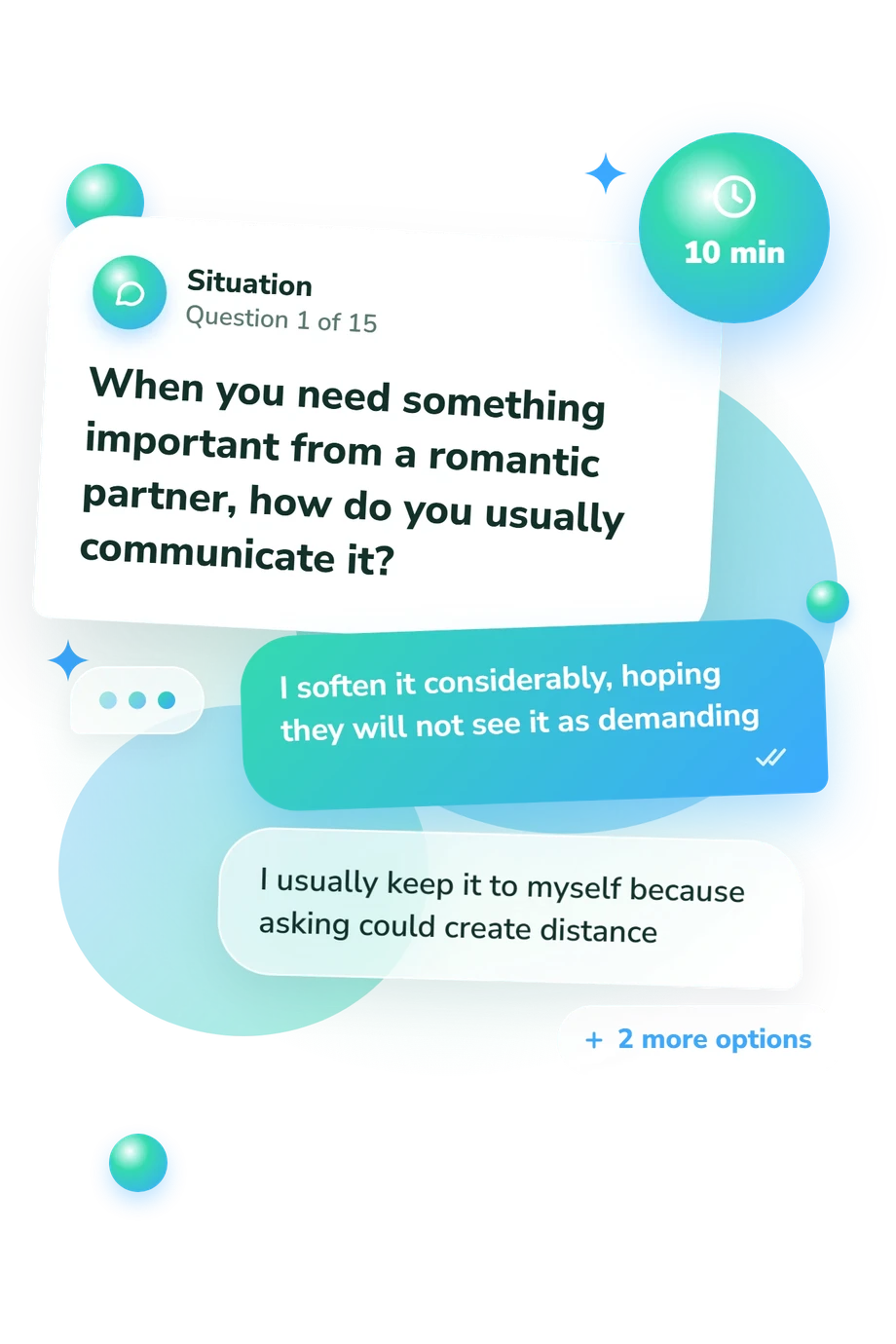
- I soften it considerably, hoping they will not see it as demanding
- I usually keep it to myself because asking could create distance
- I state it respectfully, knowing they may respond differently than I hope
- I wait for hints to work, then speak up only if the need becomes urgent
- It would feel deeply unsettling and make me want to find someone quickly
- I would see meaningful possibilities in that time, even if I still wanted love
- It would feel disappointing, but manageable alongside the rest of my life
- It would feel almost intolerable, as though I were running out of time
- Continue with my plans and check for a reply later
- Check my phone a few times while wondering what the silence means
- Keep checking and find it difficult to focus on anything else
- Send several follow-ups because waiting feels unbearable
Am I Desperate for Love Quiz - Description and methodology of the test
People who feel unsettled by romantic uncertainty can use the Am I Desperate for Love Quiz to examine whether the wish for connection is taking up too much emotional space. It is intended for readers reflecting on dating or partnership patterns, particularly when reassurance, waiting, or compromise starts shaping daily choices. The am i desperate quiz format provides a structured snapshot of tendencies rather than a fixed identity.
What This Assessment Explores
These items use scenarios about loneliness, mixed signals, a partner’s need for space, conflicting values, and choices between connection and personal commitments. A desperate for love test can help readers notice patterns without turning them into a label.
The three displayed scales are:
- Love Urgency and Preoccupation (0-15) shows how strongly love occupies attention: Spacious (0-5) leaves room for life, Pressing (6-10) can consume attention, and Dominant (11-15) often directs choices.
- Need for Romantic Reassurance (0-15) shows how much security or worth relies on repeated romantic interest: Internally anchored (0-5) stays secure, Reassurance-seeking (6-10) prompts checking, and Reassurance-dependent (11-15) links confidence to attention.
- Self-Abandonment for Connection (0-15) shows whether needs, values, comfort, or commitments are set aside: Self-connected (0-5) preserves limits, Accommodating (6-10) sometimes yields, and Self-silencing (11-15) suppresses important needs.
Methodology and Scientific Basis
This scenario-based self-report presents relationship situations with four response options, ranging from preserving personal limits to seeking more reassurance or sacrificing needs. The choices express styles of reaction rather than yes/no answers. Responses become three separate results, interpreted through the displayed bands; no fixed point value for each option is stated.
The conceptual reference point is the Desperate Love Scale (Sperling, 1985), relevant to urgency and preoccupation. The questionnaire is conceptually consistent with that work and with Atlam et al. (2023) on romantic relationship addiction, Costa et al. (2021) on love-addiction features, and Knee et al. (2008) on relationship-contingent self-esteem; it is not an adaptation of those instruments. The displayed bands are reflective rather than clinical, and this online version supplies no standardized norms. Read as a romantic urgency test, the profile is best understood through the pattern across scales and the relationship context. Reassurance may rise during ambiguity, while accommodation can mean mutual compromise or pressure depending on whether choice remains free. Self-report also reflects current circumstances, self-awareness, and the desire to appear consistent, so a recent romantic event may influence the result.
- Sperling, Michael B. “Discriminant Measures for Desperate Love.” Journal of Personality Assessment, 49(3), 324-328, 1985. 10.1207/s15327752jpa4903_20
- Atlam, Demet, Betül Akyel Göven, and Zeki Yüncü. “Addiction in Romantic Relationships Scale Development: Validity and Reliability Study.” Addicta: The Turkish Journal on Addictions, 10(1), 52-58, 2023. 10.5152/ADDICTA.2023.23027
- Costa, Sebastiano, Nadia Barberis, Mark D. Griffiths, Loredana Benedetto, and Massimo Ingrassia. “The Love Addiction Inventory: Preliminary Findings of the Development Process and Psychometric Characteristics.” International Journal of Mental Health and Addiction, 19, 651-668, 2021. 10.1007/s11469-019-00097-y
- Knee, C. Raymond, Amy Canevello, Amber L. Bush, and Astrid Cook. “Relationship-Contingent Self-Esteem and the Ups and Downs of Romantic Relationships.” Journal of Personality and Social Psychology, 95(3), 608-627, 2008. 10.1037/0022-3514.95.3.608
Updated: