
Am I Bougie Quiz
How the Scales are Structured
Who Usually Takes This Test?
See How You Compare
Below is a preview of how scores are typically distributed across each scale.
Example Questions From the Test
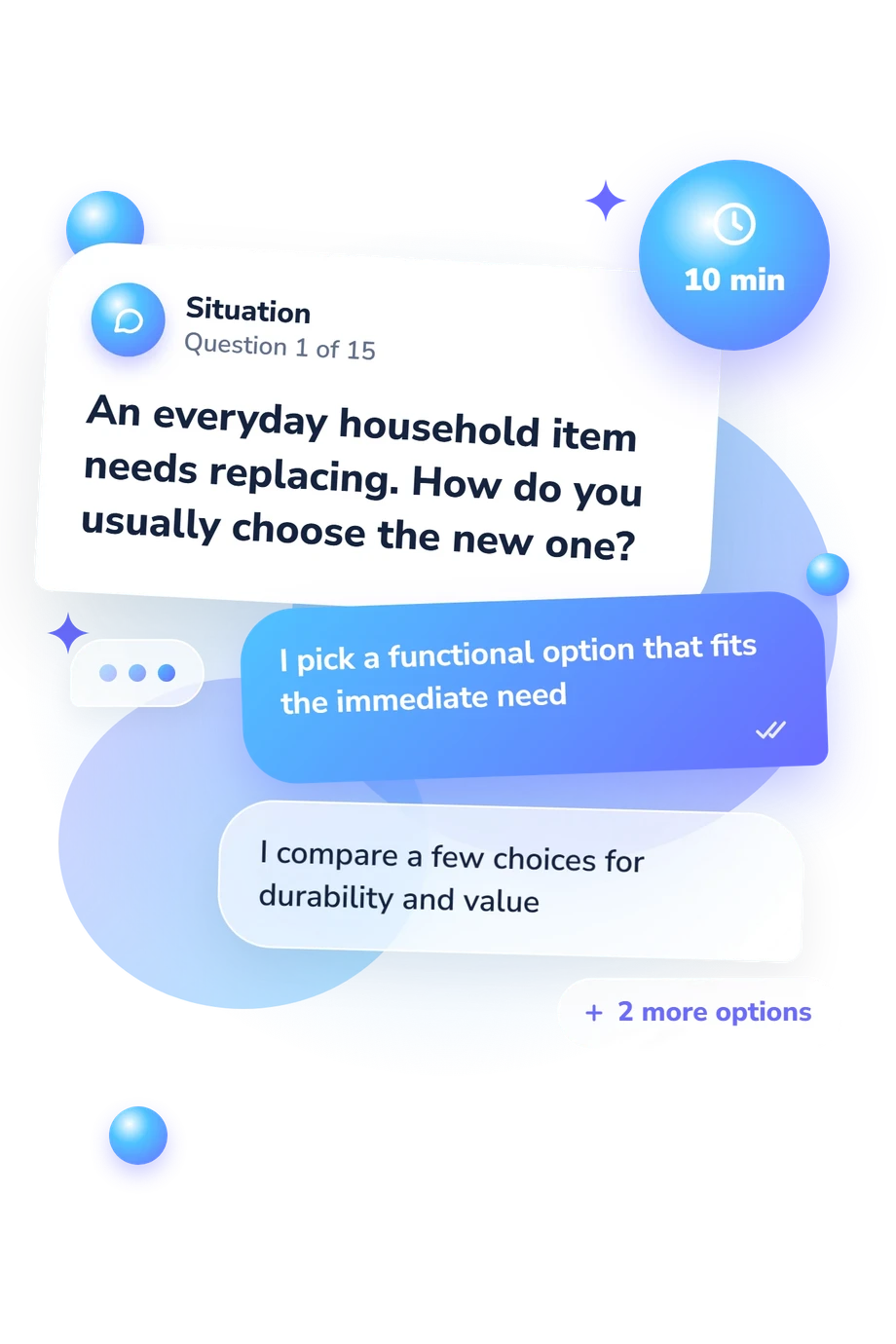
- I pick a functional option that fits the immediate need
- I compare a few choices for durability and value
- I look for materials and design that suit my space
- I will wait or save for the exact premium piece I have in mind
- I rarely post purchases
- I might share it if friends would find it useful or interesting
- I would photograph it attractively and mention what makes it special
- I would build a polished post around the brand, setting, and experience
- Whatever is clean, comfortable, and appropriate for the weather
- A simple outfit that looks put together
- Coordinated pieces with a deliberate accessory or detail
- A distinctive look planned around labels, styling, or the venue
Am I Bougie Quiz - Description and methodology of the test
People curious about how comfort, taste, and social polish shape ordinary choices can use the Am I Bougie Quiz as a structured self-reflection exercise. It is suited to readers comparing habits across home life, travel, hosting, shopping, and leisure. Framed as a how bougie are you quiz, it turns those preferences into a profile of lifestyle patterns rather than a judgment of personal worth.
What This Assessment Explores
This bougie quiz treats bougie as a preference pattern, not a verdict about wealth, popularity, or cultural value. Scenarios span home life, hosting, travel, food, clothing, events, shopping, and social trends, moving from practical responses toward premium or presentation-focused choices.
The profile uses three dimensions:
- Comfort and Convenience (0-15) reflects how readily upgrades, service, and ease enter daily life: Practical Comfort (0-5), Chosen Comforts (6-10), or Elevated Ease (11-15).
- Curated Taste (0-15) reflects selectivity, craftsmanship, aesthetics, and premium details, not income or cultural worth: Relaxed Taste (0-5), Selective Taste (6-10), or Highly Curated (11-15).
- Social Presentation (0-15) reflects polish, ambiance, recognizable signals, and impression management, not popularity or authenticity: Unscripted Presence (0-5), Polished When It Counts (6-10), or Signature Presentation (11-15).
Methodology and Scientific Basis
Each scenario uses self-report with four answer choices, moving from familiar responses toward deliberate, premium, or presentation-conscious choices. The respondent selects what best matches usual behavior, not an idealized identity. Answers are combined into the three-dimensional scores and interpreted through displayed bands; the questionnaire does not state a per-answer weighting rule, so totals should not be reverse-engineered into financial or personality judgments.
The playful question behind this am i boujee quiz is addressed through convenience, curation, and social signaling rather than one purchase or brand. Conceptually, it is consistent with Wiedmann, Hennigs, and Siebels (2009), whose framework separates luxury-related value into functional, experiential, symbolic, and financial considerations. Vigneron and Johnson (2004) add quality, exclusivity, prominence, and hedonism, while Dubois, Jung, and Ordabayeva (2021) place luxury consumption in a broader psychological context.
This questionnaire is not an adaptation, validation study, or standardized administration of those instruments. Its bands are descriptive rather than population norms. Self-report results can shift with mood, memory, social desirability, current circumstances, and self-awareness, so the profile is best read as a snapshot of present preferences.
- Klaus Peter Wiedmann, Nadine Hennigs, and Astrid Siebels. "Value-based segmentation of luxury consumption behavior." Psychology and Marketing 26, no. 7 (2009): 625-651. 10.1002/mar.20292
- Franck Vigneron and Lester W. Johnson. "Measuring perceptions of brand luxury." Journal of Brand Management 11, no. 6 (2004): 484-506. 10.1057/palgrave.bm.2540194
- David Dubois, SungJin Jung, and Nailya Ordabayeva. "The psychology of luxury consumption." Current Opinion in Psychology 39 (2021): 82-87. 10.1016/j.copsyc.2020.07.011
Updated: