
Am I Adopted Quiz
How the Scales are Structured
Who Usually Takes This Test?
See How You Compare
Below is a preview of how scores are typically distributed across each scale.
Example Questions From the Test
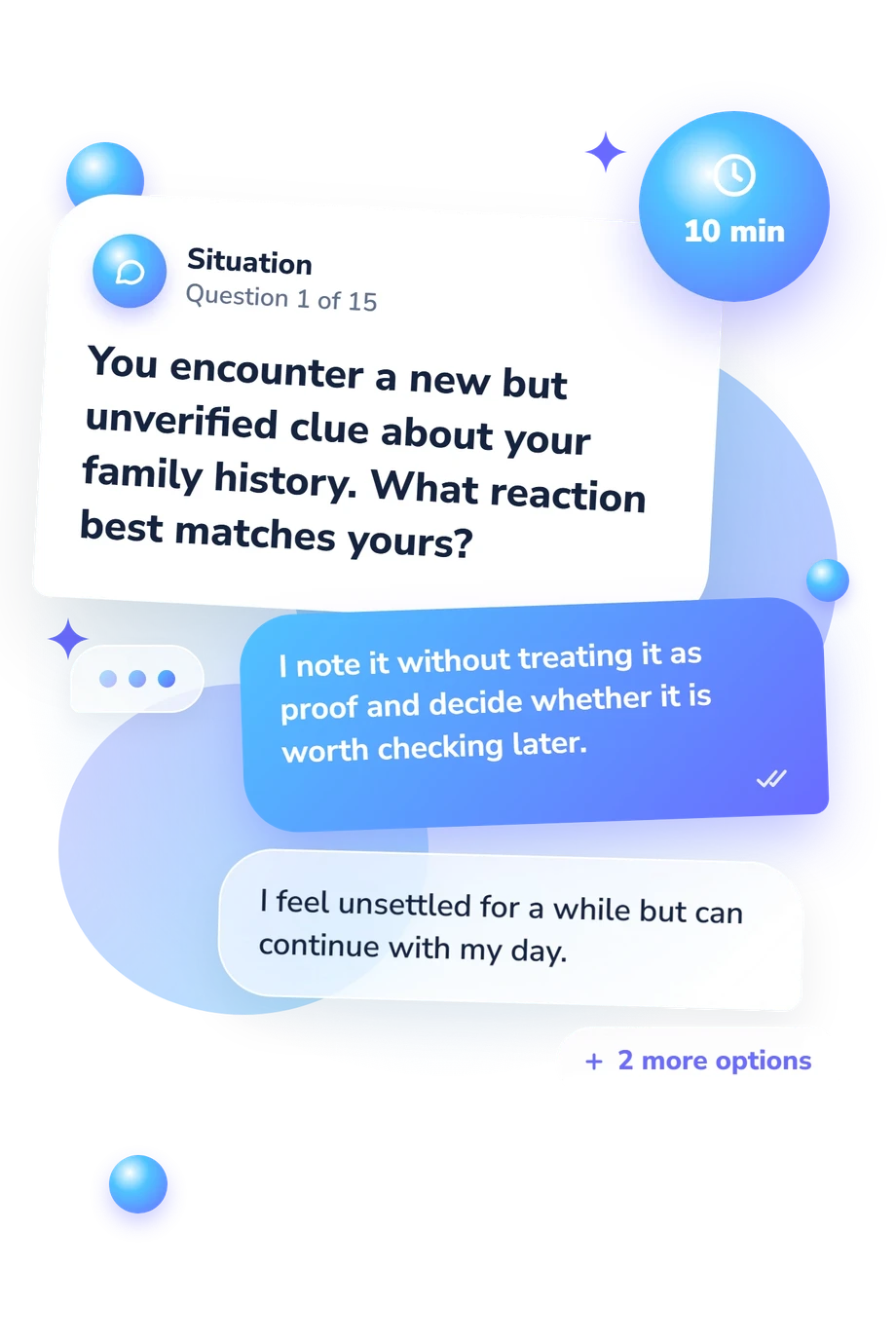
- I note it without treating it as proof and decide whether it is worth checking later.
- I feel unsettled for a while but can continue with my day.
- I repeatedly analyze it or urgently search for more information despite limited evidence.
- I become overwhelmed, unable to function normally, or afraid I cannot keep myself safe.
- I can choose whom to ask and can discuss the subject without family pressure.
- I can discuss it, although I worry about awkwardness or hurting someone’s feelings.
- I expect strong pressure to keep the question secret or avoid certain people.
- I believe discussing it could lead to retaliation, loss of support, or immediate danger.
- People explain what exists, what is unavailable, and any legitimate access limits.
- Access is slow or incomplete, but the reasons given are understandable.
- Information is withheld without a clear explanation or the explanation keeps changing.
- My attempt leads to coercion, threats, destruction of information, or fear for my safety.
Am I Adopted Quiz - Description and methodology of the test
People questioning their family history may want a calm way to use an are-you-adopted quiz to separate documented information from fear, rumors, and unanswered conversations. The Am I Adopted Quiz is designed for that purpose: it helps you consider what the uncertainty is doing to your identity and daily life, how accessible family communication feels, and whether emotional support, cautious communication, or record verification may deserve attention next.
What This Assessment Explores
Rather than treating details as proof, this was-I-adopted quiz separates emotional impact, family communication, and adoption-specific information. It suits people weighing rumors, incomplete memories, conflicting accounts, or records. The result reflects current impact, communication difficulty, and information warranting verification; it does not establish whether adoption occurred or diagnose a mental health condition.
The result covers three dimensions:
- Emotional Impact and Support Need (0-15) reflects how strongly adoption uncertainty is affecting you and how much support may be useful: Manageable reflection (0-5), Meaningful concern (6-10), Strong support need (11-15).
- Family Communication Barriers (0-15) measures how difficult it currently feels to obtain calm, direct family communication: Conversation available (0-5), Communication strained (6-10), Significant barriers (11-15).
- Verifiable Adoption Information (0-15) reflects the amount and strength of adoption-specific information, not the probability that adoption occurred: Limited documentation (0-5), Unresolved information (6-10), Verification warranted (11-15).
Methodology and Scientific Basis
Each situation offers four response options, giving this adoption quiz a structured way to distinguish manageable uncertainty and accessible support from stronger distress, blocked communication, or direct adoption-related documentation; wording varies by item. Respondents select the option closest to their current circumstances and the information they know, while some items address records, family accounts, and prior disclosures.
Responses are summarized across the dimensions above, and the result bands describe the pattern shown by those responses. A high emotional score highlights support needs, while a high information score points toward authentication through identity records. Rumors, privacy, and inconsistent memories remain reasons to distinguish personal impressions from verifiable documentation.
Its content is conceptually consistent with Baden et al. (2019) on late discovery adoptees, Grotevant et al. (2000) on adoptive identity, and Brodzinsky (2006) on family communication. This online questionnaire is not presented as an adaptation of those studies; its result bands are interpretive descriptions. Honest self-report, current circumstances, and access to reliable information affect results, so use results to plan conversation or record checking rather than infer certainty.
- Baden, A. L., Shadel, D., Morgan, R., White, E. E., Harrington, E. S., Christian, N., & Bates, T. A. (2019). Delaying Adoption Disclosure: A Survey of Late Discovery Adoptees. Journal of Family Issues, 40(9), 1154-1180. 10.1177/0192513X19829503
- Grotevant, H. D., Dunbar, N., Kohler, J. K., & Esau, A. M. L. (2000). Adoptive Identity: How Contexts Within and Beyond the Family Shape Developmental Pathways. Family Relations, 49(4), 379-387. 10.1111/j.1741-3729.2000.00379.x
- Brodzinsky, D. (2006). Family Structural Openness and Communication Openness as Predictors in the Adjustment of Adopted Children. Adoption Quarterly, 9(4), 1-18. 10.1300/J145v09n04_01
Updated: