
Am I a Socialist Quiz
How the Scales are Structured
Who Usually Takes This Test?
See How You Compare
Below is a preview of how scores are typically distributed across each scale.
Example Questions From the Test
- Provide brief emergency help while expecting personal savings and rapid job seeking to carry most of the burden
- Offer modest means-tested payments linked closely to job-search requirements
- Replace a meaningful share of lost income and provide retraining until suitable work is available
- Guarantee a secure living income and access to essential services regardless of immediate employment prospects
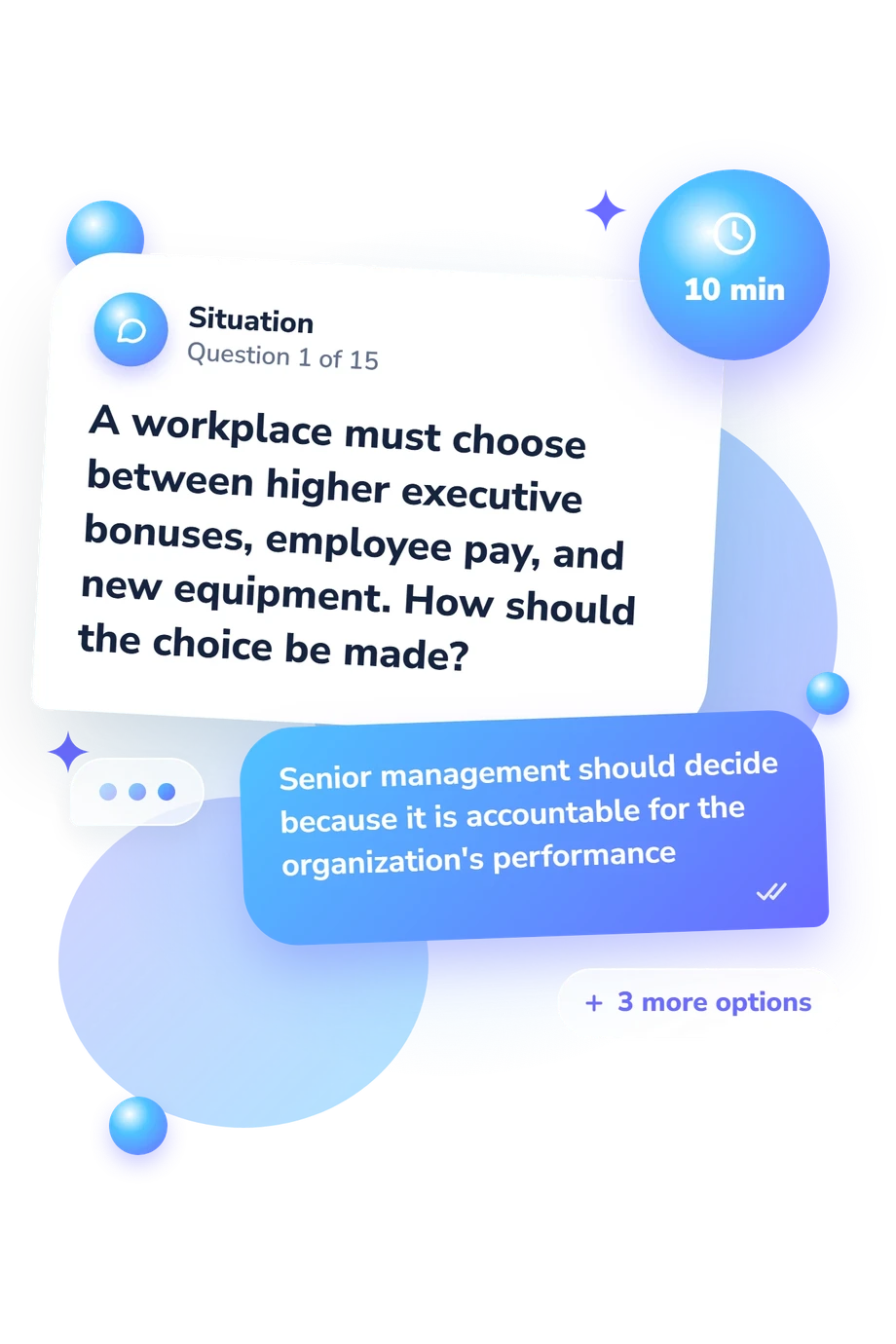
- Senior management should decide because it is accountable for the organization's performance
- Management should gather employee feedback before making the final allocation
- An elected employee council should make the decision jointly with management
- The workforce should decide through a democratic process with equal voting rights
- Private ownership should remain the norm, with public ownership used only exceptionally
- Private ownership should dominate, while a few strategic services remain public
- Private, public, and cooperative ownership should all play substantial roles
- Major productive assets should generally be owned socially and governed for shared benefit
Am I a Socialist Quiz - Description and methodology of the test
People may examine whether their views are socialist when familiar labels feel too broad or uncertain. The Am I a Socialist Quiz offers a structured way to test those intuitions against concrete choices about how society should organize resources, services, and power. Its profile highlights areas of agreement and tension without reducing a complex outlook to a single yes-or-no identity.
What This Assessment Explores
Policy scenarios about layoffs, housing, healthcare, inheritance, unions, strikes, and company governance show how you weigh market choice against collective guarantees and democratic control. The questionnaire supports self-reflection by describing stated preferences, not your complete political identity.
Rather than forcing one label, it separates commitments that can combine into different socialist or mixed outlooks, helping readers consider what kind of socialist outlook their views suggest.
The displayed dimensions are:
- Social Ownership (0-15) measures preference for private, mixed, cooperative, or public ownership: Market-centered 0-5, Mixed ownership 6-10, and Social-ownership affinity 11-15.
- Universal Provision and Equality (0-15) measures support for collective needs and reduced inequality: Targeted provision 0-5, Universalist mix 6-10, and Strong egalitarian provision 11-15.
- Worker Power (0-15) measures support for unions and workplace authority: Individual bargaining 0-5, Shared voice 6-10, and Worker-power affinity 11-15.
Methodology and Evidence Base
Each item presents four substantive scenario-based choices covering different positions on ownership, provision, equality, and worker power. The trade-offs make the pattern a record of stated preference, not factual knowledge or observed behavior.
Displayed totals summarize alignment with each dimension; no point value per answer is stated, so ranges should not be reverse-engineered into a scoring formula.
The closest conceptual reference is Socialist/Laissez Faire Scales (Heath et al., 1994), which measures core political beliefs across ideological dimensions. The questions are conceptually consistent with that framework, while the displayed dimensions and scoring belong to this questionnaire. Concrete trade-offs involving firms, services, and worker representation give that broad framework a questionnaire-specific structure.
Schweickart's analysis provides compatible context for social ownership, workplace democracy, and the role of markets in planning; it does not establish this questionnaire's categories or cutoffs.
Mixed profiles can show combinations of capitalist and socialist preferences; someone may support universal services while favoring private firms. Self-report, current circumstances, and self-interpretation can affect the profile, so read it as a structured snapshot rather than a definitive ideological classification.
- Anthony Heath, Geoffrey Evans, and Jean Martin. (1994). The Measurement of Core Beliefs and Values: The Development of Balanced Socialist/Laissez Faire and Libertarian/Authoritarian Scales. British Journal of Political Science, 24(1), 115-132. 10.1017/S0007123400006815
- David Schweickart. (1992). Socialism, Democracy, Market, Planning: Putting the Pieces Together. Review of Radical Political Economics, 24(3-4), 29-45. 10.1177/048661349202400303
Updated: