
7th Grade Science Quiz
How the Scales are Structured
Who Usually Takes This Test?
See How You Compare
Below is a preview of how scores are typically distributed across each scale.
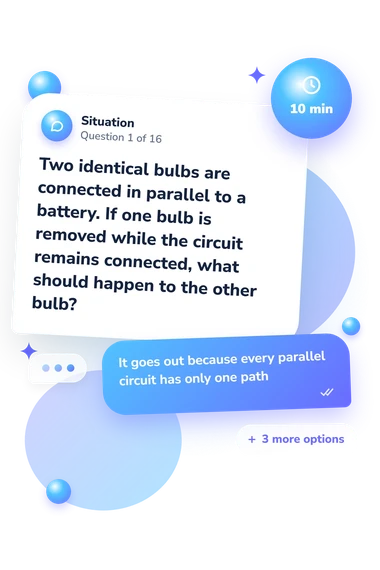
Example Questions From the Test
- It is zero because the forces are balanced
- It points in the direction of motion
- It steadily increases with speed
- It points opposite the direction of motion
- They produce sunlight for plants
- They convert predators into herbivores
- They prevent all organisms from competing
- They break down dead matter and recycle nutrients
- Nucleus
- Cell membrane
- Chloroplast
- Mitochondrion
7th Grade Science Quiz - Description and methodology of the test
For learners checking how confidently they handle core middle-school science, this 7th grade science quiz offers a focused way to decide what deserves further review. Students can use this science quiz for class 7 before classwork, homework, or a test, using the overall result to judge whether another look is worthwhile. The band gives a practical starting point for choosing what to revisit.
What This Assessment Explores
This assessment samples broad seventh-grade science knowledge through situations involving physical processes, living systems, Earth and space, and scientific investigation. Items ask learners to apply ideas about circuits, heat, forces, ecosystems, cells, chemical change, variables, density, rocks, inheritance, climate, and the Moon. As a science quiz for 7th graders, this assessment offers a practical review snapshot that connects broad concepts with situations learners may meet in class.
The displayed result uses one knowledge scale, 7th Grade Science Knowledge (0-16), with three bands:
- Foundations to build (0-6) may suggest that you recognize some concepts, while core vocabulary, measurements, or cause-and-effect relationships would benefit from review.
- Developing knowledge (7-12) means that many grade-level ideas are understood, while some topics need practice.
- Strong knowledge (13-16) indicates consistent understanding across the sampled science areas.
Methodology and Scientific Basis
Each item asks learners to select the option that best explains the situation. The scoring display reports one result on the knowledge scale and places it in the band; it gives no separate totals for life, physical, Earth, or space science. This online 7th-grade science quiz has its own four-choice items and fixed, quiz-specific descriptive bands; it is not the TIMSS assessment or a norm-referenced administration.
The content is conceptually consistent with the TIMSS science assessment framework (Centurino & Jones, 2017), which emphasizes domains and applying knowledge. It also aligns with crosscutting ideas and practices described by NGSS Lead States (2013) and the National Research Council (2012). These sources support the educational framing without establishing norms for this quiz.
Interpretation should stay close to the sampled items: the overall band shows how consistently the learner handled the concepts and can indicate whether broad review may be useful. Because this quiz covers grade 7 science, its result can be influenced by prior teaching, wording, guessing, and topic coverage. The result reflects this quiz, not a course grade or comprehensive assessment.
- Centurino, V. A. S., & Jones, L. R. (2017). TIMSS 2019 Science Framework. In I. V. S. Mullis & M. O. Martin (Eds.), TIMSS 2019 Assessment Frameworks (pp. 27-55). Chestnut Hill, MA: TIMSS & PIRLS International Study Center, Boston College.
- NGSS Lead States. (2013). Next Generation Science Standards: For States, By States. Washington, DC: The National Academies Press. 10.17226/18290.
- National Research Council. (2012). A Framework for K-12 Science Education: Practices, Crosscutting Concepts, and Core Ideas. Washington, DC: The National Academies Press. 10.17226/13165.