
5th Grade Math Quiz
How the Scales are Structured
Who Usually Takes This Test?
See How You Compare
Below is a preview of how scores are typically distributed across each scale.
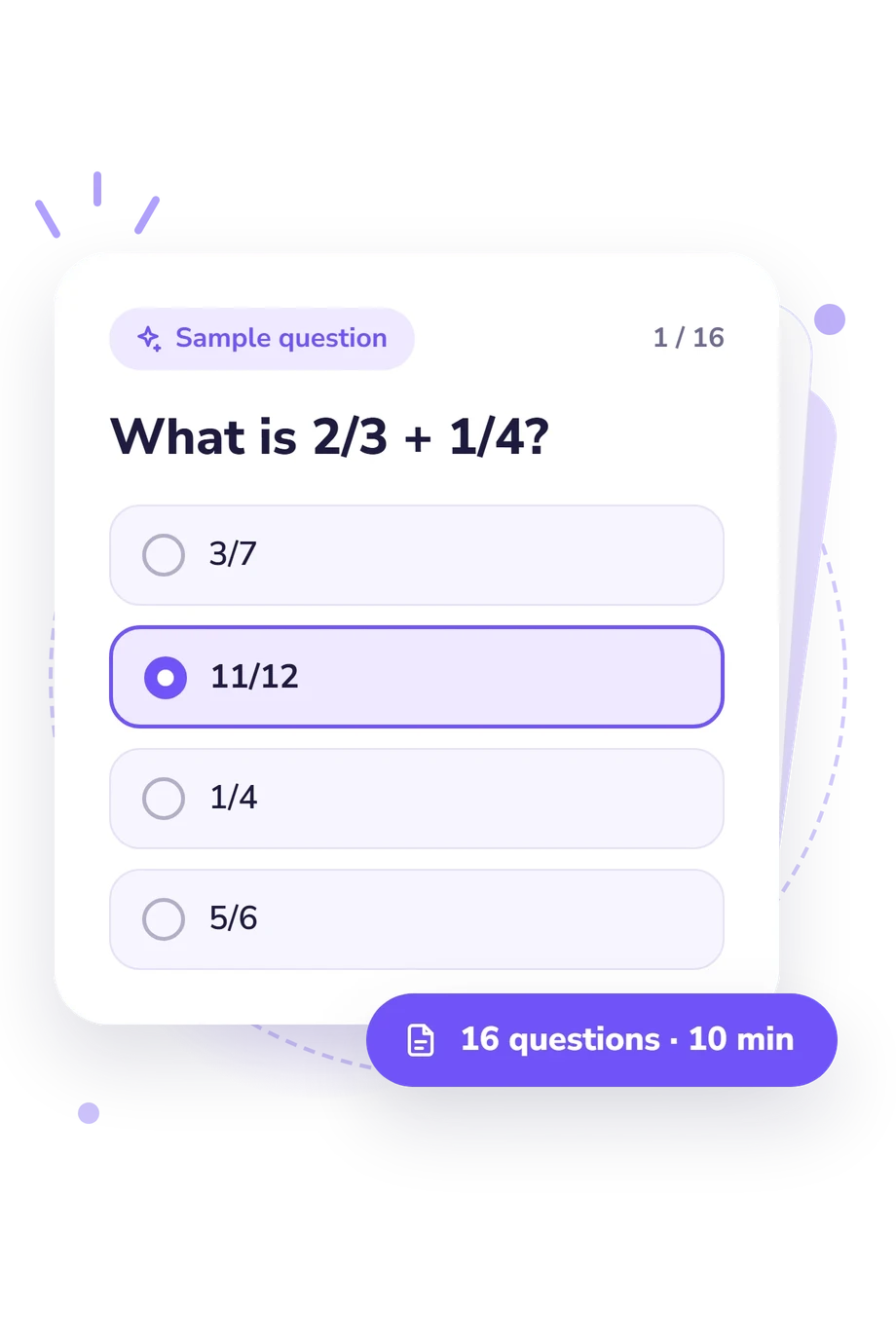
Example Questions From the Test
- 3/7
- 11/12
- 1/4
- 5/6
- (4, 7)
- (6, 1)
- (6, 5)
- (4, 5)
- Trapezoid
- Rectangle
- Rhombus
- Square
5th Grade Math Quiz - Description and methodology of the test
For learners strengthening classroom skills or checking where practice is needed, the 5th grade math quiz offers an overall snapshot of grade-level understanding. Students, families, and educators can use the result to see how the learner performed across the sampled curriculum and choose appropriate next steps. The questionnaire is a math quiz grade 5 learners can complete independently, checking recall and application across several connected topics.
What This Assessment Explores
Questions require calculation, comparison, representation, and choosing an operation. They cover whole-number place value and operations, fractions and decimals, measurement, geometry, patterns, and coordinate movements. This makes the fifth grade math quiz useful for learners reviewing a broad classroom curriculum rather than a single unit.
The result is one overall scale, 5th Grade Math Knowledge, ranging from 0-16. These bands classify overall performance on the mixed question set:
- Foundational (0-6) means the learner recognizes some key ideas but may benefit from reviewing operations, fractions, decimals, measurement, and geometry.
- Developing (7-12) shows understanding of many grade-level concepts, with some skills still needing practice.
- Strong (13-16) reflects consistently strong understanding across the topics sampled by this quiz.
The single result is most useful for choosing what to practice next across the sampled curriculum.
Methodology and Evidence Base
Each item is a multiple-choice problem with four answer options. The set moves among direct computation, word problems, numerical representations, geometry, measurement, and patterns. Distractors may reflect plausible errors, so success depends on reading the prompt as well as calculating. The format combines fluency with application.
Questions overlap with the Common Core standards in operations, number, measurement, and geometry; selected tasks also use problem solving and representation. They are conceptually consistent with the National Research Council’s account of mathematical proficiency, including understanding, accuracy, problem solving, and reasoning. These sources provide context, not validation of this online quiz; the questionnaire is not a formal adaptation of either framework.
For a math quiz for 5th graders, the score is a snapshot of selected-task performance. Responses form one overall summary, and the bands classify mixed-set performance rather than overall classroom achievement. The quiz defines this score and its bands for the mixed set; no norm-referenced standardization is stated. Attention, anxiety, format familiarity, and current practice can affect performance; classwork or teacher feedback adds context when reviewing missed topics.
- National Governors Association Center for Best Practices and Council of Chief State School Officers. (2010). Common Core State Standards for Mathematics. Washington, DC: Authors.
- National Research Council. (2001). Adding It Up: Helping Children Learn Mathematics. Edited by Jeremy Kilpatrick, Jane Swafford, and Bradford Findell. Washington, DC: National Academy Press. DOI 10.17226/9822.
- American Educational Research Association, American Psychological Association, and National Council on Measurement in Education. (2014). Standards for Educational and Psychological Testing. Washington, DC: American Educational Research Association.
Updated: