
13 Seduction Archetypes Quiz
How the Scales are Structured
Who Usually Takes This Test?
See How You Compare
Below is a preview of how scores are typically distributed across each scale.
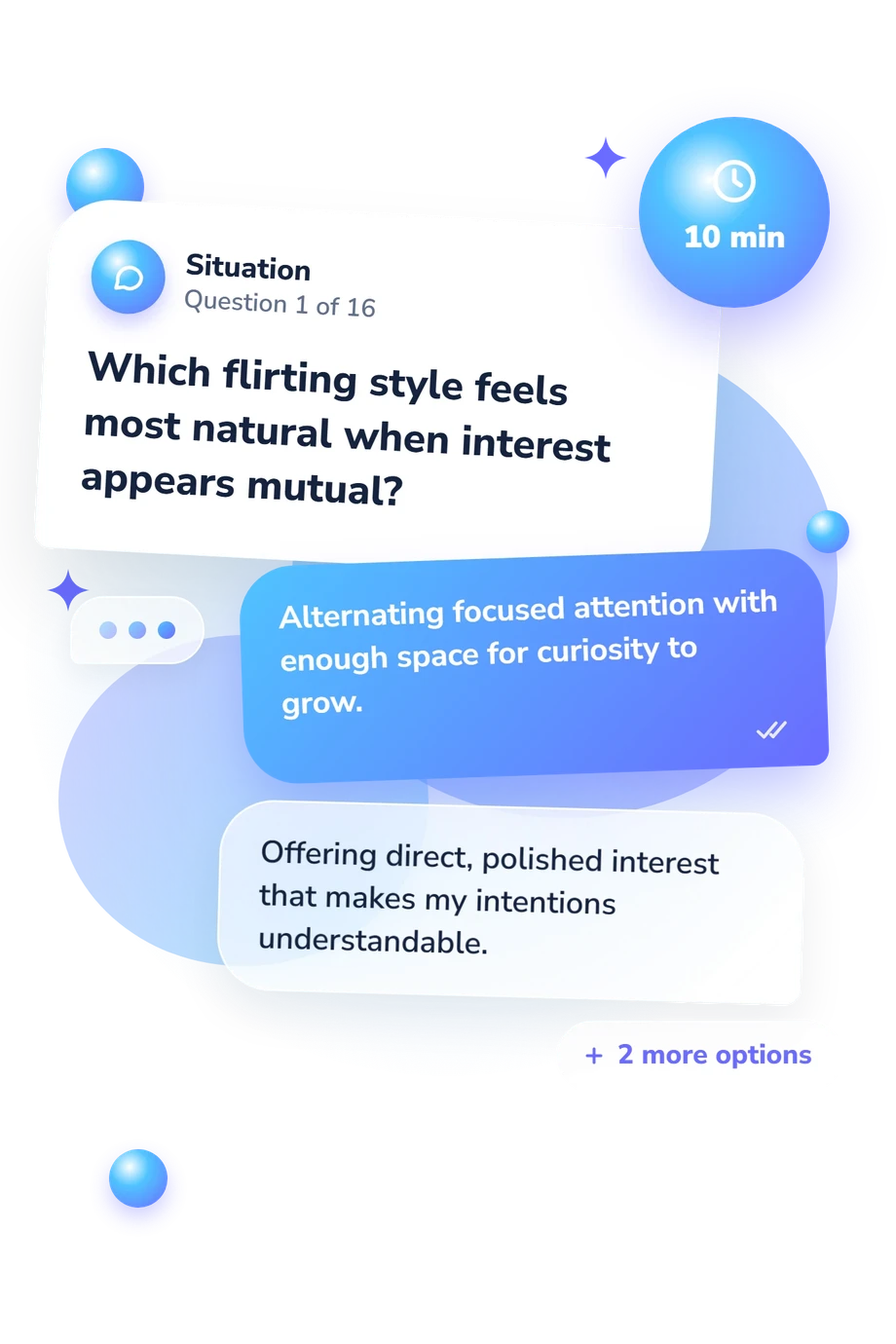
Example Questions From the Test
- Alternating focused attention with enough space for curiosity to grow.
- Offering direct, polished interest that makes my intentions understandable.
- Using expressive reactions and playful exaggeration to build energy.
- Holding warm eye contact and allowing comfortable pauses.
- Leaving room for an unexpected detour or unusual discovery.
- Choosing a setting with appealing light, sound, texture, or food.
- Making sure the plan feels thoughtful, polished, and well organized.
- Including an activity that will give both of us something lively to react to.
- That I anticipated needs and made everything feel intentional.
- That the space has a rich, inviting sensory atmosphere.
- That something original or pleasantly surprising happened.
- That everyone had permission to be animated and playful.
13 Seduction Archetypes Quiz - Description and methodology of the test
People who want to reflect on their preferred ways of expressing attraction can use the 13 Seduction Archetypes Quiz as a structured language for preferences, signals, and interpersonal style. A 13 feminine seduction archetypes quiz may suit readers exploring attraction without reducing it to a single personality label, while the resulting profile can support self-reflection and more intentional communication.
What This Assessment Explores
Items explore disclosure, pacing, humor, atmosphere, embodiment, standards, and initiative. The profile from this 13 archetypes quiz groups thirteen styles into four families; each describes preferred expression, not desirability, effectiveness, or compatibility.
The families are:
- Elusive Originality - Bohemian, Coquette & Enigma (0-12) measures independence, unconventional taste, selective disclosure, and intriguing contrasts; Open Current (0-4), Selective Mystery (5-8), Leading Mystery (9-12).
- Expressive Spark - Diva, Ingenue & Gamine (0-12) measures animation, emotional visibility, humor, curiosity, and playful spontaneity; Quiet Spark (0-4), Responsive Spark (5-8), Leading Spark (9-12).
- Magnetic Embodiment - Siren, Goddess & Sensualist (0-12) measures sensory awareness, grounded confidence, warmth, and nonverbal presence; Subtle Current (0-4), Available Current (5-8), Leading Current (9-12).
- Refined Authority - Sophisticate, Boss, Empress & Lady (0-12) measures composure, discernment, leadership, standards, and cultivated care; Relaxed Structure (0-4), Selective Structure (5-8), Leading Structure (9-12).
Methodology and Evidence Base
Each item uses a forced-choice format: four brief situations or reactions are offered, and the respondent selects the option that feels most natural. The prompts cover flirting, planning, social entry, conflict, clothing, compliments, boundaries, and shared time, so the profile samples verbal, behavioral, and nonverbal preferences.
The questionnaire is conceptually consistent with 13 Feminine Seduction Archetypes (Faines, 2021), which supplies the named style framework, but it is not presented as a reproduction or validated adaptation of that work. Jung’s archetypal theory and Bolen’s archetypal framework offer context for interpreting this seduction archetype assessment.
The result reports four displayed dimensions with their descriptive bands; it does not rank one style as better, more attractive, or more compatible than another. Answers can be influenced by mood, context, cultural expectations, and desired self-presentation, so the profile is best used to notice patterns and discuss communication, boundaries, and consent rather than diagnose personality.
- Faines, Ayesha K. (2021). 13 Feminine Seduction Archetypes. Women Love Power.
- Jung, C. G. (1968). The Archetypes and the Collective Unconscious (2nd ed.). Princeton University Press.
- Bolen, Jean Shinoda. (1984). Goddesses in Everywoman: A New Psychology of Women. Harper & Row.
- Lambert, Aliette, and George Ferns. (2024). Into the depths of the feminine: A Jungian perspective on postfeminist working life. Human Relations, 77(10), 1534-1562. 10.1177/00187267231199650
Updated: