
Would You Survive a Horror Movie Quiz
How the Scales are Structured
Who Usually Takes This Test?
See How You Compare
Below is a preview of how scores are typically distributed across each scale.
Example Questions From the Test
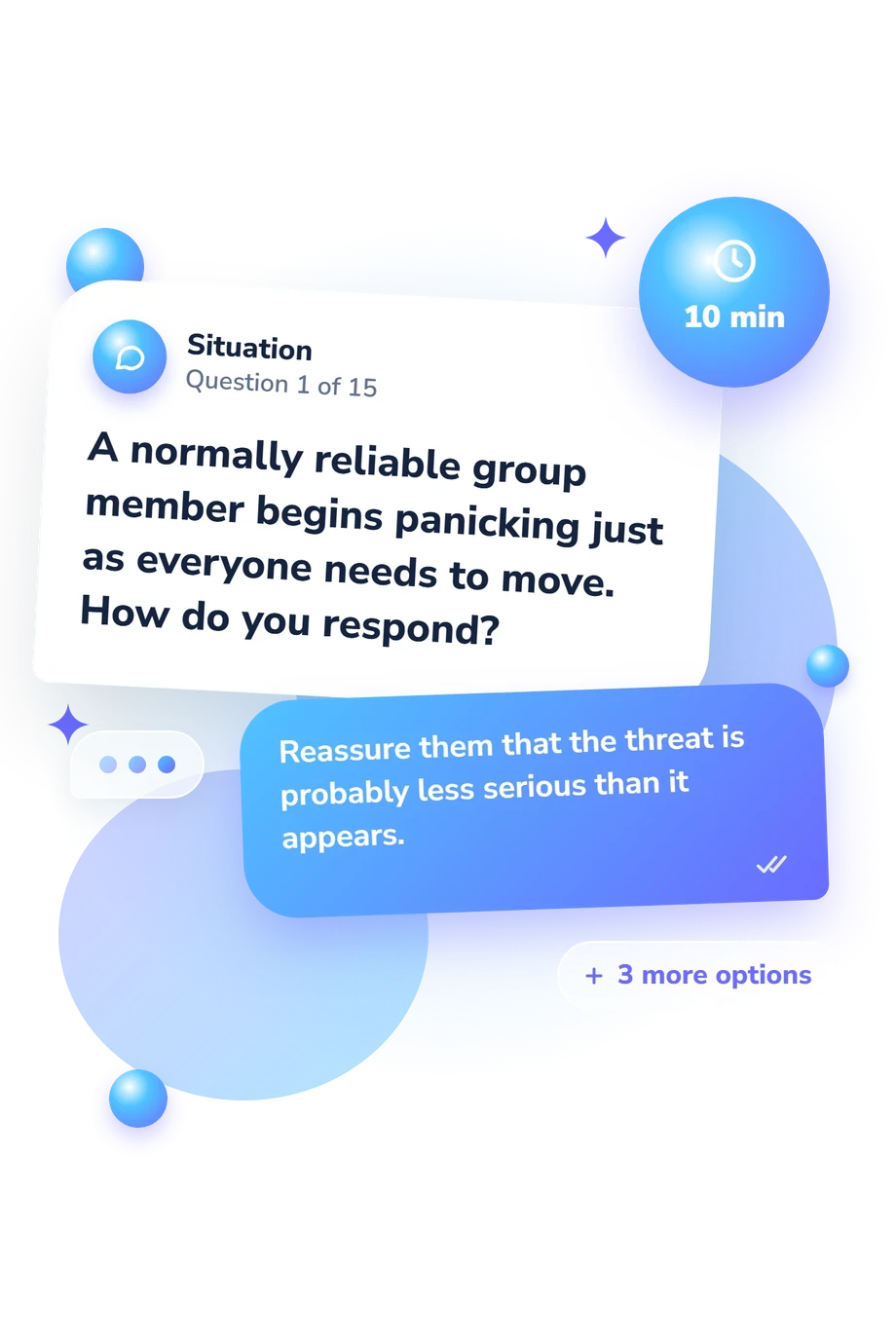
- Reassure them that the threat is probably less serious than it appears.
- Give them space away from the group so they can regain control without pressure.
- Pause briefly for breathing and water before asking what support they need.
- Acknowledge the fear, pair them with someone steady, and give them one concrete task.
- Temporarily separate the person under the most suspicion while the others search.
- Hold a quick vote on whom the group trusts before sharing any further information.
- Search in pairs with scheduled check-ins so progress continues while tension settles.
- Reconstruct the keys' timeline, check shared supplies, and keep people paired during the search.
- Keep trying the planned route because it was researched more thoroughly than the alternatives.
- Ask the quickest thinker to improvise a new route and lead immediately.
- Regroup briefly and compare the two most accessible alternatives.
- State what has changed, switch to the preselected backup, and confirm that everyone understands.
Would You Survive a Horror Movie Quiz - Description and methodology of the test
For readers who enjoy examining judgment and teamwork through imaginative dilemmas, one question-would you survive a horror movie quiz-frames the exercise. The result offers a structured profile of how several tendencies relate. A reader asking, would I survive a horror movie quiz, can use that profile to distinguish decisions, awareness, and cooperation.
What This Assessment Explores
The scenarios probe responses to incomplete information, blocked plans, ambiguous evidence, vulnerable group members, and competing priorities. Rather than testing horror trivia, they turn fictional danger into choices about action, verification, communication, resource use, and escape routes. The exercise uses a horror survival quiz format to examine decision habits and cooperation.
The three result dimensions are:
- Decisions Under Pressure (0-15) shows how you prioritize under time pressure: Deliberate Starter (0-5), Active Improviser (6-10), or Composed Decider (11-15).
- Group Adaptability (0-15) shows how you coordinate and revise plans: Independent Responder (0-5), Flexible Teammate (6-10), or Adaptive Coordinator (11-15).
- Threat Awareness (0-15) shows how you compare clues and notice anomalies: Plot-Blind (0-5), Warning-Sensitive (6-10), or Pattern Reader (11-15).
Together, the scales distinguish action, cooperation, and evidence checking; their fictional bands are not a real-world survival forecast.
Methodology and Scientific Basis
Each item presents a crisis scene and four actions. The options vary in urgency, caution, evidence checking, delegation, and plan revision, so the respondent selects a response rather than rating a statement. The format asks: can I survive a horror movie quiz? The answer depends on strategy rather than physical skill.
The displayed result reports three separate scale scores. Because the point assigned to each option is not specified, a per-answer rule should not be inferred; each score is read through its corresponding result label.
The scenarios frame can you survive a horror movie quiz as a matter of team decisions, threat perception, and situational judgment. The questionnaire is conceptually consistent with, but is not an adaptation of, Serfaty, Entin, and Volpe (1993) on team decisions under stress, Lipshitz et al. (2001) on naturalistic decision making, Mohanty, Jin, and Sussman (2023) on threat perception, and Whetzel and McDaniel (2009) on situational judgment.
As an entertainment-based self-reflection tool, the questionnaire is sensitive to self-awareness, mood, and interpretation of fictional cues.
- Serfaty, Daniel, Elliot E. Entin, and Catherine Volpe. “Adaptation to Stress in Team Decision-Making and Coordination.” Proceedings of the Human Factors and Ergonomics Society Annual Meeting, 37(18), 1993, 1228-1232. 10.1177/154193129303701806
- Lipshitz, Raanan, Gary Klein, Judith Orasanu, and Eduardo Salas. “Taking Stock of Naturalistic Decision Making.” Journal of Behavioral Decision Making, 14(5), 2001, 331-352. 10.1002/bdm.381
- Mohanty, Aprajita, Frances Jin, and Tamara Sussman. “What Do We Know About Threat-Related Perceptual Decision Making?” Current Directions in Psychological Science, 32(1), 2023, 18-25. 10.1177/09637214221129795
- Whetzel, Deborah L., and Michael A. McDaniel. “Situational Judgment Tests: An Overview of Current Research.” Human Resource Management Review, 19(3), 2009, 188-202. 10.1016/j.hrmr.2009.03.007
Updated: