
Which Hazbin Hotel Character Are You Quiz
How the Scales are Structured
Who Usually Takes This Test?
See How You Compare
Below is a preview of how scores are typically distributed across each scale.
Example Questions From the Test
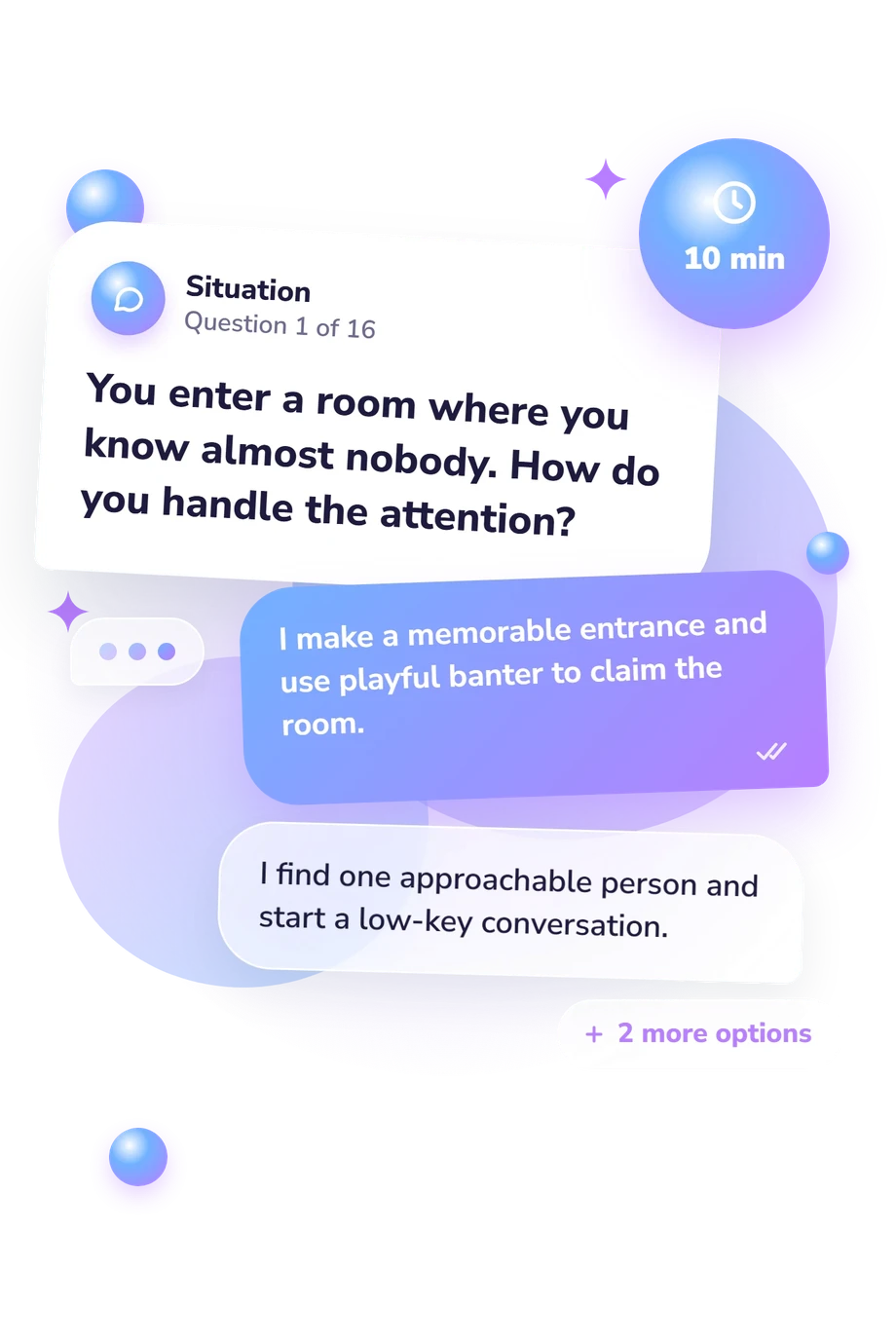
- I make a memorable entrance and use playful banter to claim the room.
- I find one approachable person and start a low-key conversation.
- I observe quietly until someone includes me.
- I turn up my charm, but only after I understand the room’s mood.
- I help freely when the request is reasonable and I have the capacity.
- I prefer an explicit exchange so both sides know what is owed.
- I enjoy being useful, especially when it gives me influence over how events unfold.
- I clarify expectations but do not keep a strict account of favors.
- Explaining calmly that appearance does not sum up a person.
- Letting the comment pass because their opinion is not worth my energy.
- Owning my style even more boldly while keeping my deeper loyalties for people who earned them.
- Answering with wit, then showing through my actions that they misjudged me.
Which Hazbin Hotel Character Are You Quiz - Description and methodology of the test
Fans deciding whether a playful personality comparison suits them can use the Which Hazbin Hotel Character Are You Quiz to reflect on social instincts rather than seek a fixed identity. The format works as a Hazbin Hotel character quiz for readers curious about attention, trust, loyalty, conflict, ambition, emotional disclosure, and responses to change. Its result shows several fictional affinities at once, so a blended profile can remain meaningful.
What This Assessment Explores
Items cover presentation, help, boundaries, leadership, trust, vulnerability, and second chances. They examine how social confidence, loyalty, realism, hope, and guarded expression appear in fictional-character affinity results. A Hazbin Hotel character match can therefore combine several styles instead of selecting one exclusive figure. The displayed dimensions are:
- Alastor Affinity (0-12) measures strategic showmanship and staged influence: Candid Contrast (0-4), Polished Strategist (5-8), or Theatrical Power Broker (9-12).
- Angel Dust Affinity (0-12) measures expressive presentation, guarded tenderness, wit, and loyalty: Reserved Contrast (0-4), Expressive Survivor (5-8), or Dazzling Deflector (9-12).
- Charlie Morningstar Affinity (0-12) measures openness, compassion, diplomacy, and faith in change: Grounded Contrast (0-4), Shared Spark (5-8), or Hopeful Visionary (9-12).
- Vaggie Affinity (0-12) measures vigilance, protective loyalty, skepticism, and firm boundaries: Open-Handed Contrast (0-4), Loyal Guardian (5-8), or Protective Realist (9-12).
Methodology and Evidence Base
Each scenario offers four response options covering presentation, emotional disclosure, collaboration, protection, trust, and openness to change. Responses contribute to character-specific totals, which are compared independently; the highest total is the strongest match, and totals within one point indicate a blend. The displayed bands are descriptive categories, so an individual answer should not be reverse-engineered into a point value.
As a character affinity quiz, this format is conceptually consistent with Rarity et al. (2022), whose findings connect identification with media characters to perceived similarity in personality traits. Cohen’s model adds a framework for understanding identification as an audience’s connection with and perspective-taking toward a character.
Medrano’s Hazbin Hotel (2024) supplies the fictional portrayals used for comparison. The questionnaire’s scoring is specific to this online format rather than a direct adaptation of either published research measure.
Because this self-report format has no published norms, reliability estimate, or validated cutoff for these affinity scores, results can shift with mood, context, self-awareness, and impression management, concerns highlighted by Paulhus’s response-bias research.
- Rarity, Erica C., Matthew R. Leitao, and Abraham M. Rutchick. “Identification With Characters in Parasocial Relationships Predicts Sharing Their Personality Traits.” Psychology of Popular Media, 11(2), 2022, 111-116. 10.1037/ppm0000389
- Medrano, Vivienne (creator). Hazbin Hotel. Television series. A24, 2024.
- Cohen, Jonathan. “Defining Identification: A Theoretical Look at the Identification of Audiences With Media Characters.” Mass Communication and Society, 4(3), 2001, 245-264. 10.1207/S15327825MCS0403_01
- Paulhus, Delroy L. “Measurement and Control of Response Bias.” In Measures of Personality and Social Psychological Attitudes, edited by John P. Robinson, Phillip R. Shaver, and Lawrence S. Wrightsman, 17-59. Academic Press, 1991. 10.1016/B978-0-12-590241-0.50006-X
Updated: