
Which Death Note Character Are You Quiz
How the Scales are Structured
Who Usually Takes This Test?
See How You Compare
Below is a preview of how scores are typically distributed across each scale.
Example Questions From the Test
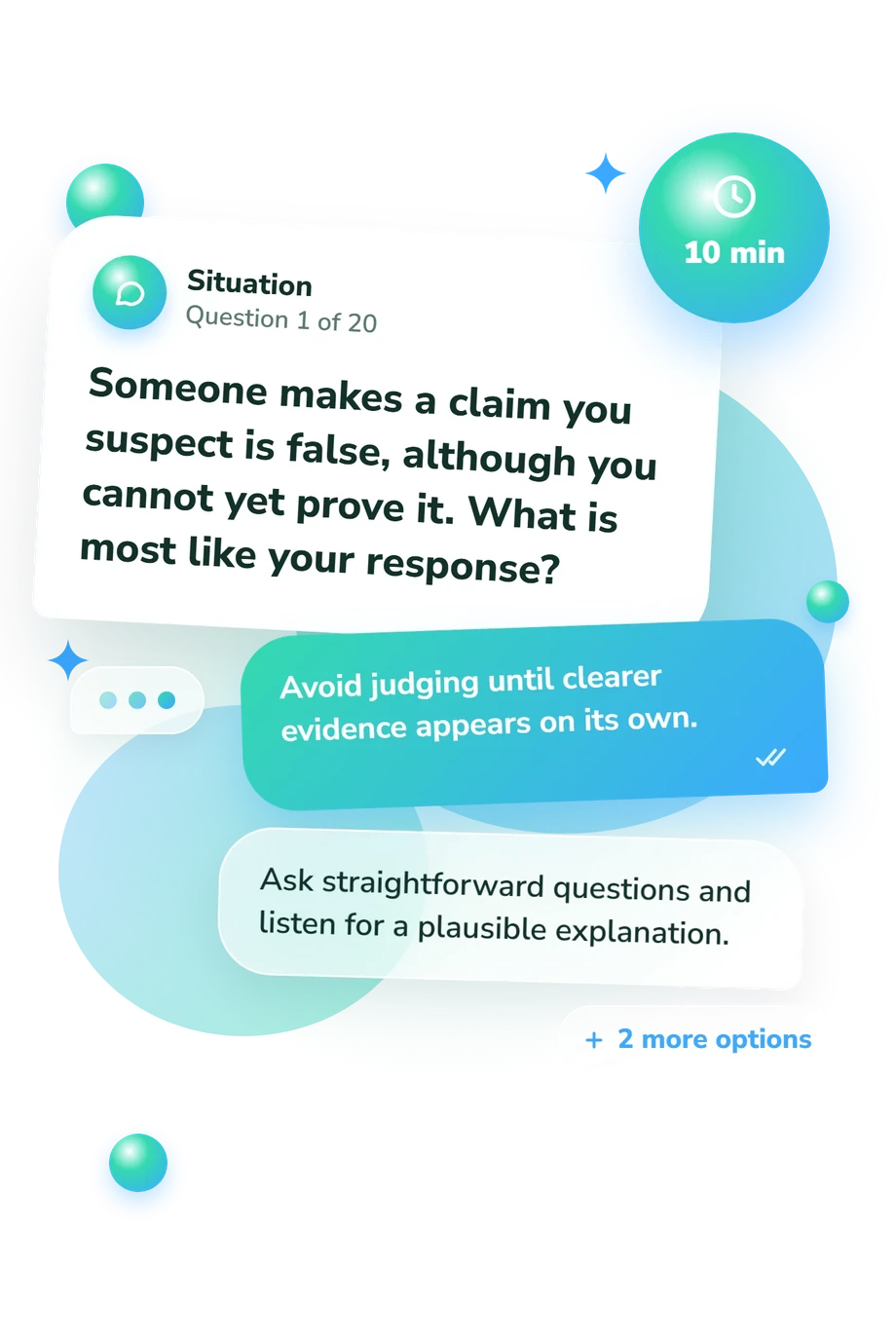
- Avoid judging until clearer evidence appears on its own.
- Ask straightforward questions and listen for a plausible explanation.
- Watch their reactions while checking the claim from several angles.
- Design a controlled test that forces the claim to succeed or fail.
- Outside the situation, focusing on responsibilities that concern me directly.
- Nearby enough to understand what is happening, while encouraging a resolution.
- Mostly as an observer, curious to see how each person responds.
- In the best seat available, fascinated by every new twist but unwilling to choose a side.
- I keep testing my conclusion and remain willing to abandon it.
- I advocate for it while making room for competing approaches.
- I pursue it decisively unless strong evidence proves me wrong.
- I commit fully and work to overcome anyone blocking the outcome.
Which Death Note Character Are You Quiz - Description and methodology of the test
Designed for fans who enjoy comparing fictional personalities with their own, this questionnaire explores decisions about evidence, control, loyalty, novelty, leadership, and uncertainty. Through the death note quiz which character are you format, fans can examine the personality patterns behind those choices. It also works as a Death Note character quiz for fans who want a structured way to compare their habits with the cast.
What This Assessment Explores
At its core, the quiz asks what Death Note character you are by comparing reasoning, impression management, risk response, emotional expression, and curiosity. These profiles describe attention, motivation, influence, and problem-solving styles rather than moral worth. The five displayed profiles are:
- Light Yagami (0-12) reflects control and ambition; Different Path (0-4), Strategic Streak (5-8), and Strong Light Affinity (9-12).
- L Lawliet (0-12) reflects skepticism and evidence-seeking; Different Method (0-4), Curious Investigator (5-8), and Strong L Affinity (9-12).
- Misa Amane (0-12) reflects expressive warmth and loyalty; Different Expression (0-4), Expressive Spark (5-8), and Strong Misa Affinity (9-12).
- Near (0-12) reflects patient model-building; Different Pace (0-4), Quiet Strategist (5-8), and Strong Near Affinity (9-12).
- Ryuk (0-12) reflects novelty-seeking independence; Different Motivation (0-4), Curious Spectator (5-8), and Strong Ryuk Affinity (9-12).
Methodology and Evidence Base
Each item presents an everyday scenario with four response choices. The options emphasize different ways of handling evidence, competition, leadership, emotion, routine, risk, and novelty, allowing the respondent to choose the response that feels most typical. The result reports five profile scores; the highest-scoring profile is the strongest affinity, and profiles within one point of it form a blended result.
The Death Note character guide by Ohba and Obata supplies the reference frame for the contrasting portraits. A study by Rarity, Leitao, and Rutchick offers conceptual support for character identification as a self-reflective lens, since identification with fictional figures can relate to perceived similarity in personality traits. The study does not validate this online questionnaire or make it an adaptation of their measure.
This Death Note personality test is an online self-report tool. Its result reflects current responses to questions about reasoning, image management, emotional commitment, patience, and appetite for novelty; mood, familiarity with the story, self-image, and response bias can shift the outcome, so read it as a playful snapshot rather than a definitive personality assessment.
- Ohba, Tsugumi, and Takeshi Obata. Death Note: How to Read. VIZ Media, 2008. ISBN 9781421518886.
- Rarity, Erica C., Matthew R. Leitao, and Abraham M. Rutchick. Identification With Characters in Parasocial Relationships Predicts Sharing Their Personality Traits. Psychology of Popular Media 11, no. 2 (2022): 111-116. 10.1037/ppm0000389
Updated: