
What Emoji Am I Quiz
How the Scales are Structured
Who Usually Takes This Test?
See How You Compare
Below is a preview of how scores are typically distributed across each scale.
Example Questions From the Test
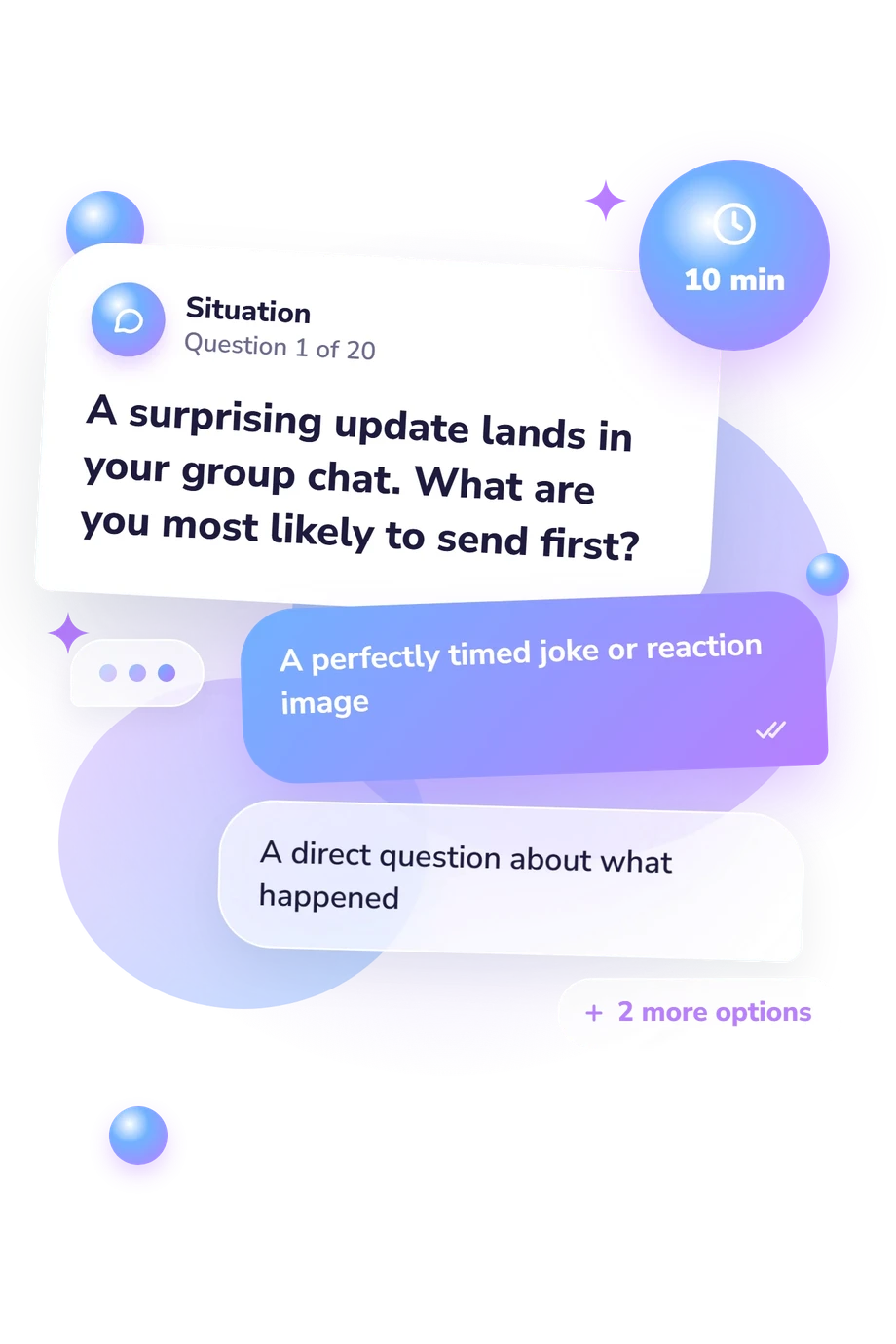
- A perfectly timed joke or reaction image
- A direct question about what happened
- A warm message checking how everyone feels
- Nothing yet—I prefer to watch the conversation unfold
- Analyze it so I can avoid repeating it
- Keep it private and move on
- Retell it as a funny story almost immediately
- Laugh about it once the initial sting has faded
- Who might appreciate being included in a conversation
- Where the liveliest part of the room is
- Who seems interesting for me to introduce myself to
- The overall atmosphere while I find my footing
What Emoji Am I Quiz - Description and methodology of the test
For anyone curious about the style they bring to ordinary interactions, the What Emoji Am I Quiz offers a concise emoji-affinity profile from everyday choices. Framed as a quiz about what emoji you are, it identifies the emoji energy with the highest affinity; scores within one point signal a blended result rather than a single dominant match.
What This Assessment Explores
Here, emoji act as symbols for recurring ways of approaching people, choices, ideas, and uncertainty. Questions cover communication, creativity, social situations, and decisions. In a quiz about which emoji you are, five affinities appear:
- Bold Energy (0-12) reflects decisive, adventurous action: Measured Pace (0-4), Ready Momentum (5-8), or Full Flame (9-12).
- Caring Heart (0-12) reflects connection-focused care: Quiet Care (0-4), Steady Support (5-8), or Openhearted Presence (9-12).
- Creative Spark (0-12) reflects imaginative expression: Clean Simplicity (0-4), Personal Touch (5-8), or Dazzling Imagination (9-12).
- Playful Spirit (0-12) reflects humorous, lighthearted energy: Quiet Amusement (0-4), Playful Streak (5-8), or Comic Spark (9-12).
- Thoughtful Mind (0-12) reflects curious analysis: Instinctive Approach (0-4), Curious Consideration (5-8), or Deep Thinker (9-12).
Methodology and Scientific Basis
Questions use short, situation-based choices rather than rating scales, so the result of my emoji quiz reflects response patterns, not right or wrong answers. They ask what you would send, notice, do, or prefer, creating a structured self-report rather than a knowledge test.
Results cover five dimensions: the highest affinity identifies the closest emoji energy, while scores within one point indicate a blended result. The individual contribution of each answer is not stated.
Marengo et al. (2017) link emoji preferences with personality, the closest reference here. Rezende et al. (2025) report validity and reliability evidence for a separate Personality Emoji Scale, while Liu and Sun (2020) connect emoji use with varied reasons and expression. This questionnaire is conceptually consistent with that research, but is not an adaptation or standardized equivalent of those instruments.
The result gives a structured snapshot of which emoji energy best matches everyday preferences. The displayed bands are style categories; no norms or clinical thresholds are stated for this online questionnaire. Mood, context, self-awareness, and honesty can shift responses, so interpret the result as reflection rather than clinical classification.
- Marengo, Davide, Fabrizia Giannotta, and Michele Settanni. “Assessing Personality Using Emoji: An Exploratory Study.” Personality and Individual Differences, vol. 112, 2017, pp. 74-78. 10.1016/j.paid.2017.02.037
- Rezende, Maria Thalita Cardoso, Isabella Leandra Silva Santos, Thais Emanuele Galdino Pessoa, and Carlos Eduardo Pimentel. “Personality Emoji Scale: Validity and Reliability Evidences.” Actualidades en Psicología, vol. 39, no. 138, 2025, pp. 24-34. 10.15517/ap.v39i138.53385
- Liu, Siying, and Renji Sun. “To Express or to End? Personality Traits Are Associated With the Reasons and Patterns for Using Emojis and Stickers.” Frontiers in Psychology, vol. 11, 2020, article 1076. 10.3389/fpsyg.2020.01076
Updated: