
What Bread Am I Quiz
How the Scales are Structured
Who Usually Takes This Test?
See How You Compare
Below is a preview of how scores are typically distributed across each scale.
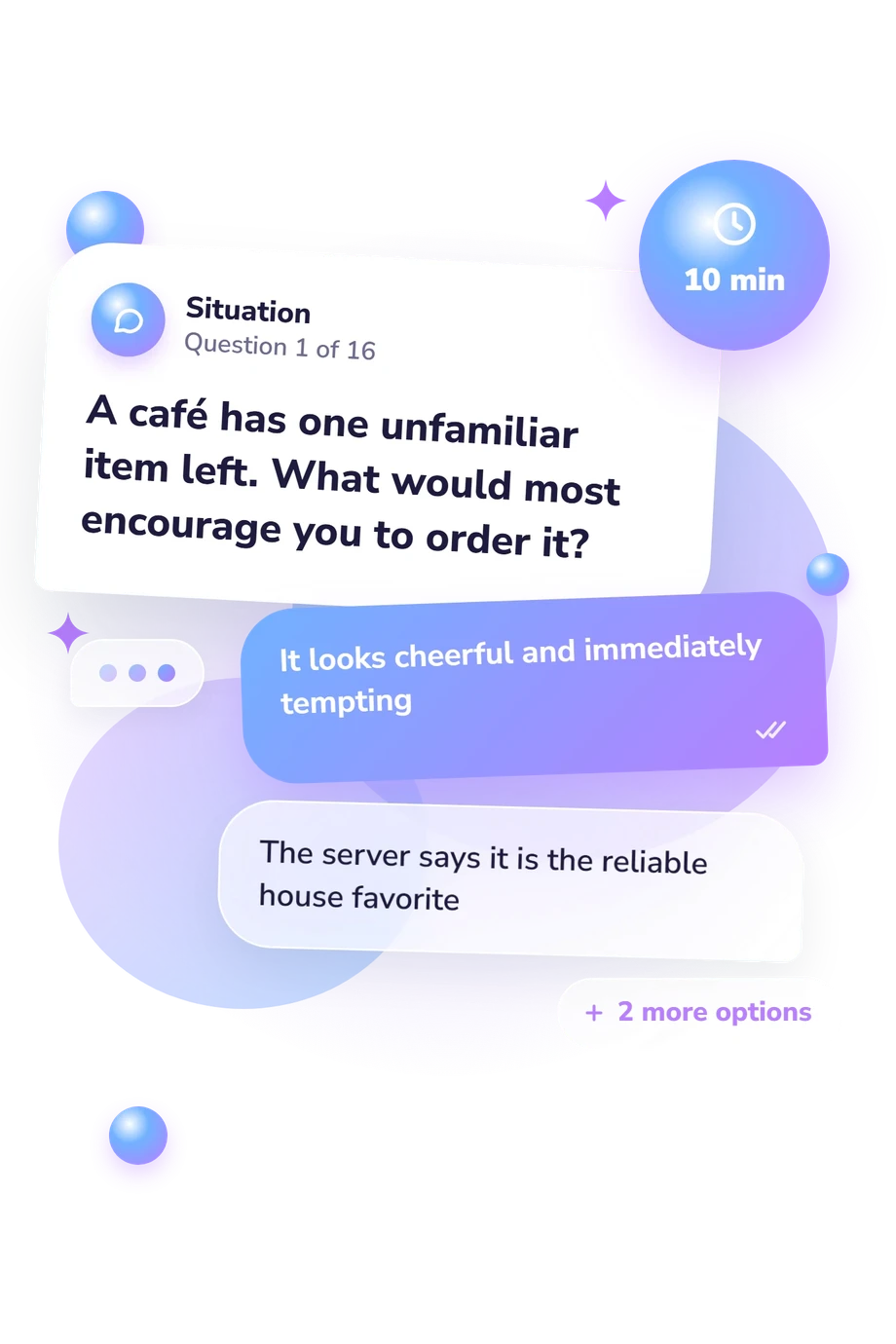
Example Questions From the Test
- A quiet lane with hidden workshops and time to wander
- A busy avenue filled with voices, movement, and open doors
- A welcoming square with soft lights and familiar faces
- A well-marked route that gets everyone where they need to go
- “You bring an interesting perspective that no one else noticed.”
- “You make even ordinary occasions feel joyful and cared for.”
- “You know how to bring a room to life.”
- “People can count on you when something needs to get done.”
- One connected to a memorable, spontaneous experience
- One with craftsmanship or complexity I keep discovering
- One that makes everyday life feel softer or more pleasurable
- One that works reliably and solves a recurring problem
What Bread Am I Quiz - Description and methodology of the test
Designed for people who enjoy playful personality interpretation, the What Bread Am I Quiz turns everyday preferences into four food-themed profiles. It suits readers curious about how they approach connection, comfort, useful routines, discovery, and unplanned experiences. By turning the question of what bread are you into a quiz about those preferences, it highlights the strongest affinity and can also reveal a close blended profile.
What This Assessment Explores
Everyday scenarios make the result relatable: choices about social contact, comfort, useful routines, discovery, and spontaneity reveal tendencies behind the metaphor. Rather than assigning a fixed personality profile, the quiz turns what kind of bread I am into a playful reflection on these preferences, not a formal trait inventory.
The four thematic affinities are:
- Baguette affinity (0-12) measures social energy, expressiveness, spontaneity, and shared enjoyment: Quiet Slice (0-4), Café Companion (5-8), or Boulevard Spark (9-12).
- Brioche affinity (0-12) measures warmth, generosity, comfort, and celebration: Simple Serving (0-4), Golden Center (5-8), or Richly Warm (9-12).
- Rye affinity (0-12) measures steadiness, practicality, quiet resilience, and substance: Light Foundation (0-4), Steady Grain (5-8), or Solid Loaf (9-12).
- Sourdough affinity (0-12) reflects patience, independence, curiosity, and appreciation for character that develops over time: Fresh Crumb (0-4), Developing Starter (5-8), or Distinctive Loaf (9-12).
Methodology and Scientific Basis
As an online self-report questionnaire, each item presents a familiar situation and four answer choices, with each option emphasizing a different preference. The quiz turns the question of what type of bread I am into four thematic scores without abstract trait vocabulary.
Scoring is comparative: the highest score marks the strongest affinity, and any profile within one point joins it as a blend. This keeps mixed patterns from being forced into one category.
The themes are conceptually consistent with broad domains in the Big Five Aspect Scales (DeYoung et al., 2007), including social engagement, dependability, and openness-related curiosity. The bread categories are neither an administration nor an adaptation of that instrument, so its standardized scoring does not apply here.
Displayed bands are the questionnaire’s interpretive score categories. Mood, recent experiences, self-awareness, and answer appeal can influence a result. As a what kind of bread are you quiz, it is best treated as a flexible reflection prompt about preference tendencies, rather than a fixed account of personality.
- DeYoung, Colin G., Lena C. Quilty, and Jordan B. Peterson. (2007). Between Facets and Domains: 10 Aspects of the Big Five. Journal of Personality and Social Psychology, 93(5), 880-896. 10.1037/0022-3514.93.5.880
- Soto, Christopher J., and Oliver P. John. (2017). Short and extra-short forms of the Big Five Inventory-2: The BFI-2-S and the BFI-2-XS. Journal of Research in Personality, 68, 69-81. 10.1016/j.jrp.2017.02.004
- Goldberg, Lewis R. (1992). The Development of Markers for the Big-Five Factor Structure. Psychological Assessment, 4(1), 26-42. 10.1037/1040-3590.4.1.26
Updated: