
US Cities Quiz
How the Scales are Structured
Who Usually Takes This Test?
See How You Compare
Below is a preview of how scores are typically distributed across each scale.
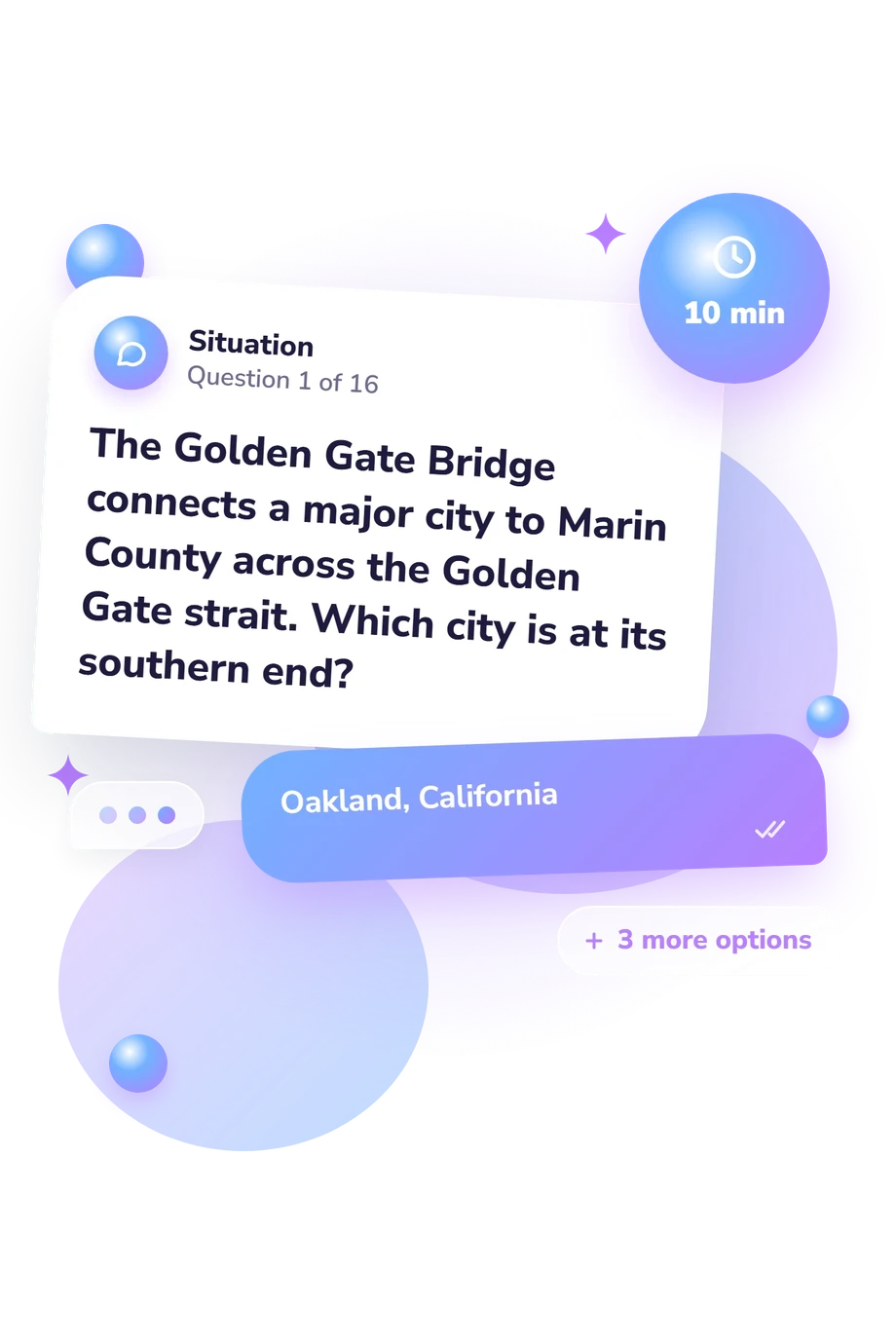
Example Questions From the Test
- Oakland, California
- San Jose, California
- San Francisco, California
- Sacramento, California
- Memphis, Tennessee
- Nashville, Tennessee
- Louisville, Kentucky
- Austin, Texas
- Seattle, Washington
- Tacoma, Washington
- Portland, Oregon
- Anchorage, Alaska
US Cities Quiz - Description and methodology of the test
People who want to check their geographic recall can use the US Cities Quiz to identify American cities from landmarks, waterways, neighborhoods, regions, and cultural clues. This American cities quiz asks readers to identify places through contextualized geographic and cultural clues, showing which associations come readily and which facts may deserve another look. It offers a focused way to examine geographic awareness without treating city names as isolated facts.
What This Assessment Explores
The questionnaire measures knowledge of US cities through scenarios linking landmarks, waterways, regions, and cultural traditions to a fitting city. The questions focus on well-known US cities and their defining places, making this US major cities quiz a check of contextualized recall: scenarios frame facts, but answers still depend on geographic knowledge.
The result is organized around four clue groups:
- Landmarks and culture show how sites and traditions identify a city.
- Waterways and landscapes show how physical geography narrows location.
- Neighborhoods and civic geography show recognition of urban structure.
- Regional identity shows links among a city, state, climate, and position.
The US Cities Knowledge scale runs from 0-16. Foundations (0-6) means strengthening connections among cities, regions, landmarks, and waterways; Developing (7-12) means solid knowledge of geographic and cultural clues; Strong (13-16) means consistently connecting cities with locations, histories, and landmarks.
Methodology and Evidence Base
Each item presents a location scenario with four answer choices. In this US cities map quiz, respondents select the city that best fits landmarks, waterways, neighborhoods, landscapes, or regional settings; they do not place answers on an interactive map.
Scoring produces one knowledge result rather than separate trait scores. It summarizes links among names, places, and geographic or cultural associations. Travel, media exposure, classroom learning, map familiarity, attention, and current recall can influence performance.
Mason and Blankenship discuss place-name geography as assessable learning, while Dunn examines location knowledge and spatial thinking and Golledge describes geographic knowledge as relations among places. The questionnaire is conceptually consistent with these discussions, but they do not validate or establish this online item set as standardized.
No population norms or standardization are established for this online item set, so the result is a snapshot rather than a diagnostic assessment. Prior exposure, cultural familiarity, and current context affect performance, while selected clues cannot represent national urban geography.
- Mason, Mary T., and Glen Blankenship. "Where in the World? The Status of Place-Name Geography Instruction." The Journal of Social Studies Research 12, no. 1 (1988): 1-7. 10.1177/235227981988012001001
- Dunn, James M. "Location Knowledge: Assessment, Spatial Thinking, and New National Geography Standards." Journal of Geography 110, no. 2 (2011): 81-89. 10.1080/00221341.2010.511243
- Golledge, Reginald G. "The Nature of Geographic Knowledge." Annals of the Association of American Geographers 92, no. 1 (2002): 1-14. 10.1111/1467-8306.00276
Updated: