
Tooth Identification Quiz
How the Scales are Structured
Who Usually Takes This Test?
See How You Compare
Below is a preview of how scores are typically distributed across each scale.
Example Questions From the Test
- Maxillary central incisor
- Mandibular central incisor
- Mandibular lateral incisor
- Maxillary canine
- Maxillary left central incisor
- Maxillary right lateral incisor
- Mandibular left central incisor
- Maxillary right central incisor
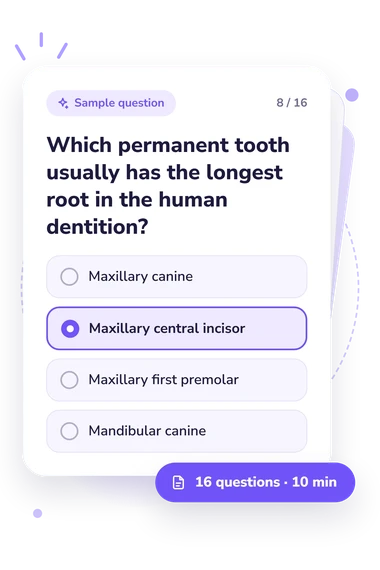
- Maxillary canine
- Maxillary central incisor
- Maxillary first premolar
- Mandibular canine
Tooth Identification Quiz - Description and methodology of the test
Learners studying or reviewing dental anatomy can use this tooth id quiz to practise recognizing teeth from morphology, arch position, and notation clues. The assessment suits anyone who wants a focused review of dental anatomy rather than a broad test of clinical knowledge. The Tooth Identification Quiz shows which recognition skills are secure and which distinctions deserve another look.
What This Assessment Explores
Questions ask you to distinguish incisors, canines, premolars, molars, and primary teeth by crown shape, cusps, roots, grooves, arch position, and notation. This quiz uses real-world tooth-identification clues to connect dental vocabulary with practical identification.
The displayed result is Tooth Identification Knowledge, scored 0-16. Its bands are Foundation (0-6), Developing (7-12), and Strong (13-16). Foundation signals features needing review; Developing indicates many correct identifications with some inconsistency; Strong indicates reliable recognition across tooth form, arch identification, and numbering. This educational score does not establish clinical competence.
The assessed areas are:
- Crown morphology shows how you use symmetry, ridges, fossae, grooves, and cusps.
- Arch position shows whether anatomy helps you locate a tooth.
- Root and dentition clues show how you distinguish primary and permanent features.
- Numbering systems show whether you apply Universal and FDI notation.
Methodology and Scientific Basis
Each item presents an anatomical description followed by four answer choices. Prompts target details such as a heart-shaped molar outline, a developmental groove, an incisor twist, or a notation number, so the task tests applied identification rather than term matching.
The result is reported on the displayed educational scale. This online questionnaire is an educational self-assessment without standardized norms, so it describes performance on written identification tasks rather than a normed psychometric estimate. It reflects recognition of morphology and notation, not direct examination of an extracted or live tooth.
The Tooth Identification Puzzle and an augmented-reality tooth-identification test are educational precedents for this clue-based format, not validation studies of this online questionnaire. A dental anatomy textbook supplies morphology terminology, while the Universal Numbering System provides a reference for numbering items. These conceptual parallels do not make the quiz an adaptation of those instruments.
As a tooth morphology quiz, it is best read alongside observation and review. Terminology familiarity, attention, and item wording can affect performance, so a strong result reflects recognition on this task rather than mastery of every clinical situation.
- Risnes S, Khan Q, Hadler-Olsen E, Sehic A. Tooth identification puzzle: A method of teaching and learning tooth morphology. European Journal of Dental Education. 2019;23(1):62-67. 10.1111/eje.12403
- Kim-Berman H, Karl E, Sherbel J, Sytek L, Ramaswamy V. Validity and User Experience in an Augmented Reality Virtual Tooth Identification Test. Journal of Dental Education. 2019;83(11):1345-1352. 10.21815/JDE.019.139
- Nelson SJ. Wheeler's Dental Anatomy, Physiology, and Occlusion. 11th ed. St. Louis, MO: Elsevier; 2020.
- American Dental Association. Universal Tooth Designation System - Value Set. July 2024.