
Tissue Quiz Anatomy and Physiology
How the Scales are Structured
Who Usually Takes This Test?
See How You Compare
Below is a preview of how scores are typically distributed across each scale.
Example Questions From the Test
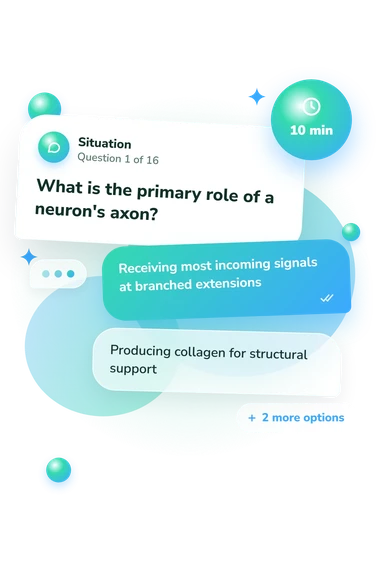
- Receiving most incoming signals at branched extensions
- Producing collagen for structural support
- Conducting signals away from the cell body
- Connecting muscle fibers to tendons
- Endocrine
- Exocrine
- Paracrine
- Neuroendocrine
- Cardiac muscle tissue
- Skeletal muscle tissue
- Smooth muscle tissue
- Dense regular connective tissue
Tissue Quiz Anatomy and Physiology - Description and methodology of the test
Students, trainees, and curious readers can use this assessment to rehearse anatomy and histology decisions that arise in class or laboratory study. The Tissue Quiz Anatomy and Physiology turns that preparation into a focused knowledge check. Learners practise identifying body tissues in quiz questions that apply principles to familiar examples. The questions centre on usable structure-function reasoning. It also supports anatomy and physiology study through focused quiz practice with tissues.
What This Assessment Measures
This assessment checks whether learners identify the four primary tissue classes and connect microscopic features with roles. Clues involve cell shape, layers, fibers, matrix, location, repair, secretion, contraction, and signaling. It suits introductory anatomy and physiology learners.
Learners may find that questions about types of tissues in this quiz challenge them to distinguish structures by location, microscopic form, and function.
Results use the Tissue Anatomy and Physiology Knowledge scale (0-16): Foundation Building (0-6) signals review of defining structures, locations, and functions; Developing Knowledge (7-12) shows many essentials but needs practice applying histology clues; Strong Knowledge (13-16) reflects well-developed identification and structure-function reasoning.
The content areas are:
- Epithelial tissue links layers with protection, absorption, and exchange.
- Connective tissue relates cells, fibers, and matrix to support and repair.
- Muscle tissue distinguishes forms by structure, control, and movement.
- Nervous tissue covers signaling and neuroglial support.
Methodology and Evidence Base
Each item presents a tissue scenario or direct concept question with four answer choices. This multiple-choice method tests recognition and application: clues such as striations, cell layers, ducts, intercalated discs, matrix, and function must be matched to the best option. Reviewing the tissue quiz questions and answers requires learners to connect those clues with the best option.
The displayed result is one overall knowledge score with three descriptive bands and no established normative interpretation. It offers a focused snapshot of performance rather than a complete measure of laboratory skill or practical microscopy competence.
The questionnaire is conceptually consistent with the anatomy and physiology relationships described by Betts et al. (2022), and with the histology focus on tissue organization and identification in Pawlina and Ross (2020). It is also consistent with the tissue definition and classification discussed by Neumann and Neumann (2021), but it is not an adaptation of any one published instrument.
Performance can vary with prior instruction, guessing, wording familiarity, and current context, while the four-option format can make recognition easier than unaided practical identification.
- Betts, J. Gordon, Kelly A. Young, James A. Wise, Eddie Johnson, Brandon Poe, Dean H. Kruse, Oksana Korol, Jody E. Johnson, Mark Womble, and Peter DeSaix. Anatomy and Physiology 2e. 2nd ed. Houston, TX: OpenStax, 2022.
- Pawlina, Wojciech, and Michael H. Ross. Histology: A Text and Atlas: With Correlated Cell and Molecular Biology. 8th ed. Philadelphia, PA: Wolters Kluwer, 2020.
- Neumann, Paul E., and Eve E. Neumann. General histological woes: Definition and classification of tissues. Clinical Anatomy 34, no. 5 (2021): 794-801. 10.1002/ca.23741