
Teeth Quiz
How the Scales are Structured
Who Usually Takes This Test?
See How You Compare
Below is a preview of how scores are typically distributed across each scale.
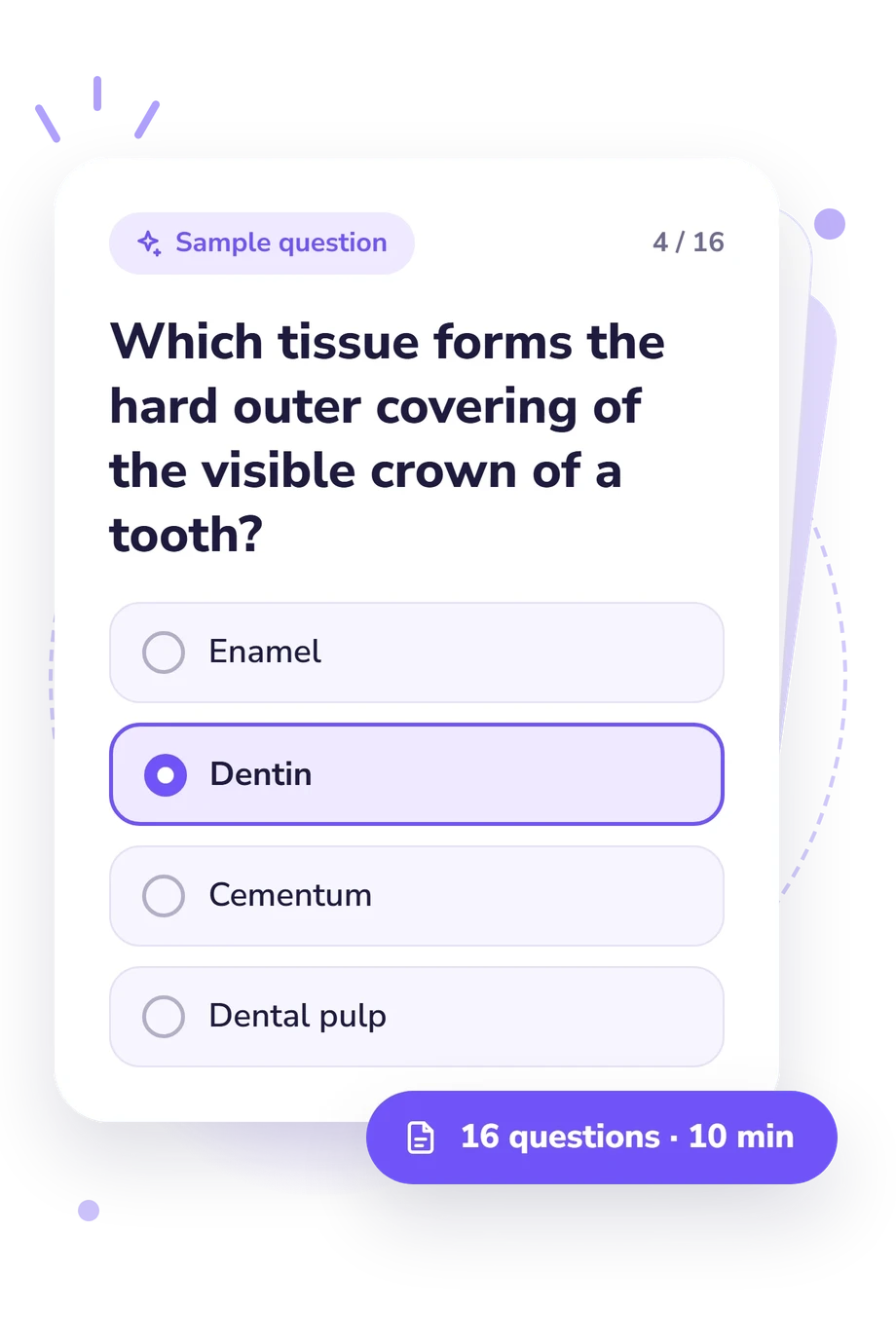
Example Questions From the Test
- Enamel
- Dentin
- Cementum
- Dental pulp
- It washes away debris and helps neutralize acids in the mouth
- It permanently seals pits in the chewing surfaces
- It replaces enamel that has been completely lost
- It prevents all oral bacteria from growing
- 28
- 32
- 24
- 36
Teeth Quiz - Description and methodology of the test
Readers preparing to revisit basic dental information or think through common oral-health situations may benefit from this teeth quiz. This tooth quiz suits people who want to test practical reasoning about prevention, symptoms, and first responses. Its overall knowledge band can guide further learning without presenting a topic-by-topic breakdown.
What the Assessment Measures
The questionnaire covers teeth, gums, prevention, symptoms, and urgent responses. Its Teeth Knowledge score runs from 0-16: Foundation Building (0-6) calls for review of core concepts; Developing Knowledge (7-12) indicates many basics are understood but some details may need attention; Strong Knowledge (13-16) reflects a well-rounded grasp of everyday dental health.
The result draws on four connected themes:
- Tooth structure covers enamel, dentin, cementum, and pulp.
- Prevention knowledge covers plaque, tartar, fluoride, saliva, acids, brushing, and flossing.
- Gum awareness covers inflammation, pain, dry mouth, cracks, and persistent sores.
- Urgent care and protective habits cover injury responses and mouthguard use.
This dental knowledge test identifies learning needs; its score measures knowledge, not the physical condition of teeth or gums, so symptoms warrant clinical assessment regardless of the band.
Methodology and Evidence Base
Each item presents a brief everyday scenario or factual question with four answer choices. Selecting the best answer tests applied oral-health knowledge rather than agreement with a personality statement.
The result summarizes performance across the questionnaire as an overall educational score, and the displayed band places that total in a broad learning level. Attention, guessing, and current knowledge can influence a self-administered result.
Its evidence base is conceptually consistent with CMOHK, a measure of conceptual oral-health knowledge, and KROHL, developed to evaluate oral-health knowledge. These sources support the focus on practical health concepts, but this questionnaire is not presented as an adaptation of either published tool.
The online oral health knowledge test uses a four-choice format of its own; CMOHK and KROHL provide conceptual reference points, not a scoring rule for this version. Results are most useful when read as a prompt to revisit oral-health information and consider how confidently the respondent can apply it.
- Mark D. Macek, Don Haynes, William Wells, Simon Bauer-Leffler, P. Ann Cotten, and Ruth M. Parker. Measuring conceptual health knowledge in the context of oral health literacy: preliminary results. Journal of Public Health Dentistry. 2010;70(3):197-204. 10.1111/j.1752-7325.2010.00165.x
- Silvia Spivakovsky, Yoon Weon Suh, and Malvin N. Janal. Development of KROHL, a tool for evaluating oral health knowledge. PEC Innovation. 2022;1:100100. 10.1016/j.pecinn.2022.100100
Updated: