
Should I Be a Dermatologist Quiz
How the Scales are Structured
Who Usually Takes This Test?
See How You Compare
Below is a preview of how scores are typically distributed across each scale.
Example Questions From the Test
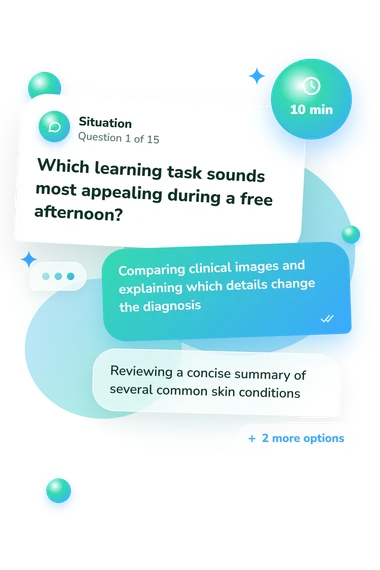
- Comparing clinical images and explaining which details change the diagnosis
- Reviewing a concise summary of several common skin conditions
- Studying a subject with formulas or standardized inputs instead
- Memorizing a short list of hallmark findings
- Somewhat appealing when improvement is visible within a few visits
- Very appealing; I value adapting care as symptoms, circumstances, and goals change
- Moderately appealing if each visit has a clear problem to solve
- I would prefer encounters that are usually resolved in a single episode
- Appealing because I like switching among precise clinical tasks within a structured setting
- Reasonably appealing, although I would want some longer, less compressed work periods
- Tolerable, but I would prefer a day dominated by one kind of task
- Less appealing than work with a slower pace and fewer transitions
Should I Be a Dermatologist Quiz - Description and methodology of the test
For students, career changers, and curious readers weighing a medical specialty, this questionnaire offers a structured way to examine whether dermatology’s everyday demands suit their preferences. The Should I Be a Dermatologist Quiz turns a broad career question into a profile that highlights topics worth investigating before you choose a direction. This dermatologist quiz can help organize questions to investigate before choosing a direction.
What This Assessment Explores
Dermatology blends visual examination, precise procedures, documentation, changing priorities, and conversations about visible or sensitive concerns. The questionnaire treats career fit as a pattern of preferences, making it useful when reflecting on fit with a dermatology career before committing to a medical path.
The three displayed dimensions are:
- Patient Communication and Ongoing Care (0-15) measures comfort with sensitive discussions and collaborative follow-up; Different interaction fit (0-5), Situational fit (6-10), and Strong affinity (11-15) are its result bands.
- Precision Work and Training Commitment (0-15) measures alignment with detailed work, clinic workflow, documentation, and lengthy training; Alternative work-style fit (0-5), Conditional fit (6-10), and Strong affinity (11-15) are its bands.
- Visual Diagnostic Curiosity (0-15) measures interest in close observation, pattern comparison, and incomplete information; Other strengths (0-5), Emerging fit (6-10), and Strong affinity (11-15) are reflective bands.
Methodology and Evidence Base
Each item presents a work or patient-care situation with four response choices. The options reflect preferences for ambiguity, follow-up, expectations, procedural detail, and prolonged training. As a dermatology career quiz, this questionnaire produces a profile rather than a pass-or-fail verdict.
Answers are combined within the three dimensions, and each receives a catalogue-defined score and band. The questionnaire does not state how individual choices contribute to a score, so the ranges alone do not establish a weighting or reverse-scoring formula.
The Medical Specialty Preference Inventory (MSPI) is the closest named framework. Its manual and related studies treat specialty preference as a vocational construct; Glavin, Richard, and Porfeli examined predictive validity, and Porfeli, Richard, and Savickas studied specialization scales. This questionnaire is conceptually consistent with that work, not an adaptation or validated administration of the MSPI. It is an unvalidated reflection tool for examining preferences about specialty work. Smith and colleagues’ dermatology study adds context about specialty choice, but does not validate this questionnaire.
Interpret results as prompts for investigating daily work, training demands, and patient contact. Self-report can reflect current circumstances, response bias, or limited self-awareness, so scores do not predict admission, performance, or career satisfaction.
- Glavin, Kevin W., George V. Richard, and Erik J. Porfeli. (2009). Predictive validity of the medical specialty preference inventory. Journal of Vocational Behavior, 74(1), 128-133. 10.1016/j.jvb.2008.11.004
- Smith, Ambrosia, Travis Fulk, Katelyn Rypka, Kevin Gaddis, Ronda Farah, and Matthew Mansh. (2023). Cross-sectional study of factors influencing specialty choice among diverse medical students pursuing careers in dermatology. Journal of the American Academy of Dermatology, 89(4), 853-857. 10.1016/j.jaad.2023.05.091
- Richard, George V. (2011). Medical Specialty Preference Inventory, Revised Edition Technical Manual. Washington, DC: Association of American Medical Colleges.
- Porfeli, Erik J., George V. Richard, and Mark L. Savickas. (2010). Development of specialization scales for the MSPI: A comparison of empirical and inductive strategies. Journal of Vocational Behavior, 77(2), 227-237. 10.1016/j.jvb.2010.04.011