
Scientific Method Quiz
How the Scales are Structured
Who Usually Takes This Test?
See How You Compare
Below is a preview of how scores are typically distributed across each scale.
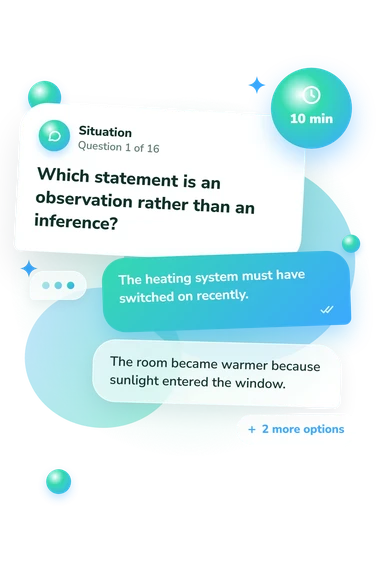
Example Questions From the Test
- The heating system must have switched on recently.
- The room became warmer because sunlight entered the window.
- The thermometer reads 22.4°C.
- People in the room probably feel comfortable.
- Replication
- Peer review
- Instrument calibration
- Random sampling
- Use the measured value without rounding it
- Repeat the measurement several times and calculate the average
- Compare the value with an unrelated experiment
- Replace the hypothesis after seeing the value
Scientific Method Quiz - Description and methodology of the test
For learners who want to check how they reason about evidence, the Scientific Method Quiz turns familiar research situations into a focused self-check. It suits students, educators, and curious readers who want a clearer sense of which concepts are secure and which deserve practice. As a scientific process quiz, it emphasizes practical decisions rather than memorizing isolated definitions.
What This Assessment Explores
The assessment checks whether you separate observations from inferences, identify variables and confounds, and judge what evidence supports. It covers hypotheses, controls, replication, correlation, random assignment, peer review, and graphs.
Used as a scientific reasoning assessment, it examines whether you distinguish records from explanations, design fair comparisons, and limit conclusions to available evidence. Learners and educators can use the result to choose topics for further practice.
The result is reported on the Scientific Method Knowledge scale (0-16), with three interpretive bands:
- Foundations to build (0-6) indicates that variables, controls, evidence, and testable claims need review.
- Developing command (7-12) shows core understanding with some research-design distinctions left to practice.
- Strong command (13-16) indicates consistent recognition of sound methods, interpretations, and conclusions.
Methodology and Evidence Base
Classroom and research scenarios in this scientific method online quiz offer four answer choices each. You select the option that best matches sound reasoning, so the result reflects knowledge of scientific practice rather than personality. The displayed score summarizes performance across the items.
Its content is conceptually consistent with TOSLS (Gormally et al., 2012), which examines how people assess scientific evidence and claims, and with experimental-design concerns studied by Dasgupta, Anderson, and Pelaez (2014). Lawson (1978) addresses formal scientific reasoning, and Bao et al. (2018) examine later validity evidence. These sources clarify related concepts, while the displayed score summarizes performance on this questionnaire's items rather than applying published norms from those measures.
Interpret the result as a snapshot of current understanding. A stronger band suggests recognition of testable claims, controls, replication, and evidence-limited conclusions; a developing or lower band identifies topics for review rather than fixed ability. Attention, prior instruction, guessing, and interpretation of a scenario can affect performance. With no population norms or diagnostic cutoff supplied, use the score to guide learning and self-reflection.
- Gormally, Cara, Peggy Brickman, and Mary Lutz. "Developing a Test of Scientific Literacy Skills (TOSLS): Measuring Undergraduates’ Evaluation of Scientific Information and Arguments." CBE-Life Sciences Education 11, no. 4 (2012): 364-377. 10.1187/cbe.12-03-0026
- Dasgupta, Annwesa P., Trevor R. Anderson, and Nancy Pelaez. "Development and Validation of a Rubric for Diagnosing Students’ Experimental Design Knowledge and Difficulties." CBE-Life Sciences Education 13, no. 2 (2014): 265-284. 10.1187/cbe.13-09-0192
- Lawson, Anton E. "The Development and Validation of a Classroom Test of Formal Reasoning." Journal of Research in Science Teaching 15, no. 1 (1978): 11-24. 10.1002/tea.3660150103
- Bao, Lei, Yang Xiao, Kathleen Koenig, and Jing Han. "Validity Evaluation of the Lawson Classroom Test of Scientific Reasoning." Physical Review Physics Education Research 14, no. 2 (2018): 020106. 10.1103/PhysRevPhysEducRes.14.020106
Updated: