
SAT Quiz
How the Scales are Structured
Who Usually Takes This Test?
See How You Compare
Below is a preview of how scores are typically distributed across each scale.
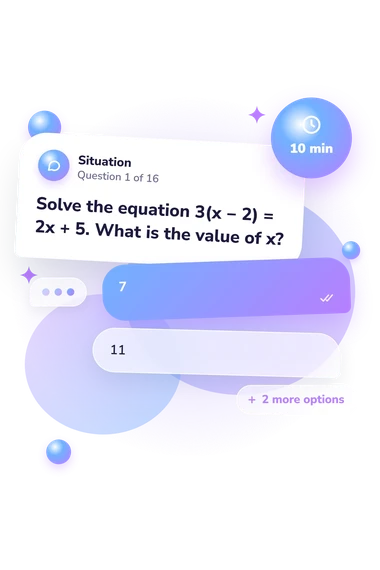
Example Questions From the Test
- 7
- 11
- 8
- 5
- 4
- 5
- 3
- 6
- 7
- 8
- 9
- 5
SAT Quiz - Description and methodology of the test
Students who want a focused view of their current readiness can use this sat quiz to examine the reasoning expected across core SAT content. It suits learners planning independent study, classroom review, or targeted revision. A sat prep quiz can help identify which skills deserve attention before a broader study plan is built.
What This Assessment Explores
The questionnaire samples mathematical problem solving, reading, and writing decisions rather than personal opinions or study habits. Its sat math practice quiz content includes equations, functions, percentages, geometry, growth, and data interpretation. Other items examine grammar, transitions, sentence structure, vocabulary, evidence, and synthesis, so the result reflects more than mathematics alone. Because the full set also requires verbal judgment, calling it only a sat math quiz would be incomplete.
A single SAT Knowledge scale runs from 0-16 and totals correct answers across the quiz, without separate subject scores. Bands are Foundation Building (0-6), Developing (7-12), and Strong (13-16).
These result dimensions show:
- Mathematical reasoning covers algebra, functions, geometry, and quantitative relationships.
- Data reasoning shows how you compare information, identify patterns, and support conclusions.
- Reading and writing control reflects passage interpretation, revision, vocabulary, and standard English conventions.
Methodology and Scientific Basis
Each item presents a prompt with four answer choices. The respondent selects the option that solves the problem or completes the passage. Correct responses contribute to one total, interpreted through the overall scale rather than separate math and verbal subscores.
The design is conceptually consistent with the Digital SAT Suite, which organizes assessment around Reading and Writing and Math domains and emphasizes reasoning with texts, language, data, algebra, and advanced mathematics. The College Board’s Assessment Framework and Technical Manual provide the relevant framework for these sampled content categories. This online questionnaire is a shorter practice instrument, not a reproduction of the full SAT.
The result from a sat practice quiz is most useful as a snapshot for choosing review topics. The Wiley, Shavelson, and Kurpius study supports viewing SAT performance as multidimensional, but it does not validate this online version. No normative comparison group is displayed; attention, familiarity, guessing, and current confidence can affect performance. The bands describe these sampled tasks rather than predict an official SAT score.
- College Board. The Digital SAT Suite of Assessments Specifications Overview. Summer 2022. College Board, 2022.
- College Board. Assessment Framework for the Digital SAT Suite, version 3.01 (August 2024). Lead author and editor: Jim Patterson. New York: College Board, 2024.
- College Board. Digital SAT Suite of Assessments Technical Manual. New York: College Board, 2024.
- Wiley, Edward W., Richard J. Shavelson, and Amy A. Kurpius. On the Factorial Structure of the SAT and Implications for Next-Generation College Readiness Assessments. Educational and Psychological Measurement 74, no. 5 (2014): 859-874. 10.1177/0013164414528332.