
Road Signs Quiz
How the Scales are Structured
Who Usually Takes This Test?
See How You Compare
Below is a preview of how scores are typically distributed across each scale.
Example Questions From the Test
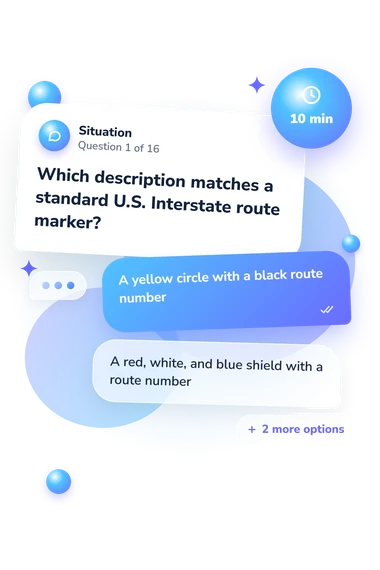
- A yellow circle with a black route number
- A red, white, and blue shield with a route number
- A white pentagon with a black route number
- A green rectangle with a white route number
- Maintain speed but drive on the shoulder for added traction
- Reduce speed smoothly and avoid abrupt steering or braking
- Brake sharply to test how much traction remains
- Treat the sign as applying only when standing water is visible
- Warning signs
- Regulatory signs
- Temporary traffic-control signs
- Guide signs
Road Signs Quiz - Description and methodology of the test
People preparing for a written driving test, refreshing everyday road knowledge, or checking how confidently they read U.S. signs can use the Road Signs Quiz as a focused knowledge check. It asks you to connect familiar visual conventions with the action or meaning they convey. This traffic signs quiz shows your performance across the signs covered by the questionnaire and points you toward official materials for any needed review.
What This Test Measures
It summarizes performance on the covered text-based questions rather than driving skill. The items ask about route markers, sign shapes, color conventions, categories, and the response implied by common U.S. warnings and controls. The emphasis is on linking a visible design or wording with its road meaning, including yield, railroad, work-zone, school, speed-limit, and wrong-way situations.
For learners, it works as a quiz about signs of the road, while licensed drivers can use it to refresh knowledge before reading a current handbook. The result is a focused summary of performance on this question set, not a measure of reaction time or judgment in traffic.
The questions cover three practical areas:
- Route markers and guide signs identify roads, destinations, services, and numbered routes.
- Regulatory, warning, and temporary-control signs explain rules, hazards, changes, or work conditions.
- Shapes, colors, and special symbols support recognition before every word is read.
Methodology and Evidence Base
Each item presents a text prompt and four answer choices. Some questions describe a sign’s shape or wording; others place it in a brief driving situation and ask for the meaning or appropriate response. This fixed-choice format tests recognition and interpretation, not self-reported driving habits.
The content is conceptually consistent with the MUTCD, 11th Edition, which provides national guidance for U.S. traffic-control signs, while the study by Lengyel, Valoczi, and Torok (2021) provides only adjacent context from automated road-sign recognition research. Neither source validates this human, text-based questionnaire or its bands. Road Signs Knowledge spans 0-16: Foundations to review (0-6), Developing recognition (7-12), and Strong recognition (13-16).
The total summarizes performance across the fixed-choice items, while the bands function as descriptive labels for this set of questions rather than legal driving competence. No standardization or norming procedure is stated for this online questionnaire. This quiz on traffic signs cannot measure observation, judgment, vehicle control, or responses to changing local conditions. Current state handbooks and official signs take priority when rules or local details matter.
- Lengyel, Henrietta, Denes Valoczi, and Adam Torok. “Determining the minimal safety level of automatic road sign recognition system - field study survey.” Transportation Research Procedia 55 (2021): 307-312. 10.1016/j.trpro.2021.06.035
- Federal Highway Administration. Manual on Uniform Traffic Control Devices for Streets and Highways (MUTCD), 11th Edition, December 2023, with Revision 1 incorporated, December 2025. U.S. Department of Transportation.