
Riddle Quiz
How the Scales are Structured
Who Usually Takes This Test?
See How You Compare
Below is a preview of how scores are typically distributed across each scale.
Example Questions From the Test
- T
- N
- O
- M
- A radio
- A recording
- An echo
- A whisper
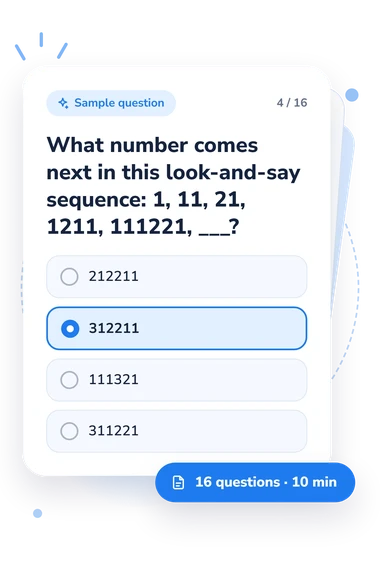
- 212211
- 312211
- 111321
- 311221
Riddle Quiz - Description and methodology of the test
People who enjoy logic puzzles, wordplay, or mental challenges can use this assessment to examine how they approach clues rather than simply whether they know a particular fact. In this riddle quiz, the result summarizes performance across verbal, numerical, spatial, and multi-step problems. As a riddle-solving test, it offers focused self-reflection on attention, interpretation, and problem solving.
What This Assessment Measures
Attention to wording, hidden assumptions, and changing perspectives is central here. The items cover wordplay, sequences, clock arithmetic, family relations, spatial counting, and multi-step deduction, making the wordplay quiz format varied without requiring specialist knowledge. The common thread is the ability to inspect a clue carefully and revise an initial interpretation when its wording points elsewhere.
The result has one scale, Riddle Knowledge (0-16), divided into three bands:
- Emerging Solver (0-6) indicates that some clues were solved, while layered wording and multi-step deductions were more challenging.
- Developing Detective (7-12) shows that many riddle patterns were handled, with consistency strengthened by checking assumptions and exact wording.
- Accomplished Riddler (13-16) reflects strong attention to clues, patterns, and alternative interpretations.
This profile gives general self-reflection about how the respondent handled this varied set, including which reasoning habits may benefit from further practice.
Methodology and Evidence Base
Each item presents a short prompt with multiple answer choices. The set combines verbal wordplay, number sequences, deduction, clock reasoning, spatial counting, family relations, and insight-style situations. Selecting the option that satisfies the stated constraints makes reading precision as important as reaching an answer; the scoring logic counts correct responses rather than rating personality or symptoms.
This logic puzzle assessment is a brief performance task, so results can be shaped by familiarity with classic formats, language fluency, concentration, and willingness to reconsider a first answer. Bar-Hillel et al. (2018) provide the closest conceptual comparison, treating riddles as useful cases for examining intuitive judgment and errors created by misleading assumptions. Batchelder and Alexander (2012) helps frame insight problems and the difficulty of formalizing how solutions emerge.
The questionnaire is conceptually consistent with those discussions, not a standardized adaptation of either source. It has no published norms or demonstrated clinical validity for this online version, so the outcome is best read as a snapshot of current performance rather than a general estimate of reasoning ability.
- Bar-Hillel, Maya, Tom Noah, and Shane Frederick. “Learning Psychology from Riddles: The Case of Stumpers.” Judgment and Decision Making 13, no. 1 (2018): 112-122. 10.1017/S193029750000886X
- Batchelder, William H., and Gregory E. Alexander. “Insight Problem Solving: A Critical Examination of the Possibility of Formal Theory.” The Journal of Problem Solving 5, no. 1 (2012): 56-100. 10.7771/1932-6246.1143