
Python Quiz
How the Scales are Structured
Who Usually Takes This Test?
See How You Compare
Below is a preview of how scores are typically distributed across each scale.
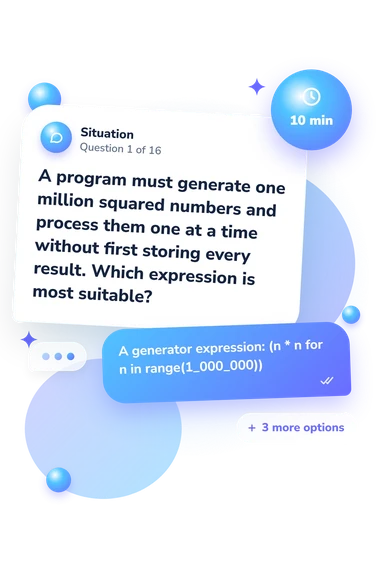
Example Questions From the Test
- The floating-point quotient -2.3333333333333335
- The floor-divided integer -3
- The integer -2 after truncation toward zero
- The positive integer 3
- #ИМЯ?
- #ИМЯ?
- #ИМЯ?
- #ИМЯ?
- yto
- yh
- pto
- yth
Python Quiz - Description and methodology of the test
People who want a practical check of their Python understanding can use this python quiz to see how well they reason through short programs and language rules. It suits learners reviewing core skills, preparing for further study, or deciding which topics need practice. Its online format supports quick, focused practice through a python online quiz.
What This Assessment Measures
Questions test prediction of Python behavior, construct choice, and language rules. This python coding quiz emphasizes practical reasoning over writing code.
Items sample object state, sorting, generators, operators, defaults, identity, slicing, exceptions, comprehensions, scope, aliases, and counting. They show how well learners trace values and recognize statement effects.
The displayed Python Knowledge scale runs from 0-16: Foundations to strengthen (0-6) marks topics to revisit; Developing knowledge (7-12) reflects common-task competence with some gaps; Strong knowledge (13-16) indicates reliable command of core concepts and short-code reasoning. The result is educational, not professional certification.
Areas represented are:
- Language behavior and control flow show how accurately you follow evaluation, conditions, exceptions, scope, and short-circuiting.
- Collections show how you use lists, dictionaries, tuples, sets, sorting, and comprehensions.
- Code reasoning shows how you trace object state, aliases, generators, slicing, and statement effects.
Methodology and Evidence Base
Each item provides four answer choices. Some ask for exact output; others identify a suitable construct or language rule. The format emphasizes recognition and code tracing rather than writing a full program. The format produces a compact result from selected answers.
The quiz reports one Python Knowledge result, interpreted through the displayed bands. No separate subscore is presented for programming topics, so the result is a checkpoint across sampled skills.
The questionnaire is conceptually consistent with the computing-knowledge work of Peteranetz and Albano (2020) and with research on prior programming knowledge and programming skill by Duran et al. (2019) and Bergersen et al. (2014). It is a separate educational quiz rather than an adaptation of those instruments.
It cannot capture every part of programming ability, because this python programming quiz samples selected knowledge rather than designing, debugging, or maintaining a system. Guessing, recent study, and current attention can affect performance, so missed concepts are revision targets rather than a complete profile.
- Markeya S. Peteranetz and Anthony D. Albano. Development and Evaluation of the Nebraska Assessment of Computing Knowledge. Frontiers in Computer Science 2 (2020), Article 11. 10.3389/fcomp.2020.00011
- Rodrigo Silva Duran, Jan-Mikael Rybicki, Arto Hellas, and Sanna Suoranta. Towards a Common Instrument for Measuring Prior Programming Knowledge. In Proceedings of the 2019 ACM Conference on Innovation and Technology in Computer Science Education, 443-449. ACM, 2019. 10.1145/3304221.3319755
- Gunnar R. Bergersen, Dag I. K. Sjøberg, and Tore Dybå. Construction and Validation of an Instrument for Measuring Programming Skill. IEEE Transactions on Software Engineering 40, no. 12 (2014): 1163-1184. 10.1109/TSE.2014.2348997