
Pythagorean Theorem Quiz
How the Scales are Structured
Who Usually Takes This Test?
See How You Compare
Below is a preview of how scores are typically distributed across each scale.
Example Questions From the Test
- It is the shortest side of the triangle.
- It is the side opposite the right angle.
- It is either side that forms the right angle.
- It is the side opposite the smallest angle.
- The sides of lengths 8 and 15
- The sides of lengths 8 and 17
- The sides of lengths 15 and 17
- Every pair of sides forms a right angle.
- 7 units
- 10 units
- 14 units
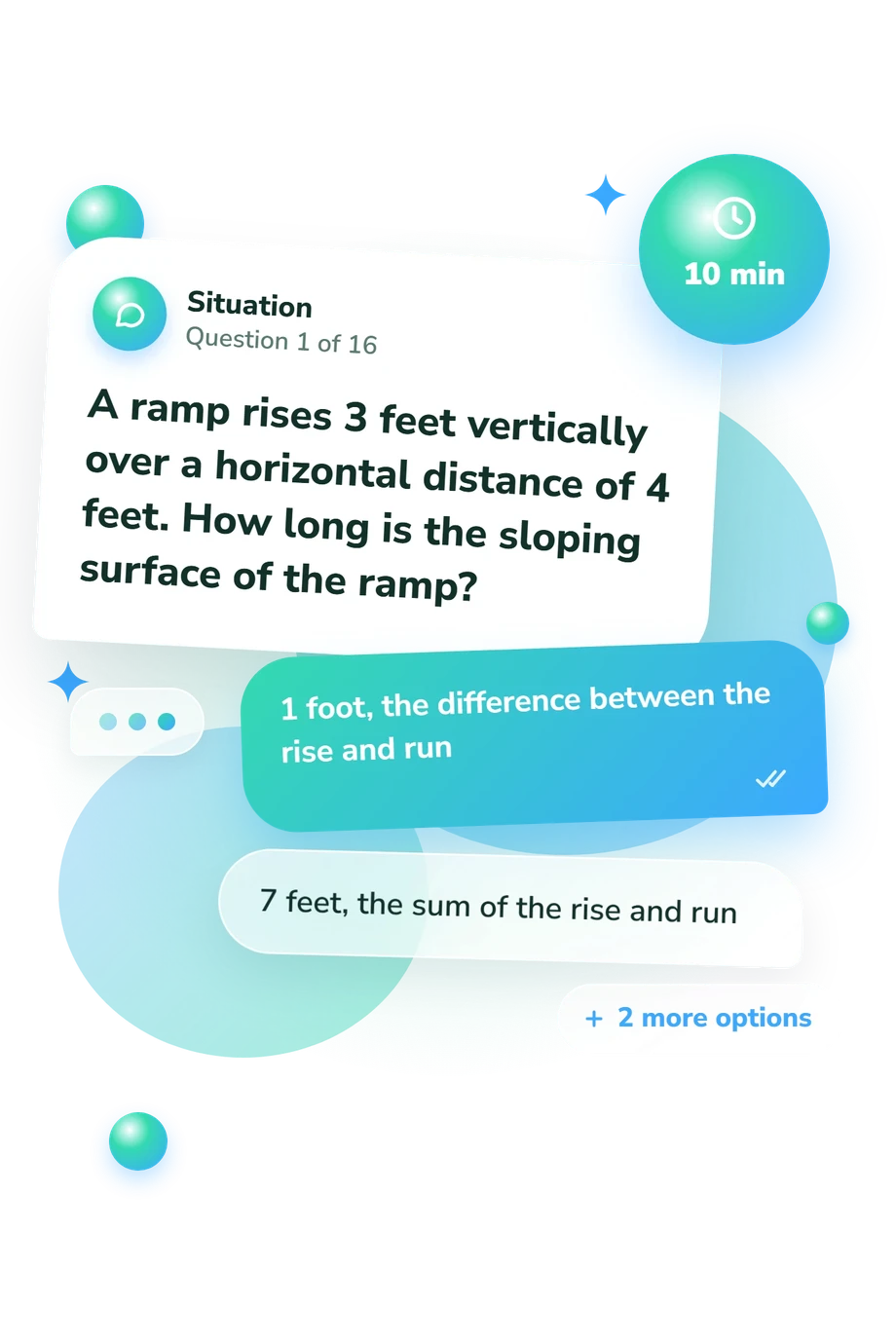
- The square root of 28 units
Pythagorean Theorem Quiz - Description and methodology of the test
Students, teachers, and independent learners can use this assessment to check whether core right-triangle ideas are secure before moving to more advanced geometry. The pythagorean theorem quiz focuses on recognizing the hypotenuse, selecting the correct relationship, and carrying calculations into coordinates and everyday measurements. For revision, a pythagorean quiz offers a focused snapshot of what to practise next.
What This Assessment Explores
These questions examine whether a learner can recognize a right triangle’s structure and apply the theorem rather than recall a formula. The pythagoras theorem quiz covers missing sides, exact radicals, converse reasoning, triangle classification, diagonals, coordinate distance, and measurements involving ramps, screens, and ladders. It suits learners reviewing the topic; the result shows how securely skills combine.
The catalogue reports one result scale, Pythagorean Theorem Knowledge (0-16). Its bands are Foundations to build (0-6), Developing knowledge (7-12), and Strong knowledge (13-16).
The tested skill groups are:
- Identifying the hypotenuse shows whether you can locate the side opposite the right angle.
- Using the equation shows whether you can find a missing side.
- Checking converse relationships shows whether you can classify triangles from side lengths.
- Applying geometry in context shows whether you can transfer the method to practical measurements.
Methodology and Evidence Base
Each item presents a mathematical situation or statement with four choices. Distractors reflect common errors, such as adding leg lengths instead of squaring them, choosing a side beside rather than opposite the right angle, or selecting an incorrect radical. This selected-response format assigns one point for each correct answer, so the result is an accumulated knowledge score rather than a weighted trait profile.
As a pythagorean theorem online quiz, this is a focused knowledge check, not a published adaptation of a standardized instrument. Its content is conceptually consistent with Lipowsky et al. (2009), whose work examined how geometry instruction relates to learners’ understanding of the theorem. Klieme, Pauli, and Reusser (2009) provide classroom-learning context, while Besser, Hagena, and Kleickmann (2024) show why subject-specific mathematical understanding matters alongside general instructional quality.
Use the result to choose practice: review side relationships, exact-form calculations, or transfer to unfamiliar contexts. This version has no published norms or demonstrated diagnostic standardization, so preparation, attention, guessing, and familiarity with the format can affect performance; the score is a snapshot of responses here, not a fixed measure of mathematical ability.
- Lipowsky, Frank; Rakoczy, Katrin; Pauli, Christine; Drollinger-Vetter, Barbara; Klieme, Eckhard; Reusser, Kurt. (2009). Quality of geometry instruction and its short-term impact on students' understanding of the Pythagorean Theorem. Learning and Instruction, 19(6), 527-537. 10.1016/j.learninstruc.2008.11.001
- Klieme, Eckhard; Pauli, Christine; Reusser, Kurt. (2009). The Pythagoras Study: Investigating Effects of Teaching and Learning in Swiss and German Mathematics Classrooms. In Tomáš Janík and Tina Seidel (Eds.), The Power of Video Studies in Investigating Teaching and Learning in the Classroom, pp. 137-160. Waxmann.
- Besser, Michael; Hagena, Maike; Kleickmann, Thilo. (2024). On the added value of considering effects of generic and subject-specific instructional quality on students’ achievements - an exploratory study on the example of implementing formative assessment in mathematics education. ZDM - Mathematics Education, 56, 815-830. 10.1007/s11858-024-01562-2
Updated: