
OSI Model Quiz
How the Scales are Structured
Who Usually Takes This Test?
See How You Compare
Below is a preview of how scores are typically distributed across each scale.
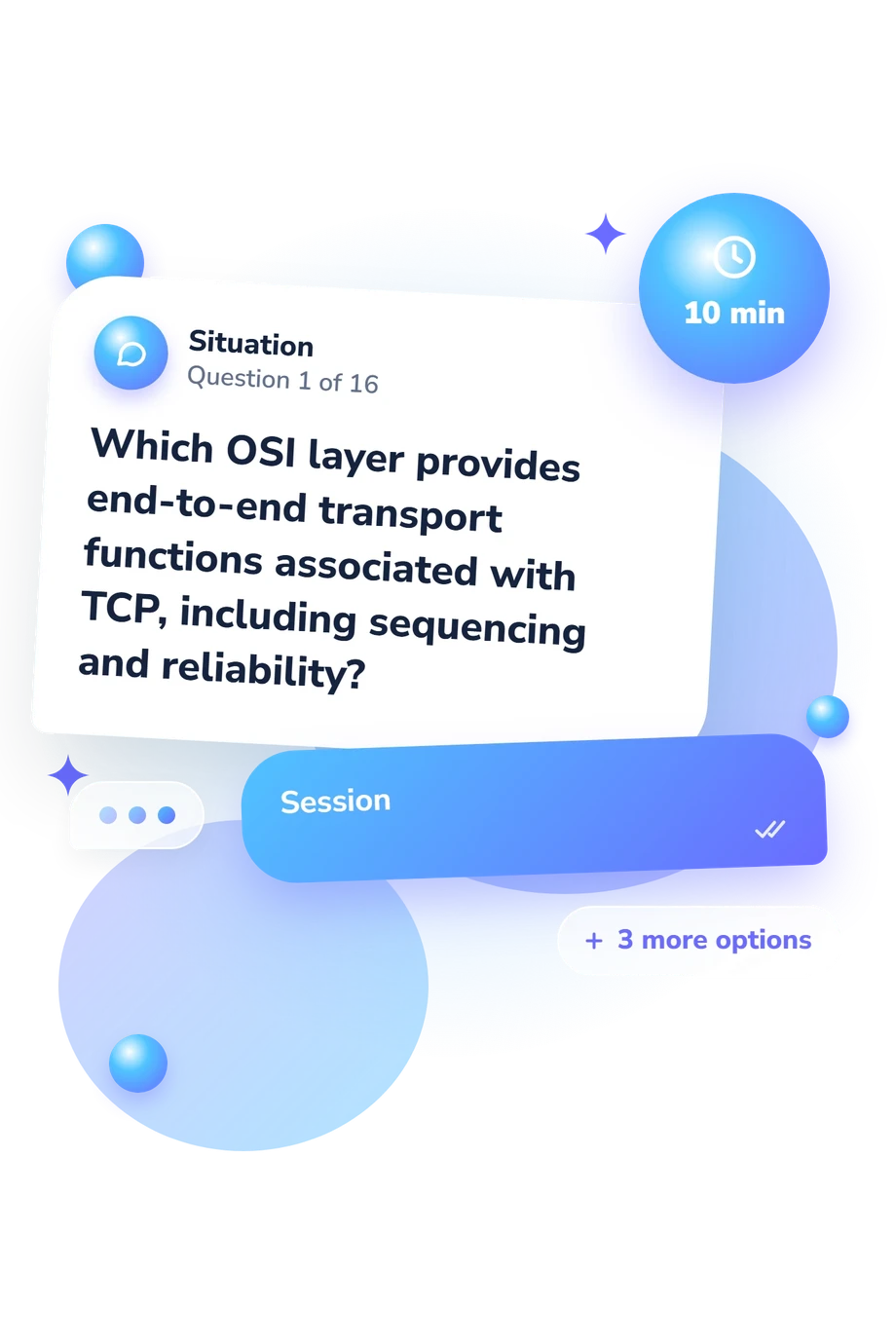
Example Questions From the Test
- Session
- Network
- Data Link
- Transport
- Presentation
- Session
- Transport
- Application
- Frame
- Packet
- Segment
- Bit
OSI Model Quiz - Description and methodology of the test
People preparing for networking study, technical interviews, or practical troubleshooting can use this OSI Model Quiz to check how clearly they can recall and apply the seven-layer model. It focuses on recognition and application rather than personal traits, so the result gives a compact indication of which concepts deserve another pass. This OSI quiz can also help learners and IT practitioners plan focused review.
What This Assessment Explores
Rather than measuring general intelligence, the questions test whether you can connect each OSI layer with its role in network communication. They cover layer identification, addresses and ports, protocol data units, encapsulation, device behavior, and fault symptoms.
The result brings those skills together in four areas:
- Layer roles show whether you distinguish the seven responsibilities.
- Protocol and data-unit knowledge shows how TCP, HTTP, frames, packets, segments, and bits fit the model.
- Device and addressing reasoning shows how hubs, switches, routers, MAC addresses, IP addresses, and ports map to layers.
- OSI Model Knowledge (0-16) places performance in Foundations (0-6), Developing (7-12), or Strong (13-16), reflecting how accurately you connect layers with practical networking concepts.
For someone taking this OSI model test, the band works as a revision guide: it identifies whether to reinforce fundamentals or practise integrated troubleshooting.
Methodology and Scientific Basis
Each item presents a networking question with four answer choices, with some questions using short scenarios. You select the layer, device, data unit, or sequence that best matches the operation, so the format tests conceptual recognition and application.
The displayed result condenses performance into a single knowledge score. Its bands classify performance on this questionnaire. Recent study, familiarity with wording, guessing, and momentary interpretation can all affect a self-administered response.
The conceptual anchor is the OSI Basic Reference Model (ISO/IEC 7498-1, 1994), which defines the seven-layer architecture and separation of network functions. The quiz is conceptually consistent with that model, Zimmermann’s 1980 architectural discussion, and Kurose and Ross (2021); it is not presented as an adaptation or validated reproduction of those publications. In this OSI networking quiz, the result can direct review toward layer roles, protocols and data units, devices and addressing, encapsulation sequences, and fault symptoms, helping you connect textbook distinctions with practical troubleshooting questions.
- ISO/IEC 7498-1:1994. Information technology - Open Systems Interconnection - Basic Reference Model: The Basic Model. International Organization for Standardization and International Electrotechnical Commission, 1994.
- Zimmermann, Hubert. “OSI Reference Model-The ISO Model of Architecture for Open Systems Interconnection.” IEEE Transactions on Communications, vol. 28, no. 4, 1980, pp. 425-432. 10.1109/TCOM.1980.1094702
- Kurose, James F., and Keith W. Ross. Computer Networking: A Top-Down Approach. 8th ed., Pearson, 2021. ISBN 9780136681557.
Updated: