
World Assumptions Scale (WAS) Test
How the Scales are Structured
Who Usually Takes This Test?
See How You Compare
Below is a preview of how scores are typically distributed across each scale.
Example Questions From the Test
- Strongly disagree
- Disagree
- Somewhat disagree
- Somewhat agree
- Agree
- Strongly agree
- Strongly disagree
- Disagree
- Somewhat disagree
- Generally agree
- Agree
- Strongly agree
- Strongly disagree
- Disagree
- Somewhat disagree
- Somewhat agree
- Agree
- Strongly agree
World Assumptions Scale (WAS) Test - Description and methodology of the test
Readers who want to examine the assumptions guiding trust, confidence, and personal agency may use the World Assumptions Scale (WAS) Test as a structured self-reflection exercise. A world assumptions questionnaire can help someone notice how they interpret relationships, setbacks, fairness, opportunity, and control. The profile describes current tendencies rather than fixed character traits, making it useful for personal reflection and discussion.
What This Assessment Explores
It examines beliefs about a benevolent world, fair outcomes, personal worth, luck, and control. Statements address trust, betrayal, deservingness, strengths, fortune, and difficult decisions. A worldview assessment maps assumptions about a safe or threatening world, fair or unfair life, a worthy or doubtful self, favorable or unfavorable luck, and strong or limited personal control.
The five displayed dimensions are:
- Benevolence of the World (0-10) shows trust and safety: Low trust 0-4; Moderate trust 5-7; High trust 8-10.
- Justice (0-10) shows belief in fair consequences: Low belief in justice 0-4; Moderate belief in justice 5-7; High belief in justice 8-10.
- Self-Image (0-10) shows self-worth and confidence: Low 0-3; Moderate 4-7; High 8-10.
- Luck (0-10) shows perceived good fortune: Low 0-3; Moderate 4-7; High 8-10.
- Control Beliefs (0-10) shows perceived influence over events: Low control 0-4; Moderate control 5-7; High control 8-10.
Methodology and Scientific Basis
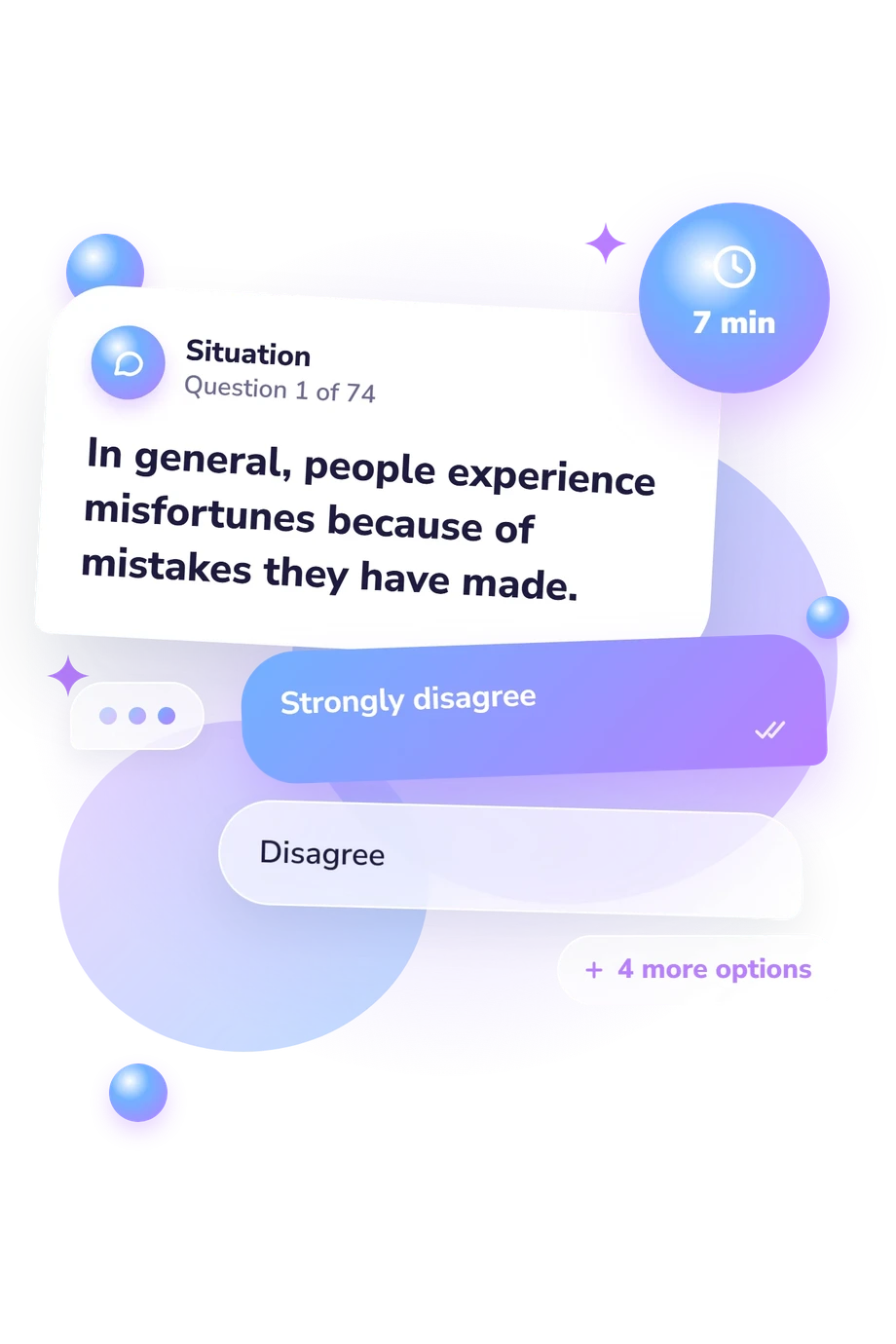
Each statement uses six ordered response choices ranging from strongly disagree to strongly agree. Statements range from favorable to unfavorable views, so answer from your usual perspective rather than an idealized self-description. Responses are grouped by dimension, and the profile summarizes each group.
The conceptual reference is Janoff-Bulman’s World Assumptions Scale, published in 1989, which treats benevolence, justice, self-worth, luck, and control as schemas shaping interpretation. This online world assumptions test is conceptually consistent with that work, not a direct reproduction or validated adaptation.
Research published by Elklit and colleagues in 2007, Kaler and colleagues in 2008, and van Bruggen and colleagues in 2018 examined factor structure, validity, and psychometric properties in published WAS versions. Their findings contextualize the constructs but do not establish population norms, reliability, or clinical cutoffs for this online questionnaire.
Interpret the profile alongside current mood, stress, history, and self-awareness. Scoring for this online questionnaire is not standardized, so the profile is descriptive and may reflect response style and present circumstances.
- Janoff-Bulman, R. (1989). Assumptive Worlds and the Stress of Traumatic Events: Applications of the Schema Construct. Social Cognition, 7(2), 113-136. 10.1521/soco.1989.7.2.113
- Elklit, A., Shevlin, M., Solomon, Z., & Dekel, R. (2007). Factor structure and concurrent validity of the World Assumptions Scale. Journal of Traumatic Stress, 20(3), 291-301. 10.1002/jts.20203
- Kaler, M. E., Frazier, P. A., Anders, S. L., Tashiro, T., Tomich, P., Tennen, H., & Park, C. (2008). Assessing the psychometric properties of the World Assumptions Scale. Journal of Traumatic Stress, 21(3), 326-332. 10.1002/jts.20343
- van Bruggen, V., ten Klooster, P. M., van der Aa, N., Smith, A. J. M., Westerhof, G. J., & Glas, G. (2018). Structural validity of the World Assumption Scale. Journal of Traumatic Stress, 31(6), 816-825. 10.1002/jts.22348
Updated: