
Red Flag Quiz

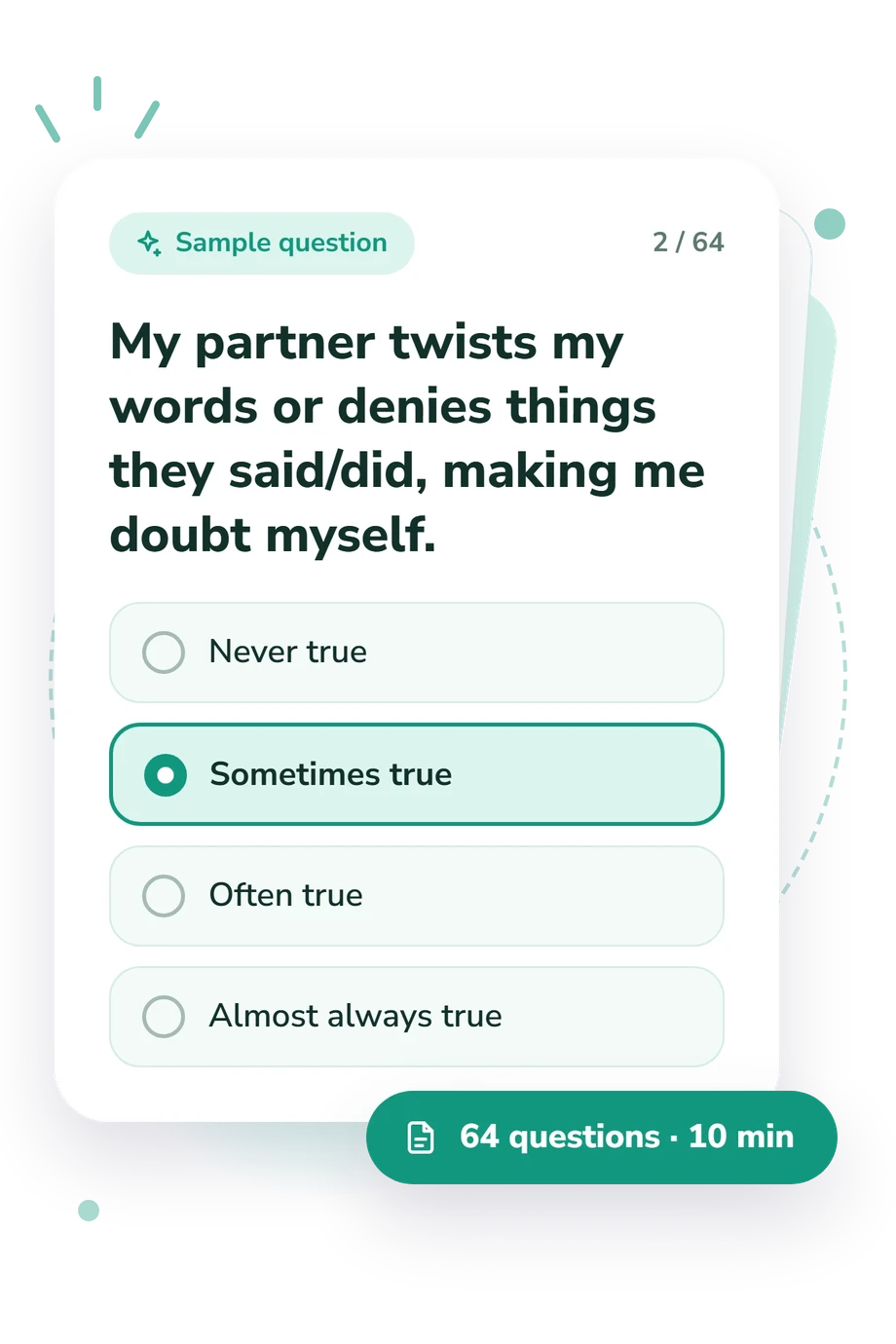
Wondering if something in your relationship feels "off"? Take this Red Flag Quiz to reflect on common warning signs like boundary issues, controlling behavior, jealousy, guilt-tripping, dishonesty, and communication breakdowns.
Start Online Test
Questions6410 minutes
Hi! My name is Freudly, i am an AI therapist, I will give you an interpretation of the test after you complete it.
08:30
March 25, 2026
March 25, 2026
Material has been updated
556 views
510 completions
63 likes
Verified by Daniel Hall
Psychologist with 25 years of experience
Share
Scale Explorer

How the Scales are Structured

example score
16/20
Boundary Respect (BR)
Measures how consistently personal limits (privacy, time, friendships, and physical/sexual boundaries) are recognized and respected in the relationship.
Boundary strain
Mixed respect
Strong respect
0NaNBoundary strain8NaNMixed respect15NaNStrong respect
A score of 16 suggests generally strong mutual boundary respect, with limits typically honored and only occasional pressure or overstepping.
example score
8/20
Communication Health (CH)
Measures how clear, respectful, and repair-oriented everyday and conflict communication tends to be in a relationship.
Strained
Mixed
Healthy
0NaNStrained10NaNMixed16NaNHealthy
A score of 8 falls in the Strained range, suggesting frequent communication breakdowns or ineffective conflict repair that can increase misunderstandings.
example score
24/40
Red Flag Severity (RFS)
Measures how often and how strongly relationship warning signs like control, jealousy, dishonesty, and boundary violations appear across scenarios.
Low concern
Moderate concern
High concern
013Low concern1426Moderate concern2740High concern
A score of 24 falls in the Moderate concern range, suggesting several recurring or noticeable red flags that may be worth exploring and naming clearly.
Start Online Test
just completed the test
DATA-BASED USER COHORTS

Who Usually Takes This Test?

Feeling Uneasy or Confused
44%OF USERS
People who sense something is off in their relationship and want clarity on whether certain behaviors are warning signs or just normal conflict.
After a Big Fight
33%OF USERS
People coming off a recent argument or tense period who want to reflect on patterns like blame, guilt, jealousy, or shutting down.
Rebuilding After Betrayal
23%OF USERS
People dealing with dishonesty, boundary breaks, or trust issues who want help sorting out what feels repairable versus concerning.
BASED ON AGGREGATED, ANONYMIZED DATA FROM TENS OF THOUSANDS OF FREUDLY USERS.
Benchmarking

See How You Compare

Once you complete the test, your results are compared with real-world data from people in your country.
Below is a preview of how scores are typically distributed across each scale.
Boundary Respect (BR)
Average
11.3
Normal range
7.614.9
min.
0
max.
20
Majority
This curve shows how scores are typically distributed.
Once you complete the test, your result will appear on the scale so you can see how you compare.
Communication Health (CH)
Average
12.5
Normal range
9.215.9
min.
0
max.
20
Majority
This curve shows how scores are typically distributed.
Once you complete the test, your result will appear on the scale so you can see how you compare.
Red Flag Severity (RFS)
Average
15
Normal range
9.820.3
min.
0
max.
40
Majority
This curve shows how scores are typically distributed.
Once you complete the test, your result will appear on the scale so you can see how you compare.
Featured On
CLEAR ANSWERS TO COMMON QUESTIONS

Frequently Asked Questions

What does this Red Flag Quiz measure?
It measures how consistently personal boundaries — privacy, time, friendships, and physical or sexual limits — are respected in a relationship, along with how clear, respectful, and repair-oriented communication tends to be during everyday interactions and conflict.
How do I know if what I'm noticing is a real red flag test result or just a rough patch?
Answer based on typical, recurring patterns rather than a single isolated event — one difficult conversation doesn't necessarily indicate a broader pattern, but a consistent theme across the quiz's realistic scenarios can help clarify whether specific behaviors are habitual rather than occasional.
How long does it take and how many items are included?
Completion typically takes about 10 minutes. The quiz contains 64 questions. Choose the option that best matches what happens most often in the relationship described, based on typical patterns rather than isolated events.
Is this Red Flag Quiz a diagnostic tool?
No. This is an educational self-reflection tool and does not diagnose mental health conditions or confirm abuse. Results describe patterns to watch and are best used as a starting point for further reflection or conversation, not a final determination.
What should I do if my results raise safety concerns?
Seek support from a trusted person or a qualified professional. If there is immediate danger, contact local emergency services right away. Recognizing a concerning pattern is an important first step, and you don't have to figure out next steps alone.
Can this red flag test help me understand a specific recent conflict?
Yes. Many people take it right after a disagreement about boundaries, jealousy, or communication to help understand whether the conflict reflects an isolated moment or part of a broader, recurring pattern in the relationship.
What should I do with my Red Flag Quiz results?
Use your results as a starting point for honest reflection about the relationship's patterns, and consider discussing concerning areas with a trusted friend, family member, or counselor. Results are most useful when paired with your own observations over time rather than treated as a single, final verdict.
WHAT THE TEST MEASURES
About This Assessment
Red Flag Quiz

This measure helps you reflect on common warning signs in a relationship, including boundary issues, controlling behavior, jealousy, guilt-tripping, dishonesty, and communication breakdowns. The Red Flag Quiz contains 64 questions and typically takes about 10 minutes to complete, providing a personalized summary of patterns to watch and possible next steps for support.

Why Take a Red Flag Quiz

Something can feel "off" in a relationship long before it's possible to name exactly why — a pattern of jealousy that seems excessive, a boundary that keeps getting pushed, communication that always seems to break down the same way. A structured red flag test helps sort through this vague unease by asking about specific, observable behaviors rather than relying on a general feeling that something isn't right.

This red flag quiz is especially useful because it separates two distinct things that often get blurred together: how consistently personal boundaries are respected, and how clear and repair-oriented communication tends to be during conflict. A relationship can struggle in one area while being genuinely solid in the other, and seeing these as separate patterns makes it much easier to understand what's actually happening.

This assessment is especially useful for people who feel uneasy about jealousy, monitoring, or pressure and want clarity on whether it reflects normal concern or a more concerning pattern, and for those who've just had a conflict and are trying to understand what it might signal about the relationship overall.

What the Assessment Measures

The quiz explores relationship patterns across two core dimensions:

  • Boundary respect — how consistently personal limits, including privacy, time, friendships, and physical or sexual boundaries, are recognized and respected in the relationship
  • Communication quality — how clear, respectful, and repair-oriented everyday and conflict communication tends to be

Results provide a personalized summary of patterns to watch, based on realistic relationship scenarios, along with suggested next steps for support.

Who This Assessment Is For

This Red Flag Quiz is appropriate for anyone wondering if something in their relationship feels "off." It's especially useful for people who feel uneasy about jealousy, monitoring, or pressure and want clarity on whether it's normal concern or a controlling pattern, and for those processing a recent conflict who want to understand what it might signal about the relationship as a whole.

How to Use This Assessment

This is an educational self-reflection tool and does not diagnose mental health conditions or confirm abuse. Choose the option that best matches what happens most often in the relationship described, answering based on typical patterns rather than isolated events. If results raise safety concerns, seek support from a trusted person or a qualified professional. If there is immediate danger, contact local emergency services.

Popular tests
Narcissistic Personality Inventory (NPI)
This self-report measure is used to assess narcissism as a personality trai…
Start Test
Yale-Brown Obsessive Compulsive Scale (Y-BOCS)
This measure is used to rapidly quantify the current severity of obsessive…
Start Test
CRAFFT Screening Test (CRAFFT 2.1)
This brief screening measure is designed to identify potential alcohol and…
Start Test
Patient Health Questionnaire-9 (PHQ-9)
This measure is commonly used to quickly screen for the presence and severi…
Start Test
Maslach Burnout Inventory (MBI)
This self-report measure is used to assess occupational burnout symptoms in…
Start Test
Adolescent Anxiety Questionnaire
This measure is designed to support a brief appraisal of anxiety symptoms a…
Start Test
Emotional Creativity Inventory (ECI)
This self-report measure assesses individual differences in the originality…
Start Test
Horne–Ostberg Morningness–Eveningness Questionnaire (MEQ)
Circadian preferences influence typical patterns of alertness and sleep tim…
Start Test
Ambivalent Sexism Inventory (ASI)
This measure is designed to assess attitudes toward women, including both o…
Start Test
Internalized Misogyny Scale (IMS)
This measure is designed to assess internalized negative beliefs and stereo…
Start Test
Perceived Stress Scale (PSS-10)
This self-report measure assesses the degree to which individuals appraise…
Start Test
Impulsive Behavior Scale (SUPPS-P)
Impulsivity is a multidimensional construct that is often assessed with bri…
Start Test
Clinical Institute Withdrawal Assessment for Alcohol, Revised (CIWA-Ar)
This rating scale is used to rapidly assess the severity of alcohol withdra…
Start Test
Positive and Negative Affect Schedule (PANAS)
This measure provides a brief self-report assessment of current or typical…
Start Test
Light Triad Scale (LTS)
This self-report measure assesses prosocial personality tendencies and orie…
Start Test
Suicidal Ideation Scale
In clinical settings, the Suicidal Ideation Scale is used to structure an i…
Start Test
Body Dysmorphic Disorder Scale (BDD-D)
This brief self-report measure is designed to screen for and quantify distr…
Start Test
Beck Anxiety Inventory (BAI)
This measure is a brief self-report inventory used to screen for anxiety sy…
Start Test
Differential Test of Perfectionism
This instrument is used to screen for perfectionism-related attitudes and t…
Start Test
Locus of Control Scale
This measure assesses generalized expectancies regarding the degree to whic…
Start Test
New Apathy Scale
This brief self-report measure is used to screen for apathy-related symptom…
Start Test
Perth Alexithymia Questionnaire (PAQ)
This measure assesses individual differences in alexithymia, including diff…
Start Test
Social Intelligence Scale
This brief self-report measure is designed to support rapid screening of in…
Start Test
Fear Test
This measure is designed to evaluate individual differences in fear-related…
Start Test
Neuroticism Level Scale
The measure is intended for brief screening of an individual’s propensity t…
Start Test
Aggressiveness Indicators Screening Questionnaire
This screening tool is designed to quickly identify behavioral indicators a…
Start Test
Comments
Leave a Comment