
5000 Character Quiz
How the Scales are Structured
Who Usually Takes This Test?
See How You Compare
Below is a preview of how scores are typically distributed across each scale.
Example Questions From the Test
- Strongly disagree
- Disagree
- Not sure
- Agree
- Strongly disagree
- Disagree
- Not sure
- Agree
- Strongly disagree
- Disagree
- Not sure
- Agree
5000 Character Quiz - Description and methodology of the test
For readers who enjoy comparing themselves with fictional figures, this assessment turns a vague sense of resemblance into a structured profile. The 5000 character quiz connects responses about motives, values, humor, and social behavior with a leading archetypal match. Readers can use this character personality test to explore whether their result is sharply focused or spread across several plausible types.
What This Assessment Explores
The items examine how consistently one archetype fits a person's motives, values, group role, stress behavior, self-description, and social style. Other statements focus on humor preferences such as irony, absurdity, banter, self-directed humor, and darker jokes. This character test uses these themes to distinguish a concentrated resemblance from a blended profile.
The displayed dimensions are:
- Archetype Clarity (0-20) measures whether results cluster around one archetype or spread across many: Diffuse (0-7), Mixed (8-14), or Distinct (15-20).
- Humor Style Match (0-20) measures alignment between your humor preferences and the humor signatures of your closest matches: Mixed Match (0-7), Moderate Match (8-14), or Strong Match (15-20).
- Match Strength (0-100) measures overall similarity to the top match across traits, values, humor, and social style: Low Match (0-33), Moderate Match (34-66), or High Match (67-100).
Methodology and Evidence Base
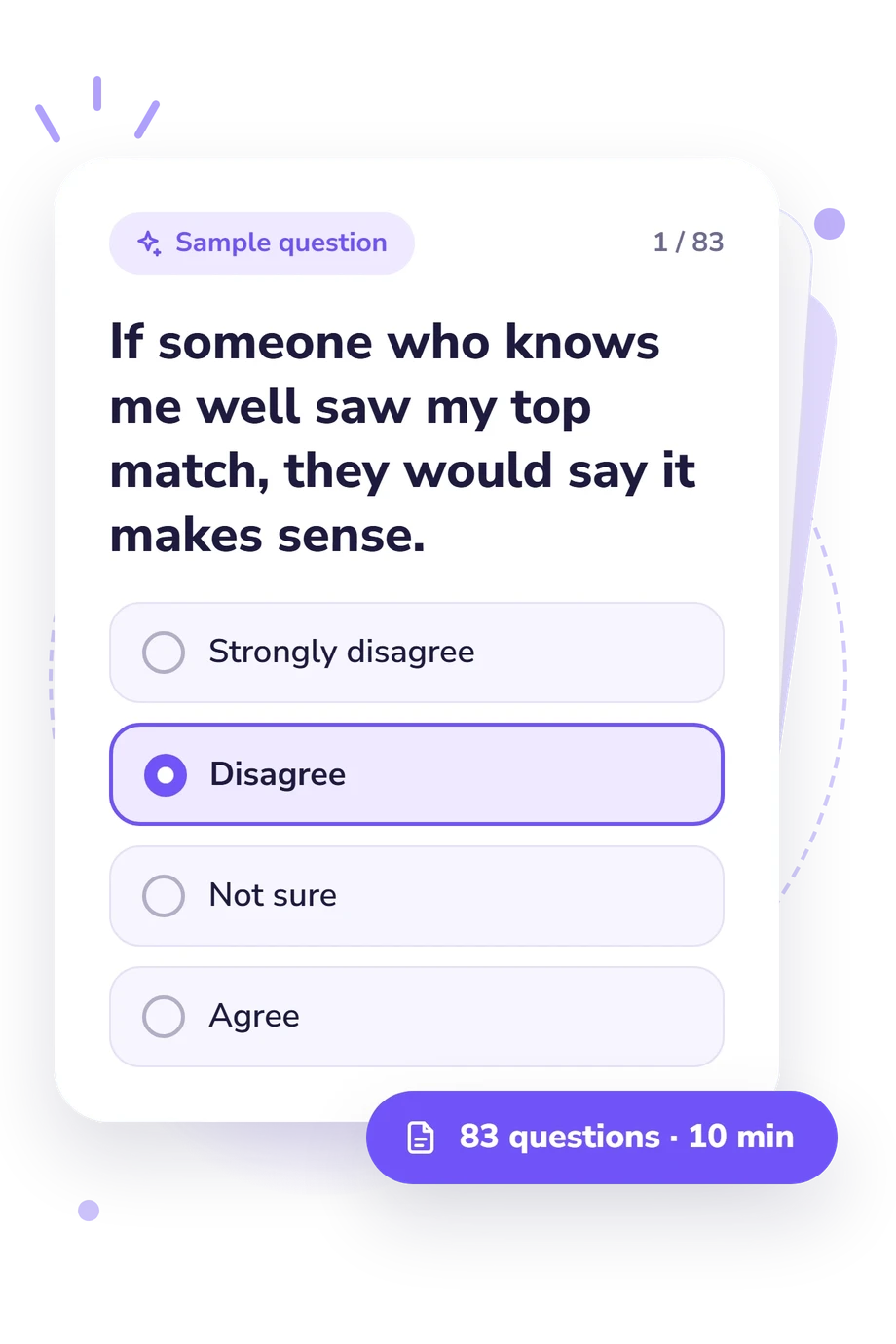
The sampled statements use four response options: Strongly disagree, Disagree, Not sure, and Agree. Items ask about recognition of the leading match, recurring group roles, reactions under stress, identity clarity, and humor preferences. This self-report format captures how the respondent interprets these situations.
The result reports three displayed dimensions with supplied score bands; the ranges alone do not establish how individual responses are weighted, so no item-level formula should be inferred.
The archetype focus can be compared conceptually with Faber and Mayer's research on resonance to fictional types. Martin and colleagues' Humor Styles Questionnaire is a related humor self-report instrument, not this questionnaire's scoring framework. These comparisons do not establish that this questionnaire is a standardized adaptation.
Used as a what character are you quiz, this assessment describes fit within the model rather than a permanent identity. The displayed bands are descriptive rather than norm-referenced, so current mood, self-awareness, and identification with a preferred fictional figure can affect the profile.
- Jorgenson, Eric. Development of the Statistical "Which Character" Personality Quiz. Open-Source Psychometrics Project, 2020; updated 2026.
- Faber, Michael A., and John D. Mayer. "Resonance to archetypes in media: There’s some accounting for taste." Journal of Research in Personality, vol. 43, no. 3, 2009, pp. 307-322. 10.1016/j.jrp.2008.11.003
- Martin, Rod A., Patricia Puhlik-Doris, Gwen Larsen, Jeanette Gray, and Kelly Weir. "Individual differences in uses of humor and their relation to psychological well-being: Development of the Humor Styles Questionnaire." Journal of Research in Personality, vol. 37, no. 1, 2003, pp. 48-75. 10.1016/S0092-6566(02)00534-2
Updated: