
Aromantic Test

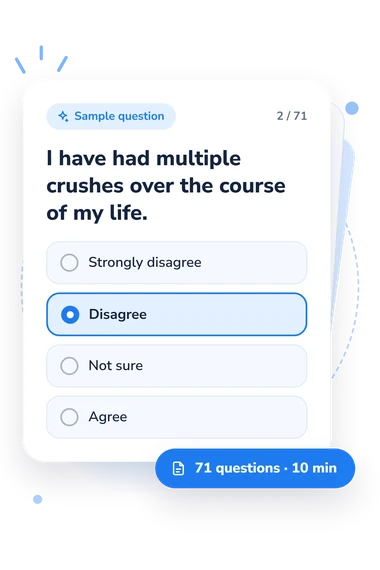
Explore whether you may be aromantic or on the spectrum. Take this Aromantic Test to reflect on how you experience romantic attraction, dating, and relationships, with free, private, supportive results and prompts for boundaries and communication.
Start Online Test
Questions7110 minutes
Hi! My name is Freudly, i am an AI therapist, I will give you an interpretation of the test after you complete it.
08:30
March 25, 2026
March 25, 2026
Material has been updated
806 views
864 completions
5 likes
Verified by Daniel Hall
Psychologist with 25 years of experience
Share
Scale Explorer

How the Scales are Structured

example score
7/20
Conditional Romantic Attraction (CRA)
Assesses how strongly romantic attraction tends to depend on specific conditions like trust, time, or a deep emotional bond.
Less conditional
Somewhat conditional
Highly conditional
06Less conditional713Somewhat conditional1420Highly conditional
A score of 7 suggests your romantic attraction may show up sometimes under certain conditions, but is not exclusively tied to rare or highly specific circumstances.
example score
20/30
Romance/Dating Interest (RI)
Measures your interest in dating and romance-coded activities and relationship structures.
Low interest
Moderate interest
High interest
010Low interest1120Moderate interest2130High interest
A score of 20 suggests a moderate interest in dating and romance-coded activities, with some openness to romantic relationship structures depending on context and preference.
example score
3/40
Romantic Attraction Intensity (RAI)
Measures how frequently and strongly you experience romantic attraction such as crushes, falling in love, or wanting romantic bonding.
Low attraction
Moderate attraction
High attraction
0NaNLow attraction14NaNModerate attraction27NaNHigh attraction
A score of 3 falls in the Low attraction range, suggesting you rarely or weakly experience romantic attraction and may lean aromantic in how you relate to romance.
Start Online Test
just completed the test
DATA-BASED USER COHORTS

Who Usually Takes This Test?

Confused About Romance
41%OF USERS
People who don’t relate to crushes or romantic feelings like others do and want language for their experience.
Questioning After Dating
34%OF USERS
People who feel bored, uneasy, or performative in dating and are exploring whether they want romance at all.
Arospec Identity Explorers
25%OF USERS
People familiar with terms like aromantic, grayromantic, or demiromantic who want a private check-in and reflection prompts.
BASED ON AGGREGATED, ANONYMIZED DATA FROM TENS OF THOUSANDS OF FREUDLY USERS.
Benchmarking

See How You Compare

Once you complete the test, your results are compared with real-world data from people in your country.
Below is a preview of how scores are typically distributed across each scale.
Conditional Romantic Attraction (CRA)
Average
5.8
Normal range
2.98.7
min.
0
max.
20
Majority
This curve shows how scores are typically distributed.
Once you complete the test, your result will appear on the scale so you can see how you compare.
Romance/Dating Interest (RI)
Average
19.3
Normal range
14.224.4
min.
0
max.
30
Majority
This curve shows how scores are typically distributed.
Once you complete the test, your result will appear on the scale so you can see how you compare.
Romantic Attraction Intensity (RAI)
Average
15.1
Normal range
9.420.7
min.
0
max.
40
Majority
This curve shows how scores are typically distributed.
Once you complete the test, your result will appear on the scale so you can see how you compare.
Featured On
CLEAR ANSWERS TO COMMON QUESTIONS

Frequently Asked Questions

What does this Aromantic Test measure?
It measures how strongly romantic attraction depends on specific conditions like trust or time (sometimes described as demiromantic), and your general interest in dating and romance-coded activities and relationship structures. Results describe possible alignment with aromantic-spectrum experiences.
Can this aromantic quiz actually tell me if I'm aromantic?
No quiz can determine your romantic orientation with certainty — that's something only you can define for yourself, often over time. This am I aromantic quiz is designed to help you reflect on your own patterns of romantic attraction, giving you language and structure rather than a final label.
Is this the same as an aroace test?
Not exactly — aroace combines aromantic (little to no romantic attraction) and asexual (little to no sexual attraction), which are two separate dimensions. This test focuses specifically on the romantic side. If you're also curious about the asexual dimension, a dedicated asexual spectrum quiz covers that separately.
How long does it take and is it private?
Completion takes about 10 minutes. Results are free and private, with prompts for boundaries and communication to support further reflection at your own pace.
What is the difference between aromantic, grayromantic, and demiromantic?
Aromantic generally describes experiencing little to no romantic attraction. Grayromantic describes experiencing romantic attraction rarely or with low intensity. Demiromantic describes experiencing romantic attraction only after forming a strong emotional connection. This aromantic test explores which of these descriptions best fits your own reported patterns.
Is this Aromantic Test a diagnostic tool?
No. This is a private self-reflection tool, not a diagnostic or clinical instrument. Results describe possible alignment with aromantic-spectrum experiences and are intended as a starting point for reflection, not a definitive answer about your identity.
What if I don't want romance but still want close relationships?
That's a common and valid experience. Many aromantic people still value deep relationships, including friendships, family bonds, and queerplatonic partnerships, which can be just as meaningful as romantic connections. This test can help clarify what kind of connection actually feels right for you, separate from romantic expectations.
WHAT THE TEST MEASURES
About This Assessment
Aromantic Test
identity
sexuality

This measure assesses patterns related to romantic attraction, romance-coded feelings, interest in dating, and preferred relationship structures. The Aromantic Test includes questions taking about 10 minutes to complete. Results describe possible alignment with aromantic-spectrum experiences.

Why Take an Aromantic Test

Many people spend time quietly wondering whether they experience romantic attraction the way others describe it — or whether crushes, dating, and romance-coded milestones just don't resonate the way they seem to for other people. A structured aromantic test gives shape to that uncertainty, asking about specific, recognizable patterns rather than leaving the question as a vague, hard-to-articulate feeling.

This am I aromantic quiz doesn't claim to tell you who you are — no quiz can do that, since romantic orientation is self-defined and can take time to fully understand. What it can do is help organize scattered feelings into clearer patterns: whether romantic attraction depends heavily on specific conditions like deep trust or time (sometimes described as demiromantic), how much genuine interest you feel in dating and romance-coded activities, and how these patterns compare to what's often described as typical romantic experience.

This assessment is especially useful for people questioning whether aromantic, grayromantic, demiromantic, or another term fits them, and who want language and reflection prompts without pressure to decide anything right now.

What the Assessment Measures

The quiz asks about several dimensions of romantic experience:

  • Conditional romantic attraction — how strongly romantic attraction tends to depend on specific conditions like trust, time, or a deep emotional bond
  • Interest in dating and romance — your interest in dating and romance-coded activities and relationship structures

Results describe possible alignment with aromantic-spectrum experiences, offering language and reflection prompts for boundaries and communication rather than a definitive answer about your identity.

Who This Assessment Is For

This Aromantic Test is appropriate for people who don't relate to crushes or romantic feelings like others seem to and want language for their experience, those who feel bored, uneasy, or performative in dating and are exploring whether they want romance at all, and people already familiar with terms like aromantic, grayromantic, or demiromantic who want a private check-in and reflection prompts.

How to Use This Assessment

This is a private self-reflection tool, not a diagnostic or clinical instrument — no quiz can determine anyone's romantic orientation with certainty. Romantic orientation is self-defined and can take time to fully understand, so use your results as a starting point for reflection rather than a final label.

Popular tests
Narcissistic Personality Inventory (NPI)
This self-report measure is used to assess narcissism as a personality trai…
Start Test
Yale-Brown Obsessive Compulsive Scale (Y-BOCS)
This measure is used to rapidly quantify the current severity of obsessive…
Start Test
CRAFFT Screening Test (CRAFFT 2.1)
This brief screening measure is designed to identify potential alcohol and…
Start Test
Patient Health Questionnaire-9 (PHQ-9)
This measure is commonly used to quickly screen for the presence and severi…
Start Test
Maslach Burnout Inventory (MBI)
This self-report measure is used to assess occupational burnout symptoms in…
Start Test
Adolescent Anxiety Questionnaire
This measure is designed to support a brief appraisal of anxiety symptoms a…
Start Test
Emotional Creativity Inventory (ECI)
This self-report measure assesses individual differences in the originality…
Start Test
Horne–Ostberg Morningness–Eveningness Questionnaire (MEQ)
Circadian preferences influence typical patterns of alertness and sleep tim…
Start Test
Ambivalent Sexism Inventory (ASI)
This measure is designed to assess attitudes toward women, including both o…
Start Test
Internalized Misogyny Scale (IMS)
This measure is designed to assess internalized negative beliefs and stereo…
Start Test
Perceived Stress Scale (PSS-10)
This self-report measure assesses the degree to which individuals appraise…
Start Test
Impulsive Behavior Scale (SUPPS-P)
Impulsivity is a multidimensional construct that is often assessed with bri…
Start Test
Clinical Institute Withdrawal Assessment for Alcohol, Revised (CIWA-Ar)
This rating scale is used to rapidly assess the severity of alcohol withdra…
Start Test
Positive and Negative Affect Schedule (PANAS)
This measure provides a brief self-report assessment of current or typical…
Start Test
Light Triad Scale (LTS)
This self-report measure assesses prosocial personality tendencies and orie…
Start Test
Suicidal Ideation Scale
In clinical settings, the Suicidal Ideation Scale is used to structure an i…
Start Test
Body Dysmorphic Disorder Scale (BDD-D)
This brief self-report measure is designed to screen for and quantify distr…
Start Test
Beck Anxiety Inventory (BAI)
This measure is a brief self-report inventory used to screen for anxiety sy…
Start Test
Differential Test of Perfectionism
This instrument is used to screen for perfectionism-related attitudes and t…
Start Test
Locus of Control Scale
This measure assesses generalized expectancies regarding the degree to whic…
Start Test
New Apathy Scale
This brief self-report measure is used to screen for apathy-related symptom…
Start Test
Perth Alexithymia Questionnaire (PAQ)
This measure assesses individual differences in alexithymia, including diff…
Start Test
Social Intelligence Scale
This brief self-report measure is designed to support rapid screening of in…
Start Test
Fear Test
This measure is designed to evaluate individual differences in fear-related…
Start Test
Neuroticism Level Scale
The measure is intended for brief screening of an individual’s propensity t…
Start Test
Aggressiveness Indicators Screening Questionnaire
This screening tool is designed to quickly identify behavioral indicators a…
Start Test
Comments
Leave a Comment