
Chakra Test

Understand how balanced your seven chakras feel in about 10 minutes. Take this Chakra Test to get a clear profile of strengths and blocks plus practical tips like journaling, breathwork, and mindful movement.
Start Online Test
Questions6710 minutes
Hi! My name is Freudly, i am an AI therapist, I will give you an interpretation of the test after you complete it.
08:30
March 25, 2026
March 25, 2026
Material has been updated
166 views
66 completions
42 likes
Verified by Daniel Hall
Psychologist with 25 years of experience
Share
Scale Explorer

How the Scales are Structured

example score
14/40
Blockage & Stress Signals (B&SS)
Measures how often and how strongly you notice stress cues and “blockage” experiences like tension, rumination, avoidance, or feeling stuck.
Low signals
Moderate signals
High signals
013Low signals1426Moderate signals2740High signals
A score of 14 falls in the Moderate signals range, suggesting you notice some recurring stress or “stuck” patterns, but they may be manageable and not constant.
example score
77/100
Chakra Balance Index (CBI)
Measures your overall self-reported sense of balance and alignment across the seven chakra themes.
Lower Balance
Moderate Balance
Higher Balance
049Lower Balance5074Moderate Balance75100Higher Balance
A score of 77 falls in the Higher Balance range, suggesting you generally feel steady and supported across most chakra-related life areas with only mild pockets of perceived imbalance.
example score
31/40
Energy & Vitality (E&V)
Measures your day-to-day sense of energy, motivation, and emotional buoyancy, including resilience and feeling in flow.
Low Vitality
Steady Vitality
High Vitality
0NaNLow Vitality20NaNSteady Vitality30NaNHigh Vitality
A score of 31 falls in the High Vitality range, suggesting you generally feel energized, motivated, and emotionally resilient right now.
Start Online Test
just completed the test
DATA-BASED USER COHORTS

Who Usually Takes This Test?

Stressed Wellness Seekers
41%OF USERS
People feeling overwhelmed or emotionally drained use it to pinpoint where they feel stuck and get gentle, practical ways to restore balance.
Yoga and Meditation Regulars
34%OF USERS
Those with an existing mind-body practice take it to reflect on their energy, deepen self-awareness, and focus their routines with intention.
Curious Spiritual Explorers
25%OF USERS
People new to chakra concepts take it to learn the basics, see which themes resonate, and try simple exercises for self-exploration.
BASED ON AGGREGATED, ANONYMIZED DATA FROM TENS OF THOUSANDS OF FREUDLY USERS.
Benchmarking

See How You Compare

Once you complete the test, your results are compared with real-world data from people in your country.
Below is a preview of how scores are typically distributed across each scale.
Blockage & Stress Signals (B&SS)
Average
16.4
Normal range
10.722.1
min.
0
max.
40
Majority
This curve shows how scores are typically distributed.
Once you complete the test, your result will appear on the scale so you can see how you compare.
Chakra Balance Index (CBI)
Average
39
Normal range
25.252.9
min.
0
max.
100
Majority
This curve shows how scores are typically distributed.
Once you complete the test, your result will appear on the scale so you can see how you compare.
Energy & Vitality (E&V)
Average
18.1
Normal range
12.423.8
min.
0
max.
40
Majority
This curve shows how scores are typically distributed.
Once you complete the test, your result will appear on the scale so you can see how you compare.
Featured On
CLEAR ANSWERS TO COMMON QUESTIONS

Frequently Asked Questions

What does this Chakra Test measure?
It screens for perceived balance across seven common chakra themes: grounding, creativity, confidence, love, expression, intuition, and meaning, along with stress and blockage signals and overall energy and vitality.
Which chakra is blocked? Can this quiz tell me?
This which chakra is blocked quiz identifies relative strengths and possible imbalance areas across all seven chakra themes based on your responses, rather than pointing to one single 'blocked' chakra in isolation.
How long does it take and how many items are included?
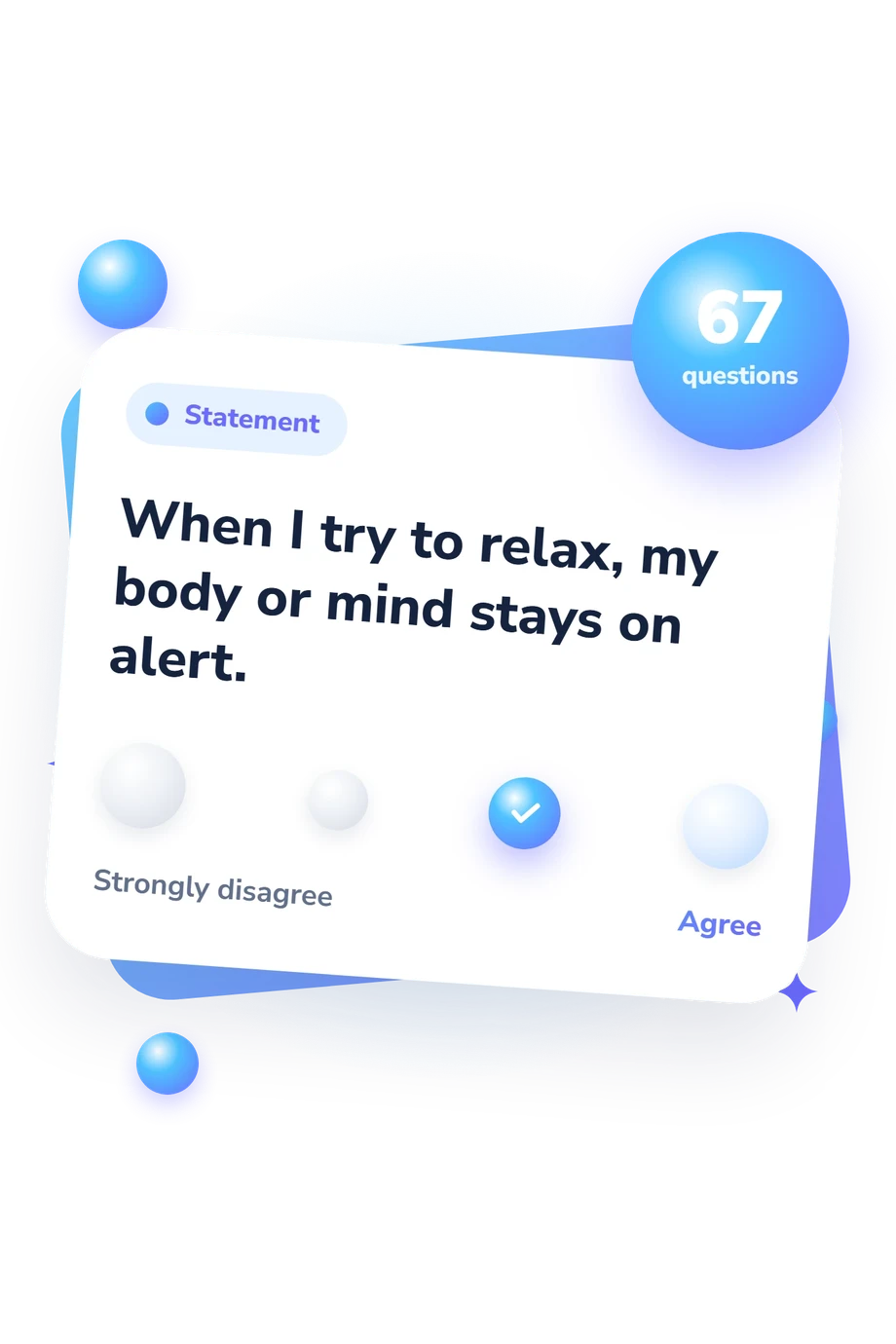
Estimated completion time is about 10 minutes. The questionnaire includes 67 items. Select the response that best matches typical experiences over the recent period, rather than an unusual day.
How are chakra quiz results presented?
Results summarize relative strengths and possible imbalance areas for each chakra theme. The report includes practical support ideas such as journaling prompts, breathing, movement, or mindfulness.
Is this Chakra Test a diagnostic or clinical instrument?
No; it is not designed to diagnose or treat any mental or medical condition. For urgent concerns or significant distress, seek evaluation from a qualified health professional.
Who typically takes this chakra quiz?
Stressed wellness seekers wanting to pinpoint where they feel stuck, yoga and meditation regulars deepening self-awareness, and curious spiritual explorers new to chakra concepts who want to learn the basics.
How should I use my Chakra Test results?
Use the practical support ideas included with your results — like journaling, breathwork, or mindful movement — to focus on the specific chakra themes where you noticed the most imbalance or stress signals, rather than trying to address everything at once.
WHAT THE TEST MEASURES
About This Assessment
Chakra Test

Explore how balanced your seven chakras may feel right now with a reflective, self-report quiz inspired by common chakra themes: grounding, creativity, confidence, love, expression, intuition, and meaning. You'll answer questions about mood, habits, stress signals, and where you feel "stuck" or energized.

Why Take a Chakra Test

The seven chakras offer a structured, symbolic framework for reflecting on different areas of life — physical security, creativity, personal power, connection, communication, insight, and meaning. This chakra quiz translates that framework into concrete self-report questions about stress signals, energy levels, and everyday habits, giving language to feelings of being "stuck" or imbalanced that can otherwise feel vague.

This test is especially useful because it separates general stress and blockage signals from an overall sense of chakra balance and day-to-day energy and vitality — someone might feel generally energized while still noticing specific stress patterns in one or two areas, or the reverse. Seeing these as distinct measures gives a more nuanced picture than a single overall wellness score.

This assessment is especially popular with stressed wellness seekers wanting to pinpoint where they feel stuck and find gentle, practical ways to restore balance, yoga and meditation regulars deepening self-awareness and focusing their practice, and curious spiritual explorers new to chakra concepts who want to learn the basics and try simple exercises.

What the Assessment Measures

The quiz explores your patterns across three core dimensions:

  • Blockage and stress signals — how often and how strongly you notice stress cues and "blockage" experiences like tension, rumination, avoidance, or feeling stuck
  • Chakra balance index — your overall self-reported sense of balance and alignment across the seven chakra themes
  • Energy and vitality — your day-to-day sense of energy, motivation, and emotional buoyancy, including resilience and feeling in flow

Results summarize relative strengths and possible imbalance areas for each chakra theme, along with practical support ideas such as journaling prompts, breathing, movement, or mindfulness.

Who This Assessment Is For

This Chakra Test is appropriate for anyone curious how balanced their seven chakras feel right now. It's especially popular with stressed wellness seekers wanting practical ways to restore balance, yoga and meditation regulars deepening self-awareness, and curious spiritual explorers new to chakra concepts.

How to Use This Assessment

Select the response that best matches typical experiences over the recent period, rather than an unusual day. This is not designed to diagnose or treat any mental or medical condition. For urgent concerns or significant distress, seek evaluation from a qualified health professional.

Popular tests
Narcissistic Personality Inventory (NPI)
This self-report measure is used to assess narcissism as a personality trai…
Start Test
Yale-Brown Obsessive Compulsive Scale (Y-BOCS)
This measure is used to rapidly quantify the current severity of obsessive…
Start Test
CRAFFT Screening Test (CRAFFT 2.1)
This brief screening measure is designed to identify potential alcohol and…
Start Test
Patient Health Questionnaire-9 (PHQ-9)
This measure is commonly used to quickly screen for the presence and severi…
Start Test
Maslach Burnout Inventory (MBI)
This self-report measure is used to assess occupational burnout symptoms in…
Start Test
Adolescent Anxiety Questionnaire
This measure is designed to support a brief appraisal of anxiety symptoms a…
Start Test
Emotional Creativity Inventory (ECI)
This self-report measure assesses individual differences in the originality…
Start Test
Horne–Ostberg Morningness–Eveningness Questionnaire (MEQ)
Circadian preferences influence typical patterns of alertness and sleep tim…
Start Test
Ambivalent Sexism Inventory (ASI)
This measure is designed to assess attitudes toward women, including both o…
Start Test
Internalized Misogyny Scale (IMS)
This measure is designed to assess internalized negative beliefs and stereo…
Start Test
Perceived Stress Scale (PSS-10)
This self-report measure assesses the degree to which individuals appraise…
Start Test
Impulsive Behavior Scale (SUPPS-P)
Impulsivity is a multidimensional construct that is often assessed with bri…
Start Test
Clinical Institute Withdrawal Assessment for Alcohol, Revised (CIWA-Ar)
This rating scale is used to rapidly assess the severity of alcohol withdra…
Start Test
Positive and Negative Affect Schedule (PANAS)
This measure provides a brief self-report assessment of current or typical…
Start Test
Light Triad Scale (LTS)
This self-report measure assesses prosocial personality tendencies and orie…
Start Test
Suicidal Ideation Scale
In clinical settings, the Suicidal Ideation Scale is used to structure an i…
Start Test
Body Dysmorphic Disorder Scale (BDD-D)
This brief self-report measure is designed to screen for and quantify distr…
Start Test
Beck Anxiety Inventory (BAI)
This measure is a brief self-report inventory used to screen for anxiety sy…
Start Test
Differential Test of Perfectionism
This instrument is used to screen for perfectionism-related attitudes and t…
Start Test
Locus of Control Scale
This measure assesses generalized expectancies regarding the degree to whic…
Start Test
New Apathy Scale
This brief self-report measure is used to screen for apathy-related symptom…
Start Test
Perth Alexithymia Questionnaire (PAQ)
This measure assesses individual differences in alexithymia, including diff…
Start Test
Social Intelligence Scale
This brief self-report measure is designed to support rapid screening of in…
Start Test
Fear Test
This measure is designed to evaluate individual differences in fear-related…
Start Test
Neuroticism Level Scale
The measure is intended for brief screening of an individual’s propensity t…
Start Test
Aggressiveness Indicators Screening Questionnaire
This screening tool is designed to quickly identify behavioral indicators a…
Start Test
Comments
Leave a Comment