
Beck Cognitive Insight Scale (BCIS) Test
How the Scales are Structured
Who Usually Takes This Test?
See How You Compare
Below is a preview of how scores are typically distributed across each scale.
Example Questions From the Test
- Strongly disagree
- Agree slightly
- Agree a lot
- Strongly agree
- Strongly disagree
- Agree slightly
- Agree a lot
- Strongly agree
- Strongly disagree
- Agree slightly
- Agree a lot
- Strongly agree
Beck Cognitive Insight Scale (BCIS) Test - Description and methodology of the test
People may take this assessment when they want structure for reflecting on certainty, self-questioning, and feedback's influence on interpretation. The Beck Cognitive Insight Scale (BCIS) Test organizes that reflection into a focused result, helping a reader notice which reasoning patterns may deserve closer attention before deciding what to explore further. As a cognitive insight assessment, it gives self-reflection a defined set of themes rather than asking for an unstructured judgment.
What This Assessment Explores
These items examine checking interpretations against experience, recognizing mistakes, and responding when another viewpoint is offered. They also address confidence in judgments, unusual experiences, and how stress can shape understanding. This BCIS test suits people who want to examine these patterns through self-reflection.
The result presents three displayed scales:
- Self-Reflectiveness (0-30) shows how readily you examine and appraise thoughts, beliefs, and experiences; Low 0-8, Moderate 9-19, High 20-30.
- Self-Certainty (0-15) shows confidence in the accuracy of your beliefs and interpretations, with higher scores potentially indicating greater rigidity and less willingness to reconsider views; Low self-confidence 0-2, Moderate self-confidence 3-10, High self-confidence 11-15.
- Cognitive Insight Level (-15-30) shows the capacity to evaluate and modify beliefs and interpretations; higher insight is associated with reconsidering inferences and incorporating other perspectives; Low insight -15-0, Moderate insight 1-13, High insight 14-30.
Methodology and Scientific Basis
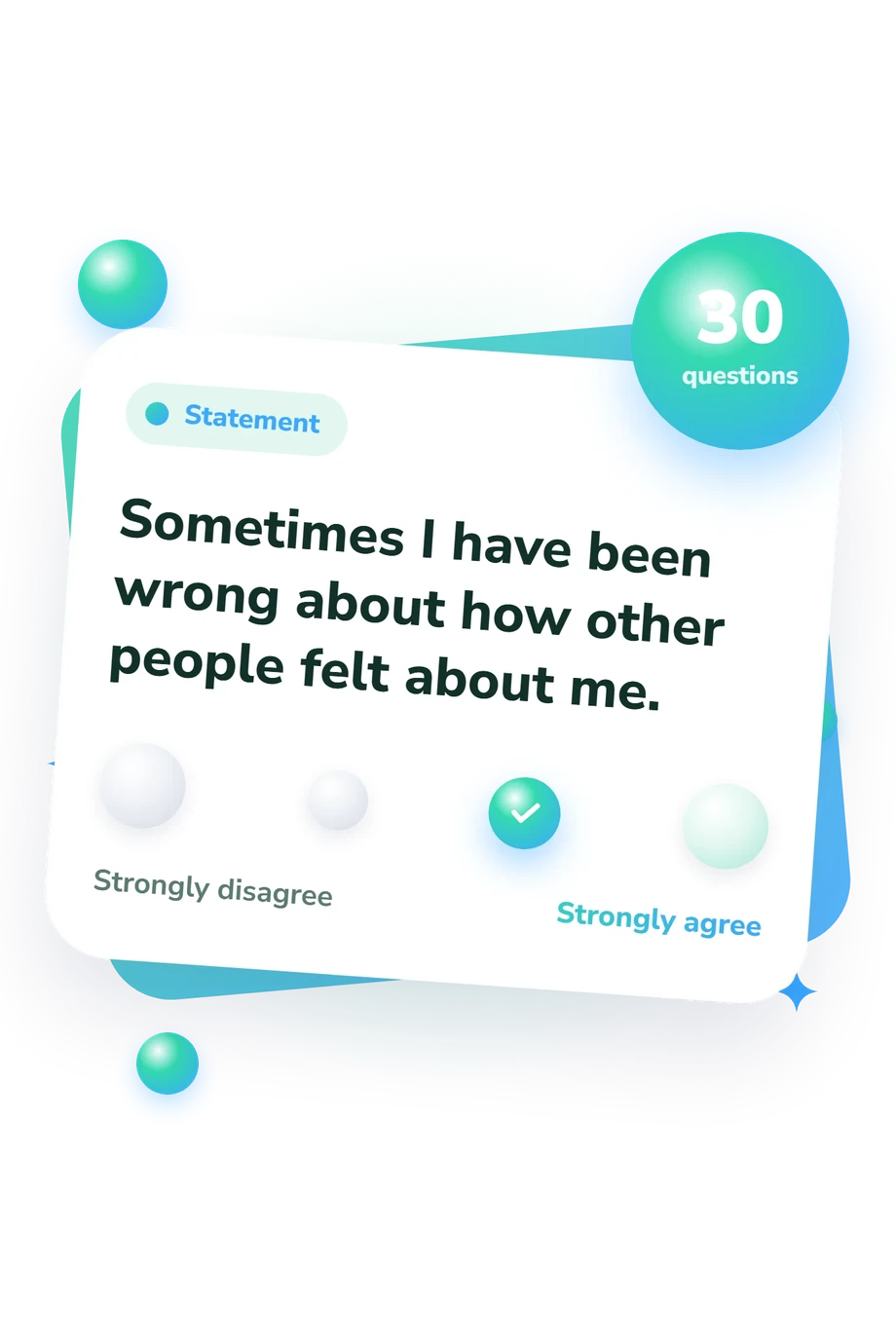
Each statement uses four agreement options: Strongly disagree, Agree slightly, Agree a lot, and Strongly agree. The items cover mistaken assumptions, certainty in judgments, alternative explanations, feedback, and how stress affects experience. Results appear on the three displayed scales. Together, the prompts invite reflection on how a person checks impressions, weighs explanations, and responds when emotions or other people challenge a conclusion.
Methodologically, the cognitive insight questionnaire is conceptually consistent with the Beck Cognitive Insight Scale (BCIS), introduced as a published instrument in 2004. This online version has a distinct presentation and scoring display, so its bands should not be read as norms or findings from that instrument.
Pedrelli and colleagues examined cognitive insight in psychotic disorders, while Martin, Warman, and Lysaker studied psychotic and non-psychiatric groups. These studies support the construct's relevance but do not validate this online questionnaire or its displayed bands.
Interpret the profile as a pattern for reflection. Self-report can shift with stress, memory, self-awareness, and openness to reconsideration, so a single result needs context and cannot establish a diagnosis.
- Beck AT, Baruch E, Balter JM, Steer RA, Warman DM. A new instrument for measuring insight: the Beck Cognitive Insight Scale. Schizophrenia Research. 2004;68(2-3):319-329. 10.1016/S0920-9964(03)00189-0
- Pedrelli P, McQuaid JR, Granholm E, Patterson TL, McClure F, Beck AT, Jeste DV. Measuring cognitive insight in middle-aged and older patients with psychotic disorders. Schizophrenia Research. 2004;71(2-3):297-305. 10.1016/j.schres.2004.02.019
- Martin JM, Warman DM, Lysaker PH. Cognitive insight in non-psychiatric individuals and individuals with psychosis: an examination using the Beck Cognitive Insight Scale. Schizophrenia Research. 2010;121(1-3):39-45. 10.1016/j.schres.2010.03.028
Updated: