
Express Assessment of Work Group Climate Test
How the Scales are Structured
Who Usually Takes This Test?
See How You Compare
Below is a preview of how scores are typically distributed across each scale.
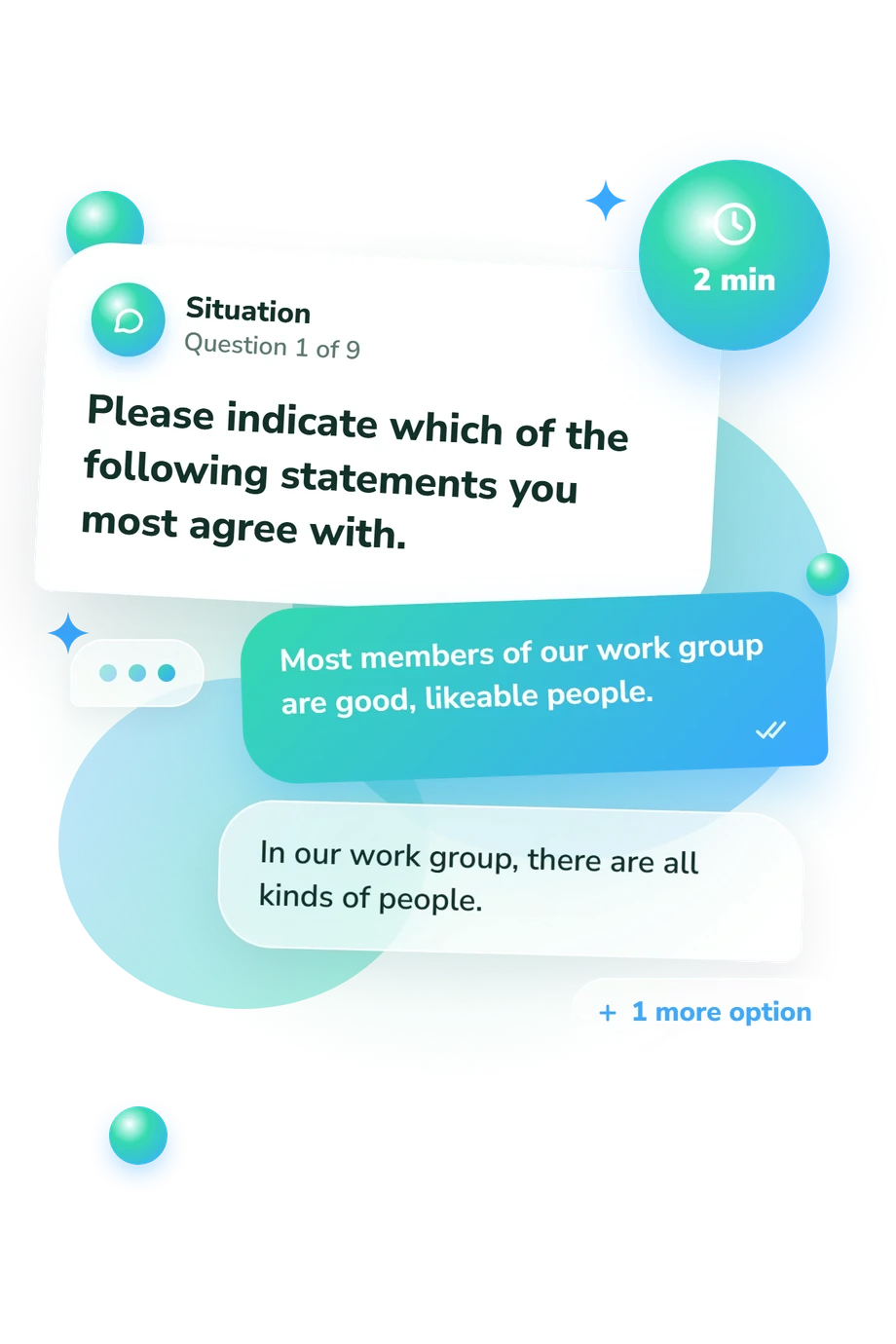
Example Questions From the Test
- Most members of our work group are good, likeable people.
- In our work group, there are all kinds of people.
- Most members of our work group are rather unpleasant people.
- No, of course not
- Probably no rather than yes
- I do not know; I have not thought about it
- Probably yes rather than no
- Yes, of course
- Yes
- Probably yes
- I don't know; I haven't thought about it
- Probably not
- No
Express Assessment of Work Group Climate Test - Description and methodology of the test
For managers, team members, and anyone reflecting on everyday cooperation, the Express Assessment of Work Group Climate Test turns personal impressions of cooperation into a structured profile for reflection and discussion. This work group climate assessment helps organize observations about how the collective functions without reducing workplace relationships to a single impression. The result is a compact profile for discussion and self-reflection.
What This Assessment Explores
This questionnaire examines work-group climate through three dimensions: awareness of colleagues, willingness to work and interact with the group in work-related and leisure relationships, and the group’s emotional attractiveness, expressed through like or dislike and pleasant or unpleasant feelings. It suits people reflecting on cooperation and everyday workplace contact. The result shows how these aspects of group experience are represented in the profile.
The displayed scales are these result dimensions:
- Cognitive: -1-1 measures awareness of colleagues; Low awareness -1-0, High awareness 0-1.
- Behavioral: -1-1 measures willingness to work and interact with the group, including work-related and leisure relationships; Low engagement -1-0, Neutral engagement 0-0, High engagement 0-1.
- Emotional: -1-1 measures how attractive, pleasant, or unpleasant the group feels; Negative -1-0, Positive 0-1.
Together, this workplace climate questionnaire can separate unfamiliarity, limited participation, and negative feeling toward the group.
Methodology and Scientific Basis
Items use several response formats: three- and five-option ordered responses, yes/no choices with uncertainty options, and 1-9 ratings for liking and atmosphere. Together, these items address knowledge, interaction, attraction, and contexts including atmosphere and mutual support rather than relying on one question.
The questionnaire reports three scale scores. Ranges describe possible outputs, but the point value assigned to each answer is not specified, so it should not be inferred from the range. The work group climate test is a compact profile, not a single overall score.
The method is conceptually consistent with Mikhalyuk and Shalyto’s 1983 express method, which supplies the relevant three-part structure; a 1990 practicum edited by Krylov discusses its applied use. Lewin, Lippitt, and White’s 1939 work provides wider social-climate context, but this questionnaire is not a reproduction of that experiment or a documented standardized adaptation.
Displayed bands are descriptive categories, not population norms or clinical thresholds. Self-report can be shaped by current conflict, selective attention, and reluctance to disclose, so interpret the profile with concrete workplace observations; it is a self-reflection measure, not a diagnosis.
- Mikhalyuk, O. S., & Shalyto, A. Yu. (1983). Studying the socio-psychological climate in a work collective using the “express method.” In E. V. Shorokhova, E. S. Kuzmin, O. I. Zotova, & V. E. Semyonov (Eds.), Socio-Psychological Problems of the Production Collective (pp. 187-197). Moscow: Nauka.
- Krylov, A. A. (Ed.). (1990). Practicum in Experimental and Applied Psychology. Leningrad: Leningrad University Press.
- Lewin, K., Lippitt, R., & White, R. K. (1939). Patterns of Aggressive Behavior in Experimentally Created “Social Climates.” The Journal of Social Psychology, 10(2), 269-299. 10.1080/00224545.1939.9713366
Updated: