
Should We Break Up Quiz
How the Scales are Structured
Who Usually Takes This Test?
See How You Compare
Below is a preview of how scores are typically distributed across each scale.
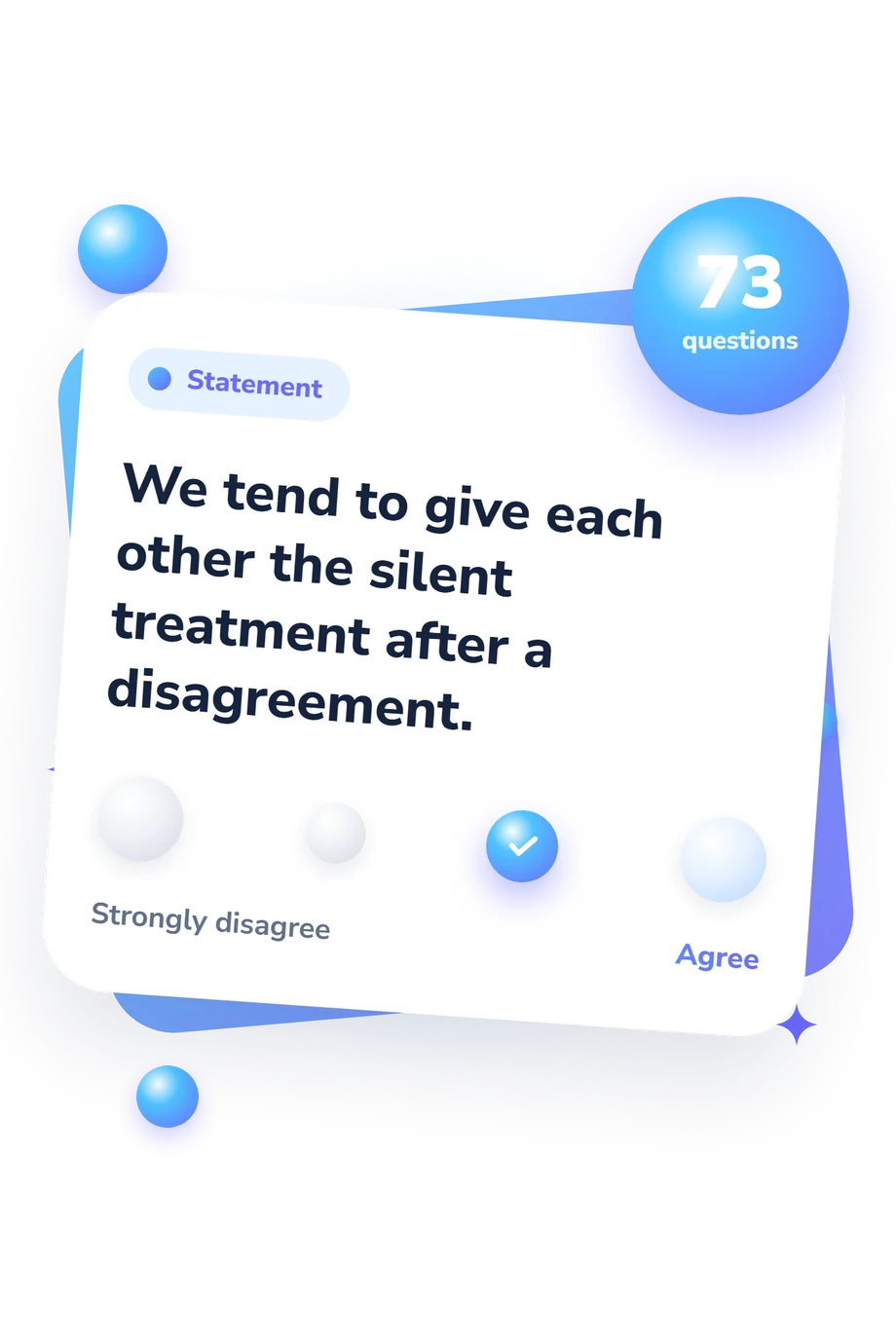
Example Questions From the Test
- Strongly disagree
- Disagree
- Not sure
- Agree
- Strongly disagree
- Disagree
- Not sure
- Agree
- Strongly disagree
- Disagree
- Not sure
- Agree
Should We Break Up Quiz - Description and methodology of the test
People considering whether a relationship remains workable can use this questionnaire to examine recurring patterns instead of relying on one intense argument. The Should We Break Up Quiz gives a structured view of conflict, trust, shared direction, and emotional support before a decision is made. Someone weighing whether to stay can use it to frame the should-I-break-up question around relationship patterns rather than one upsetting exchange. It can also help partners compare perceptions.
What This Assessment Explores
The profile asks how a couple handles friction, whether future plans fit, and how stable the relationship feels. Its relationship compatibility questions cover silent treatment, de-escalation, accountability, trust, boundaries, money, household roles, intimacy, values, commitment, and shared goals. Together, these areas examine conflict patterns, future alignment, and overall relationship health across daily life.
The profile reports these dimensions:
- Conflict & Repair (0-30) shows how disagreements de-escalate, accountability appears, and repair produces change; higher scores reflect constructive patterns, lower scores destructive cycles. Bands: Strained 0-12; Inconsistent 13-21; Constructive 22-30.
- Future Alignment (0-20) reflects fit on commitment, lifestyle, finances, family plans, intimacy, and growth; higher scores show shared direction, lower scores mismatch. Bands: Low alignment 0-7; Mixed/unclear alignment 8-14; High alignment 15-20.
- Relationship Health (0-40) summarizes communication, trust, values, and support; higher scores reflect stability, while lower scores signal broad strain. Bands: Strained 0-19; Mixed 20-29; Strong 30-40.
Methodology and Scientific Basis
Each statement uses an agreement response format: Strongly disagree, Disagree, Not sure, and Agree; some items use the combined option "Not sure / Not discussed." This lets the respondent indicate how strongly each statement describes the relationship. Responses are combined into the displayed scores, which are presented with score ranges and result bands. The displayed bands organize the results into descriptive levels for this questionnaire.
Conceptually, the questionnaire is consistent with AIRR, which considers relationship functioning through interacting risks and resources; it is not an adaptation of that instrument. Its conflict content also fits the domain measured by the Romantic Partner Conflict Scale, while its emphasis on coordinated future planning is consistent with Gere et al. (2016). These sources support the selected themes, not the validity of this online scoring model.
A relationship decision quiz can organize reflection, but self-report is influenced by current mood, selective memory, defensiveness, and unequal awareness between partners. Interpret the result alongside concrete examples over time, especially when two accounts differ sharply.
- Leth-Nissen, A. B., Fentz, H. N., Wellnitz, K. B., & Trillingsgaard, T. L. (2024). Development and validation of the Assessment Inventory on relationship Risks and Resources (AIRR). Family Relations, 73(4), 2490-2509. 10.1111/fare.13007
- Zacchilli, T. L., Hendrick, C., & Hendrick, S. S. (2009). The romantic partner conflict scale: A new scale to measure relationship conflict. Journal of Social and Personal Relationships, 26(8), 1073-1096. 10.1177/0265407509347936
- Gere, J., Almeida, D. M., & Martire, L. M. (2016). The Effects of Lack of Joint Goal Planning on Divorce over 10 Years. PLOS ONE, 11(9), e0163543. 10.1371/journal.pone.0163543
Updated: