
What Fruit Am I Quiz
How the Scales are Structured
Who Usually Takes This Test?
See How You Compare
Below is a preview of how scores are typically distributed across each scale.
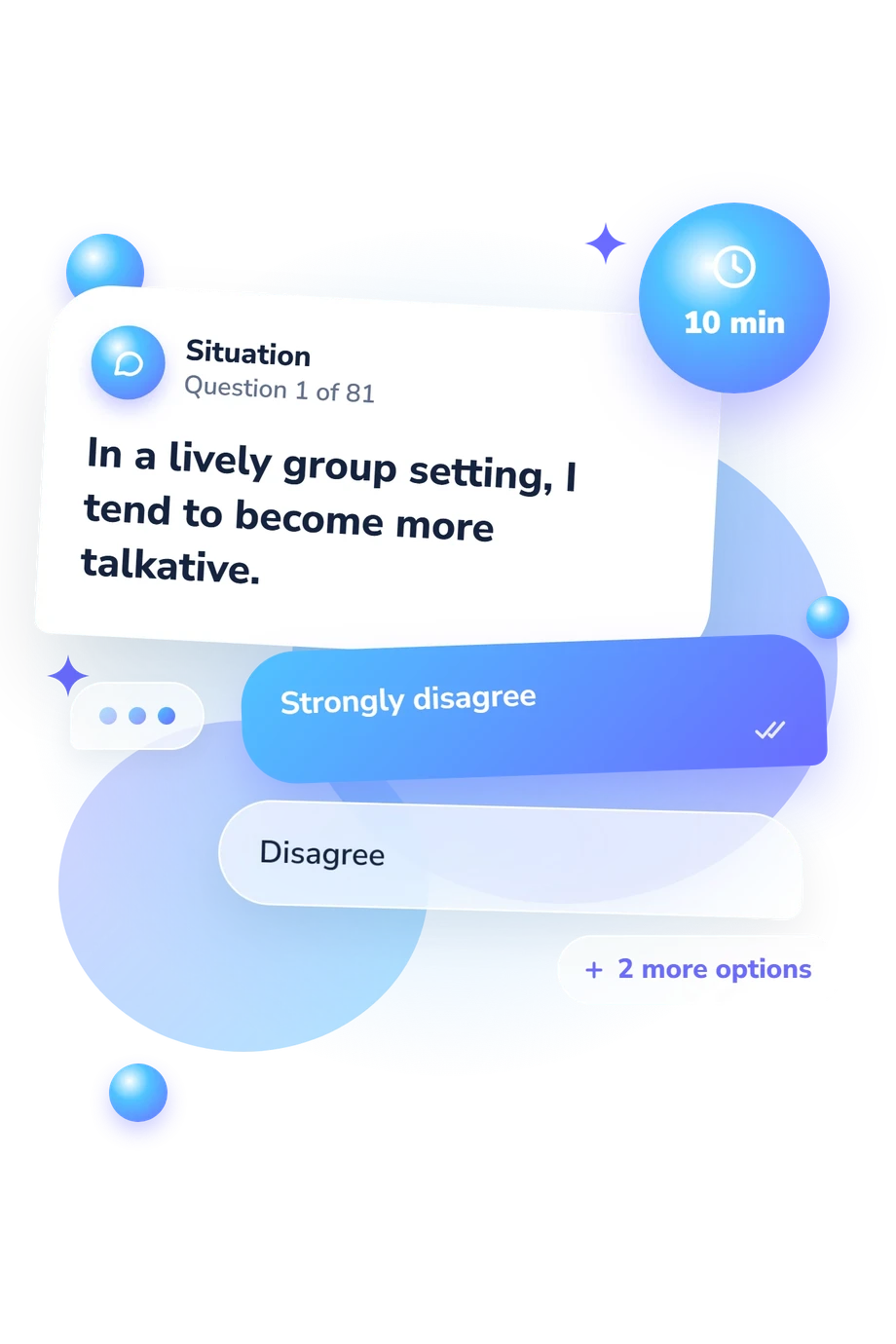
Example Questions From the Test
- Strongly disagree
- Disagree
- Not sure
- Agree
- Strongly disagree
- Disagree
- Not sure
- Agree
- Strongly disagree
- Disagree
- Not sure
- Agree
What Fruit Am I Quiz - Description and methodology of the test
People who enjoy personality quizzes but want more than a single playful label can use this What Fruit Am I Quiz to reflect on everyday preferences. Results from this fruit personality test organize responses into a memorable profile that can help readers notice patterns in how they connect, handle demands, and make choices. It suits curious readers who want a clearer vocabulary for their everyday tendencies.
What the Assessment Explores
As a playful fruit test, the questionnaire examines personality through everyday patterns in social engagement, pressure management, and the balance between preparation and flexibility. Items address group settings, solitude, deadlines, changing plans, and reactions under stress, helping the result connect with recognizable situations.
The three displayed dimensions are:
- Social Energy (0-20) measures energy gained from people versus solitude: Solo-Recharging (0-7), Flexible Mixer (8-13), or Socially Fueled (14-20).
- Stress Response Style (0-20) measures steadiness and constructive coping under pressure: More Reactive (0-8), Moderately Steady (9-14), or Calm & Regulated (15-20).
- Structure vs Spontaneity (0-20) measures planning and predictability versus flexible choices: Spontaneous (0-8), Balanced (9-14), or Structured (15-20).
Together, these dimensions create a profile of tendencies rather than a fixed identity, while the fruit framing keeps the interpretation memorable.
Methodology and Scientific Basis
The questionnaire uses four-point agreement responses. Preference statements run from Strongly disagree through Disagree and Not sure to Agree, while several stress statements use Strongly disagree, Disagree, Agree, and Strongly agree. This format invites graded self-report rather than a right-or-wrong answer.
Items address social engagement, stress responses, and planning preferences; point assignment and item-to-scale mapping are undisclosed. Bands classify the profile, but ranges do not show each option’s points, so the formula cannot be inferred.
The approach is dimensional and conceptually consistent with the Big Five Inventory-2 (Soto & John, 2017), which attends to social engagement and planful behavior, and the Brief COPE (Carver, 1997), which addresses coping under pressure. This questionnaire is neither of those instruments nor a documented adaptation.
By asking what fruit you are, the quiz stays approachable while its dimensions add substance. The BFI-2 and Brief COPE are conceptual reference instruments, not validation studies for this questionnaire. Its bands are descriptive self-report results that vary with current stress, self-awareness, and response style; they are a snapshot, not a diagnosis.
- Soto, C. J., & John, O. P. (2017). The next Big Five Inventory (BFI-2): Developing and assessing a hierarchical model with 15 facets to enhance bandwidth, fidelity, and predictive power. Journal of Personality and Social Psychology, 113(1), 117-143. 10.1037/pspp0000096
- Carver, C. S. (1997). You want to measure coping but your protocol’s too long: Consider the Brief COPE. International Journal of Behavioral Medicine, 4(1), 92-100. 10.1207/s15327558ijbm0401_6
Updated: