
Freudly+971 508685814hello@freudly.ai
Freudly
structure of personality

Big Five Inventory-2 Short Form (BFI-2-S) Test
Take the online Big Five Inventory-2 Short Form (BFI-2-S) Test - AI psychologist FreudlyYou can take Big Five Inventory-2 Short Form (BFI-2-S) Testhere. Online version of a simple and accurate psychological test with interpretation.en
Get a clear snapshot of your core personality traits and key facets in about 6 minutes. Use the results to guide personal growth, coaching, and better teamwork with a reliable, research-based profile.
Start Online Test
Questions: 306 minutes
08:30
October 2, 2025
October 2, 2025
Material has been updated
October 2, 2025
Material has been published
13,971 view
1,571 completion
1,289 likes
Verified by Daniel Hall
Psychologist with 25 years of experience
Share
Scale Explorer

How the Scales are Structured

example score
24/100
Extraversion (E)
Extraversion measures tendencies toward sociability, energetic engagement with others, and positive, active participation in social life.
Low
Moderate
High
030: Low | 3170: Moderate | 71100: High
A score of 24 falls in the Low range, suggesting a more reserved style with a preference for smaller or less frequent social interactions.
example score
65/100
Sociability (S)
Sociability reflects how readily a person seeks and enjoys social interaction, forms contacts, and feels comfortable being noticed by others.
Low
Moderate
High
033: Low | 3466: Moderate | 67100: High
A score of 65 falls in the Moderate range, suggesting a generally comfortable and communicative style that may vary with context rather than a strong preference for constant social engagement.
example score
47/100
Organization (O)
Organization measures how consistently a person plans, structures activities, and maintains order in tasks and routines.
Low
Moderate
High
033: Low | 3466: Moderate | 67100: High
A score of 47 falls in the Moderate range, suggesting a balanced tendency toward planning and order that may vary by situation or workload.
example score
82/100
Assertiveness (A)
Persistence measures the tendency to pursue goals with sustained effort, initiative, and energetic follow-through despite obstacles.
Low
Moderate
High
039: Low | 4069: Moderate | 70100: High
A score of 82 falls in the High range, suggesting a strong tendency toward determined goal pursuit and proactive, sustained effort.
example score
60/100
Energy Level (EL)
Energy Level reflects how active, alert, and vital a person tends to feel and behave in daily life.
Low
Moderate
High
031: Low | 3270: Moderate | 71100: High
A score of 60 falls in the Moderate range, suggesting a generally steady level of activity and initiative that may vary by situation.
example score
50/100
Agreeableness (A)
Kindness reflects a tendency toward cooperative, polite, and trusting interactions with others.
Low
Moderate
High
030: Low | 3170: Moderate | 71100: High
A score of 50 falls in the Moderate range, suggesting a balanced style that can be supportive and tactful while still being appropriately direct when needed.
example score
42/100
Compassion (C)
Empathy reflects how readily a person notices, resonates with, and responds to other people’s feelings with care and compassion.
Lower empathy
Moderate empathy
Higher empathy
033: Lower empathy | 3466: Moderate empathy | 67100: Higher empathy
A score of 42 suggests a moderate level of empathy, indicating you often recognize others’ emotions and can be supportive, though this may vary by situation.
example score
69/100
Respectfulness (R)
Measures the tendency to interact with others in a polite, tactful, and courteous manner.
Low
Moderate
High
033: Low | 3466: Moderate | 67100: High
A score of 69 falls in the High range, suggesting you typically communicate with noticeable tact, politeness, and consideration for others.
example score
43/100
Trust (T)
Trust measures how readily a person relies on others, assumes positive intent, and stays open to cooperation.
Low
Moderate
High
031: Low | 3270: Moderate | 71100: High
A score of 43 falls in the Moderate range, suggesting a balanced tendency to trust others while still being selective about reliance and collaboration.
example score
68/100
Conscientiousness (C)
Conscientiousness measures how organized, responsible, and goal-directed a person tends to be in daily life and work.
Low
Moderate
High
030: Low | 3170: Moderate | 71100: High
A score of 68 falls in the Moderate range, suggesting a generally reliable and structured approach with some flexibility rather than consistently strict discipline.
example score
48/100
Productiveness (P)
Productivity reflects how effectively a person sets goals and completes tasks in a timely, organized way.
Lower
Moderate
Higher
033: Lower | 3466: Moderate | 67100: Higher
A score of 48 falls in the Moderate range, suggesting a generally adequate ability to complete tasks and meet goals with some variability depending on circumstances.
example score
66/100
Responsibility (R)
Responsibility reflects the tendency to keep commitments, follow through on tasks, and reliably meet obligations.
Low
Moderate
High
031: Low | 3270: Moderate | 71100: High
A score of 66 falls in the Moderate range, suggesting a generally reliable approach to commitments with some variability depending on context and motivation.
example score
66/100
Negative Emotionality (NE)
Negative Emotionality measures the tendency to experience anxiety, low mood, and emotional reactivity under stress.
Low
Moderate
High
030: Low | 3170: Moderate | 71100: High
A score of 66 falls in the Moderate range, suggesting a noticeable tendency toward stress sensitivity and emotional fluctuations that is present but not extreme.
example score
27/100
Anxiety (A)
Anxiety reflects a tendency to worry, feel insecure, and experience distress about potential difficulties.
Low
Moderate
High
033: Low | 3466: Moderate | 67100: High
A score of 27 falls in the Low range, suggesting you generally experience relatively little worry and insecurity about potential problems.
example score
37/100
Depressiveness (D)
Depressiveness reflects a tendency toward lowered mood, sadness, and pessimistic thoughts.
Low
Moderate
High
033: Low | 3466: Moderate | 67100: High
A score of 37 falls in the Moderate range, suggesting occasional or situationally increased negative mood and pessimistic thinking without being a dominant pattern.
example score
38/100
Emotional Volatility (EV)
Emotional variability reflects how often and how sharply a person’s mood and emotional state tend to shift over time.
Low
Moderate
High
031: Low | 3270: Moderate | 71100: High
A score of 38 falls in the Moderate range, suggesting occasional mood shifts that are noticeable but not typically extreme or frequent.
example score
52/100
Openness To Experience (OTE)
Openness to Experience reflects curiosity, creativity, and receptiveness to new ideas and varied experiences.
Low
Moderate
High
030: Low | 3170: Moderate | 71100: High
A score of 52 falls in the Moderate range, suggesting a balanced mix of practical preferences and openness to new ideas or experiences.
example score
44/100
Curiosity (C)
Curiosity reflects interest in learning, seeking new information, and exploring unfamiliar ideas or experiences.
Low
Moderate
High
033: Low | 3466: Moderate | 67100: High
A score of 44 falls in the Moderate range, suggesting a balanced tendency to explore and learn, with curiosity that may vary by topic or situation.
example score
50/100
Aesthetic Sensitivity (AS)
Aesthetics reflects receptiveness to art, beauty, and aesthetically meaningful experiences.
Lower
Moderate
Higher
033: Lower | 3466: Moderate | 67100: Higher
A score of 50 falls in the Moderate range, suggesting a balanced sensitivity to aesthetic experiences that may vary by context and interest.
example score
52/100
Creative Imagination (CI)
Creative imagination reflects how readily a person generates novel ideas, fantasizes, and thinks in original ways.
Lower
Moderate
Higher
031: Lower | 3270: Moderate | 71100: Higher
A score of 52 falls in the Moderate range, suggesting a balanced tendency to come up with new ideas and imaginative variations without relying on it constantly.
Start Online Test
just completed the test
DATA-BASED USER COHORTS

Who Usually Takes This Test?

Career and team builders
41%OF USERS
People taking it to understand their work style, collaboration habits, and strengths to improve performance or leadership.
Students and researchers
34%OF USERS
Those using a quick, reliable personality measure for coursework, studies, or data collection with limited time.
Self-growth seekers
25%OF USERS
Individuals curious about their everyday tendencies and looking for insights to guide personal development and relationships.
BASED ON AGGREGATED, ANONYMIZED DATA FROM TENS OF THOUSANDS OF FREUDLY USERS.
Benchmarking

See How You Compare

Once you complete the test, your results are compared with real-world data from people in your country.
Below is a preview of how scores are typically distributed across each scale.
Extraversion (E)
Extraversion (E)
Average
45
Normal range
32.857.1
min.
0
max.
100
This curve shows how scores are typically distributed.
Once you complete the test, your result will appear on the scale so you can see how you compare.
Sociability (S)
Sociability (S)
Average
74.7
Normal range
6089.5
min.
0
max.
100
This curve shows how scores are typically distributed.
Once you complete the test, your result will appear on the scale so you can see how you compare.
Organization (O)
Organization (O)
Average
64.8
Normal range
50.679
min.
0
max.
100
This curve shows how scores are typically distributed.
Once you complete the test, your result will appear on the scale so you can see how you compare.
Persistence (P)
Persistence (P)
Average
73.8
Normal range
5988.6
min.
0
max.
100
This curve shows how scores are typically distributed.
Once you complete the test, your result will appear on the scale so you can see how you compare.
Energy Level (EL)
Energy Level (EL)
Average
51.8
Normal range
33.769.8
min.
0
max.
100
This curve shows how scores are typically distributed.
Once you complete the test, your result will appear on the scale so you can see how you compare.
Kindness (K)
Kindness (K)
Average
70.6
Normal range
5586.3
min.
0
max.
100
This curve shows how scores are typically distributed.
Once you complete the test, your result will appear on the scale so you can see how you compare.
Empathy (E)
Empathy (E)
Average
72.3
Normal range
56.288.3
min.
0
max.
100
This curve shows how scores are typically distributed.
Once you complete the test, your result will appear on the scale so you can see how you compare.
Respectfulness (R)
Respectfulness (R)
Average
46.9
Normal range
29.864
min.
0
max.
100
This curve shows how scores are typically distributed.
Once you complete the test, your result will appear on the scale so you can see how you compare.
Trust (T)
Trust (T)
Average
27.7
Normal range
13.941.6
min.
0
max.
100
This curve shows how scores are typically distributed.
Once you complete the test, your result will appear on the scale so you can see how you compare.
Conscientiousness (C)
Average
56.9
Normal range
39.174.6
min.
0
max.
100
This curve shows how scores are typically distributed.
Once you complete the test, your result will appear on the scale so you can see how you compare.
Productivity (P)
Productivity (P)
Average
70.9
Normal range
53.288.5
min.
0
max.
100
This curve shows how scores are typically distributed.
Once you complete the test, your result will appear on the scale so you can see how you compare.
Responsibility (R)
Responsibility (R)
Average
71.2
Normal range
5488.4
min.
0
max.
100
This curve shows how scores are typically distributed.
Once you complete the test, your result will appear on the scale so you can see how you compare.
Negative Emotionality (NE)
Average
51.2
Normal range
38.563.9
min.
0
max.
100
This curve shows how scores are typically distributed.
Once you complete the test, your result will appear on the scale so you can see how you compare.
Anxiety (A)
Anxiety (A)
Average
33.1
Normal range
1749.2
min.
0
max.
100
This curve shows how scores are typically distributed.
Once you complete the test, your result will appear on the scale so you can see how you compare.
Depressiveness (D)
Depressiveness (D)
Average
28
Normal range
13.442.5
min.
0
max.
100
This curve shows how scores are typically distributed.
Once you complete the test, your result will appear on the scale so you can see how you compare.
Emotional variability (Ev)
Average
70.3
Normal range
53.786.9
min.
0
max.
100
This curve shows how scores are typically distributed.
Once you complete the test, your result will appear on the scale so you can see how you compare.
Openness to Experience (OtE)
Average
67
Normal range
50.883.2
min.
0
max.
100
This curve shows how scores are typically distributed.
Once you complete the test, your result will appear on the scale so you can see how you compare.
Curiosity (C)
Curiosity (C)
Average
74.5
Normal range
59.189.9
min.
0
max.
100
This curve shows how scores are typically distributed.
Once you complete the test, your result will appear on the scale so you can see how you compare.
Aesthetics (A)
Aesthetics (A)
Average
34
Normal range
17.650.3
min.
0
max.
100
This curve shows how scores are typically distributed.
Once you complete the test, your result will appear on the scale so you can see how you compare.
Creative imagination (Ci)
Average
64.1
Normal range
45.482.9
min.
0
max.
100
This curve shows how scores are typically distributed.
Once you complete the test, your result will appear on the scale so you can see how you compare.
Featured On
SAMPLE QUESTIONS

Example Questions From the Test

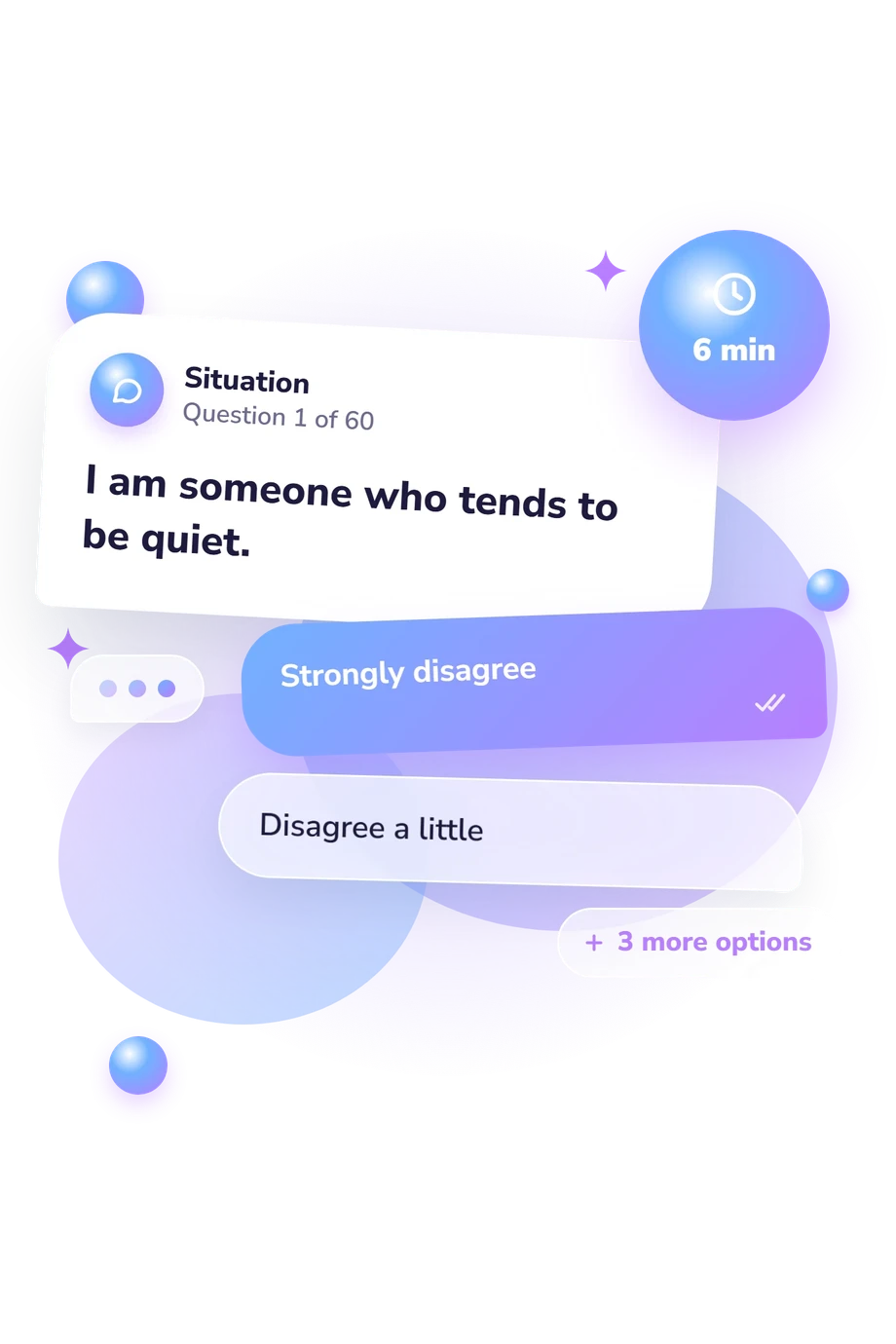
Below is a list of characteristics that may or may not describe you. For example, do you agree that you are a person who enjoys spending time with other people? Please indicate the extent to which you agree or disagree with each statement.
    • Strongly disagree
    • Disagree a little
    • Neither agree nor disagree
    • Agree a little
    • Strongly agree
    • Strongly disagree
    • Disagree a little
    • Neutral, no opinion
    • Agree a little
    • Strongly agree
    • Strongly disagree
    • Disagree a little
    • Neutral, no opinion
    • Agree a little
    • Strongly agree
WHAT THE TEST MEASURES
About This Assessment

Big Five Inventory-2 Short Form (BFI-2-S) Test - Symptoms and Signs

structure of personality

In clinical and research settings, a brief assessment of broad personality traits can support case formulation and treatment planning. The Big Five Inventory-2 Short Form (BFI-2-S) is a self-report measure based on the five-factor model of personality.

The instrument includes 30 items and typically requires about 6 minutes to complete. It yields scores reflecting the major personality domains and can be used to characterize typical patterns of behavior, affect, and interpersonal style.

Results from the Big Five Inventory-2 Short Form (BFI-2-S) are generally interpreted as dimensional trait estimates and are best considered alongside clinical interview data, behavioral observations, and other assessment information rather than as a standalone diagnostic indicator.

Author: Christopher J. Soto, Oliver P. John
Literature: Soto, C. J., & John, O. P. The next Big Five Inventory (BFI-2): Developing and assessing a hierarchical model with 15 facets to enhance bandwidth, fidelity, and predictive power. Journal of Personality and Social Psychology. 2017.; Soto, C. J., & John, O. P. Short and extra-short forms of the Big Five Inventory–2: The BFI-2-S and BFI-2-XS. Journal of Research in Personality. 2017.; McCrae, R. R., & Costa, P. T., Jr. Personality in adulthood: A five-factor theory perspective. Guilford Press. 2003.; John, O. P., Naumann, L. P., & Soto, C. J. Paradigm shift to the integrative Big Five trait taxonomy: History, measurement, and conceptual issues. In O. P. John, R. W. Robins, & L. A. Pervin (Eds.), Handbook of personality: Theory and research. Guilford Press. 2008.
Popular tests
Comments
Leave a Comment