
Furry Quiz
How the Scales are Structured
Who Usually Takes This Test?
See How You Compare
Below is a preview of how scores are typically distributed across each scale.
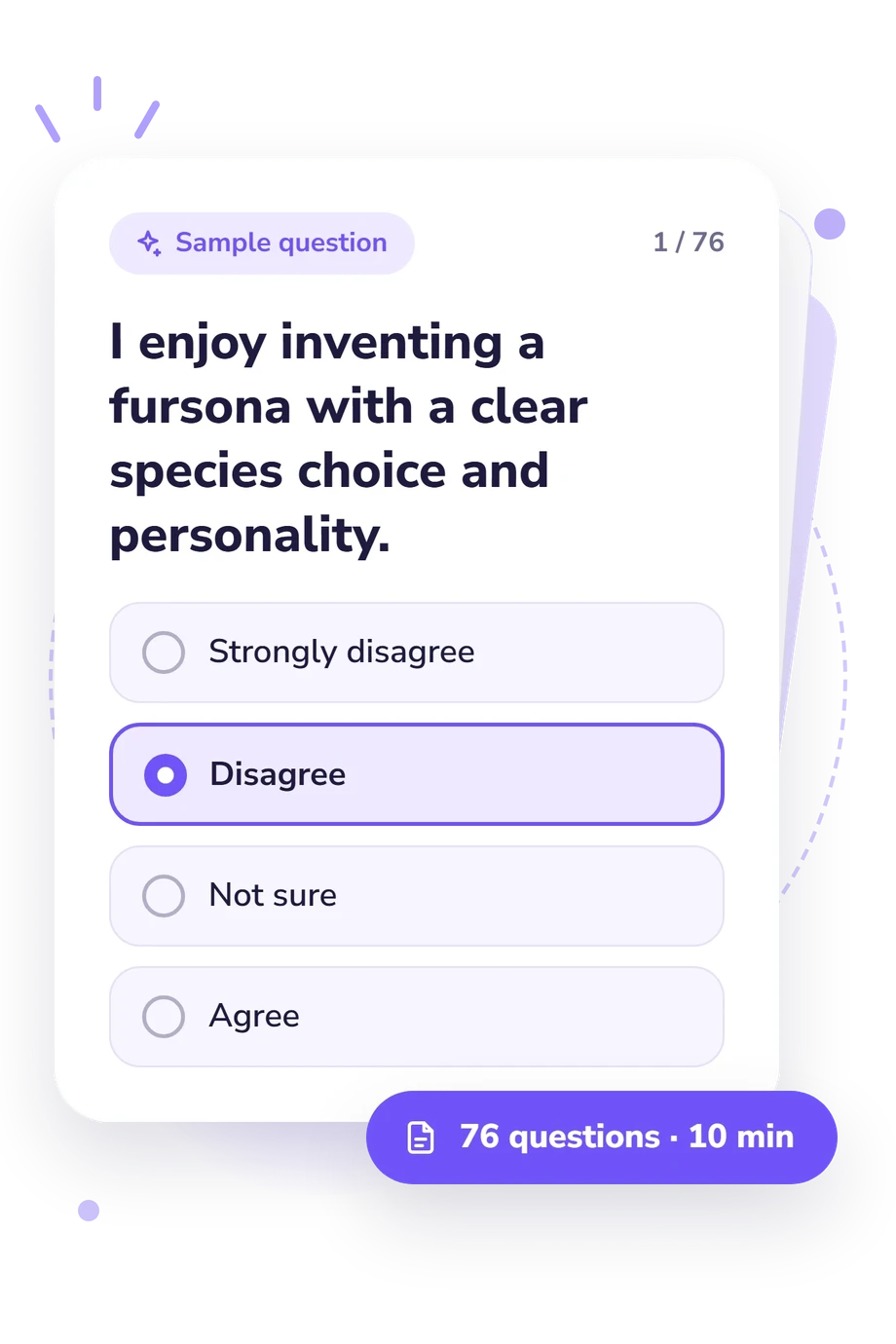
Example Questions From the Test
- Strongly disagree
- Disagree
- Not sure
- Agree
- Strongly disagree
- Disagree
- Not sure
- Agree
- Strongly disagree
- Disagree
- Not sure
- Agree
Furry Quiz - Description and methodology of the test
People curious about their place in furry culture can use this furry test to organize involvement, from creative identity-building to social participation and roleplay. The assessment may suit newcomers, casual followers, and established participants who want to explore the question behind an am i a furry quiz without reducing it to a yes-or-no label. It lets readers consider these forms of involvement separately before deciding whether the questionnaire matches what they want to explore.
What This Assessment Explores
Items examine how a person follows, shares, or joins furry spaces, develops a fursona, and approaches character-based interaction. The furry quiz therefore accommodates casual interest as well as active participation.
Three dimensions organize the result:
- Fandom Engagement: 0-30 measures activity in content, communities, events, and creating or sharing: Exploratory 0-10, Engaged 11-20, Highly involved 21-30.
- Fursona Creativity: 0-20 measures enjoyment of persona design and expression: Low 0-6, Moderate 7-13, High 14-20.
- Roleplay Comfort: 0-20 measures ease with identity play, boundaries, and consent awareness: Observer-leaning 0-7, Selective roleplayer 8-14, Immersive & confident 15-20.
Together, these bands show a participation profile for you rather than deciding whether someone belongs to the fandom.
Methodology and Evidence Base
Questions ask for self-report judgments about enjoyment, frequency, willingness, comfort, tension, and boundaries. Response options include four-option agreement choices for statements about preferences and comfort, as well as frequency choices such as never, sometimes, often, and very often for activity reports. These formats capture both personal reactions and reported participation.
The result is reported across the three displayed scales, so it can address the question behind an are you a furry quiz with a profile: someone may show strong interest in fursona design while preferring to observe roleplay.
The questionnaire is conceptually consistent with Reysen et al. (2020), particularly its discussion of fursonas and creative expression, but it is not a direct adaptation. That study offers conceptual context rather than validation of this online questionnaire. Mock et al. (2013) provides context for viewing fandom engagement as leisure participation, while Reysen et al. (2016) provides context for fandom identification; these sources do not establish the questionnaire's measurement properties.
Current context may influence responses, as can community access and roleplay experience. Honest self-report remains important because personal interpretation and self-awareness shape answers. The displayed bands are descriptive categories for this questionnaire rather than universal thresholds.
- Reysen, Stephen, Courtney N. Plante, Sharon E. Roberts, and Kathleen C. Gerbasi. "Psychology and Fursonas in the Furry Fandom." In Furries Among Us 3: Essays by Furries About Furries, edited by T. Howl, 86-104. Thurston Howl Publications, 2020.
- Mock, Steven E., Courtney N. Plante, Stephen Reysen, and Kathleen C. Gerbasi. "Deeper Leisure Involvement as a Coping Resource in a Stigmatized Leisure Context." Leisure/Loisir 37, no. 2 (2013): 111-126. 10.1080/14927713.2013.801152
- Roberts, Sharon E., Courtney N. Plante, Kathleen C. Gerbasi, and Stephen Reysen. "The Anthrozoomorphic Identity: Furry Fandom Members’ Connections to Nonhuman Animals." Anthrozoös 28, no. 4 (2015): 533-548. 10.1080/08927936.2015.1069993
- Reysen, Stephen, Courtney N. Plante, Sharon E. Roberts, and Kathleen C. Gerbasi. "Optimal Distinctiveness and Identification with the Furry Fandom." Current Psychology 35, no. 4 (2016): 638-642. 10.1007/s12144-015-9331-0
Updated: