
Misophonia Test
How the Scales are Structured
Who Usually Takes This Test?
See How You Compare
Below is a preview of how scores are typically distributed across each scale.
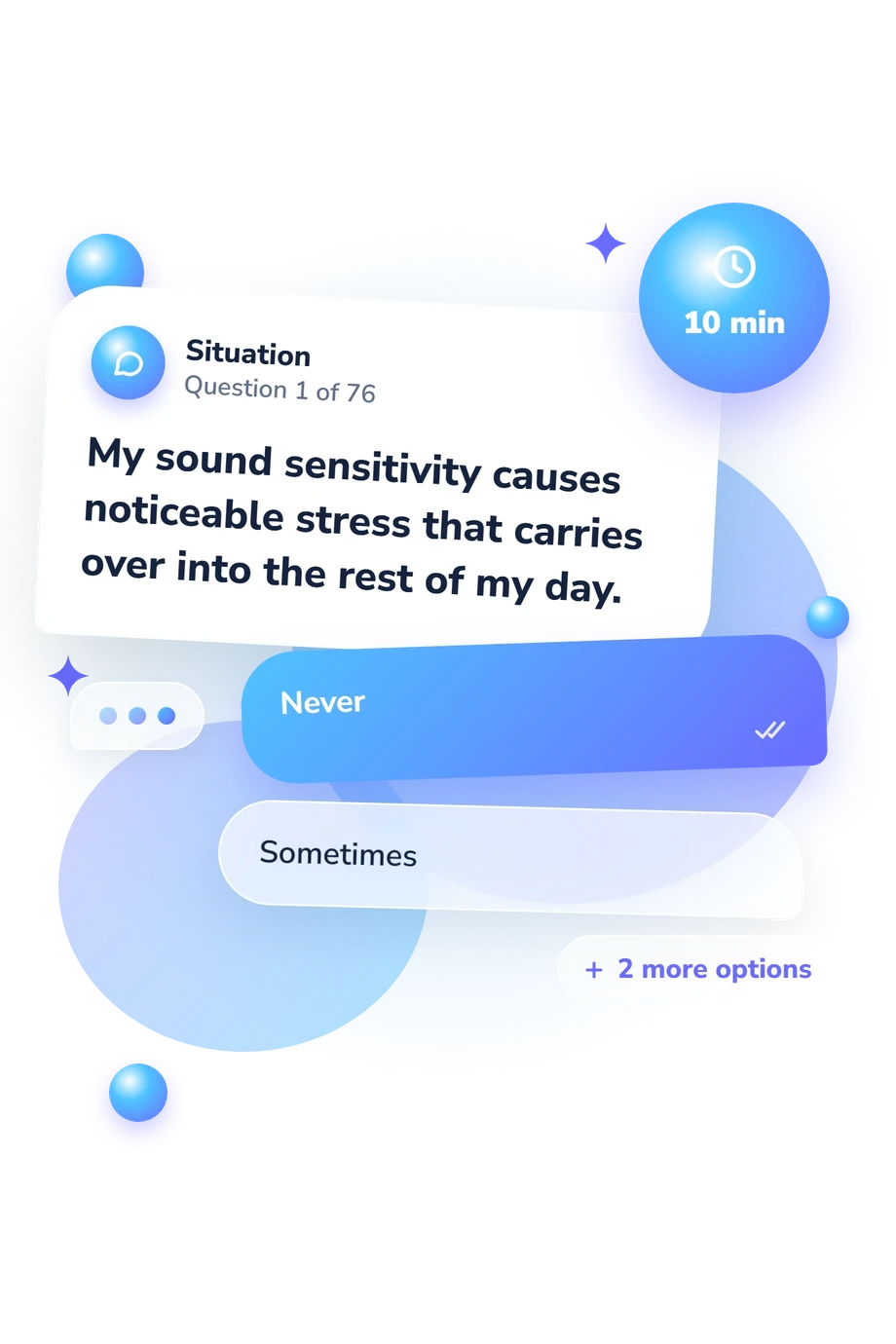
Example Questions From the Test
- Never
- Sometimes
- Often
- Almost always
- Strongly disagree
- Disagree
- Agree
- Strongly agree
- Never
- Sometimes
- Often
- Almost always
Misophonia Test - Description and methodology of the test
People who experience anger, anxiety, tension, or an urge to escape when ordinary sounds occur can use the misophonia test to organize those reactions and their effects on daily life. By examining sound sensitivity through coping, daily functioning, and reactions to trigger sounds, it gives readers a profile to compare with their current context. The result highlights the pattern that feels most prominent now.
What This Assessment Explores
These items examine situations in which trigger sounds cause distress, bodily tension, abrupt emotional shifts, or behavioral changes. References to meals, classrooms, workplaces, transport, sleep, and shared rooms show how recurring misophonia symptoms can affect ordinary settings. The three dimensions are:
- Avoidance & Coping (0-30) measures reliance on leaving, blocking, or controlling exposure: Low use (0-10), Moderate use (11-20), High use (21-30).
- Functional Impact (0-30) measures interference with relationships, performance, activities, and quality of life: Low impact (0-10), Moderate impact (11-20), High impact (21-30).
- Trigger Reactivity (0-40) measures immediate emotional and physiological responses to trigger sounds: Low (0-13), Moderate (14-26), High (27-40).
Together, the results show whether the main burden lies in the reaction itself, efforts to manage exposure, or consequences for daily life.
Methodology and Scientific Basis
The questionnaire uses four-option statements. Some ask frequency-Never, Sometimes, Often, or Almost always-while others ask agreement from Strongly disagree to Strongly agree. This captures repeated coping and immediate reactions.
The questionnaire reports separate scores for the displayed scales, each with its listed bands. Higher scores indicate more coping or avoidance, functional interference, or stronger reactions to triggers; item-level point contributions are unspecified. Readers asking whether this is a do i have misophonia quiz can use its profile to reflect on current patterns.
Its closest published reference is the Duke-Vanderbilt Misophonia Screening Questionnaire. The content is also conceptually consistent with the Duke Misophonia Questionnaire and Swedo and colleagues’ consensus definition, which emphasizes emotional, physiological, and behavioral responses to trigger sounds. The online questionnaire has no documented standardization, norms, or independent validation; these published works provide conceptual context, not validation of this questionnaire.
Interpretation is sensitive to current stress, context, recall, and self-awareness. The result can highlight a pattern worth examining, but cannot by itself establish a diagnosis or explain every source of distress.
- Williams, Z. J., Cascio, C. J., & Woynaroski, T. G. (2022). Psychometric validation of a brief self-report measure of misophonia symptoms and functional impairment: The Duke-Vanderbilt Misophonia Screening Questionnaire. Frontiers in Psychology, 13, 897901. 10.3389/fpsyg.2022.897901
- Rosenthal, M. Z., Anand, D., Cassiello-Robbins, C., Williams, Z. J., Guetta, R. E., Trumbull, J., & Kelley, L. D. (2021). Development and Initial Validation of the Duke Misophonia Questionnaire. Frontiers in Psychology, 12, 709928. 10.3389/fpsyg.2021.709928
- Swedo, S. E., Baguley, D. M., Denys, D., Dixon, L. J., Erfanian, M., Fioretti, A., Jastreboff, P. J., Kumar, S., Rosenthal, M. Z., Rouw, R., Schiller, D., Simner, J., Storch, E. A., Taylor, S., Vander Werff, K. R., Altimus, C. M., & Raver, S. M. (2022). Consensus Definition of Misophonia: A Delphi Study. Frontiers in Neuroscience, 16, 841816. 10.3389/fnins.2022.841816
Updated: