
Personal and Social Performance Scale (PSP) Test
How the Scales are Structured
Who Usually Takes This Test?
See How You Compare
Below is a preview of how scores are typically distributed across each scale.
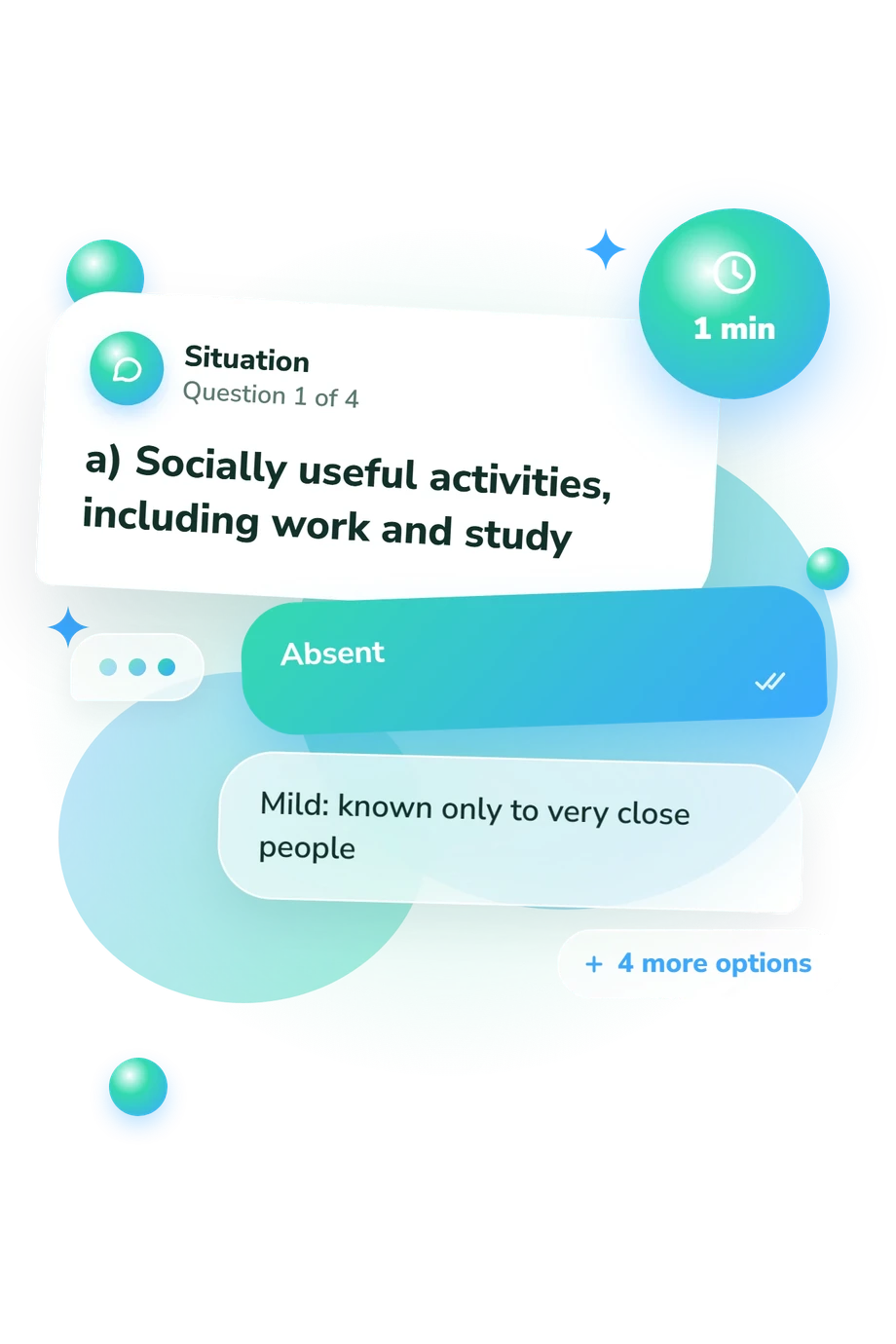
Example Questions From the Test
- Absent
- Mild: known only to very close people
- Marked: difficulties are evident to anyone around the patient, but do not substantially and negatively affect the patient’s ability to perform functions in this domain, taking into account the patient’s sociocultural status, age, sex, and level of education
- Severe: difficulties greatly interfere with functioning in this domain; however, the patient is still able to function without professional or social assistance, even if not always adequately and/or only episodically; with assistance, he/she can reach the previous level of functioning
- Very severe: difficulties make functioning in this domain impossible without professional assistance, or lead to destructive behavior, but there is no danger to life
- Extremely severe: impairments and difficulties are so severe that the patient’s life is in danger
- Absent
- Mild: known only to very close people
- Manifest: difficulties are obvious to anyone in the patient’s environment, but do not have a substantial negative impact on the patient’s ability to carry out functions in this area, taking into account the patient’s sociocultural status, age, sex, and level of education
- Marked: difficulties greatly interfere with functioning in this area; however, the patient is still able to function without professional or social assistance, although not always adequately and/or only intermittently; with help from others, he/she can reach the previous level of functioning
- Severe: difficulties make it impossible to function in this area without professional assistance, or lead to destructive behavior, but there is no threat to life
- Very severe: impairments and difficulties are so pronounced that the patient’s life is in danger
- Absent
- Mild: known only to very close people
- Moderate: difficulties are obvious to anyone around the patient, but do not have a substantial negative impact on the patient’s ability to carry out functions in this area, taking into account the patient’s sociocultural status, age, sex, and educational level
- Marked: difficulties greatly interfere with functioning in this area; nevertheless, the patient is still able to function without professional or social assistance, although not always adequately and/or intermittently; with assistance from others, he/she is able to achieve the previous level of functioning
- Severe: difficulties make functioning in this area impossible without professional help, or lead to destructive behavior; however, there is no threat to life
- Very severe: impairments and difficulties are so pronounced that the patient’s life is in danger
Personal and Social Performance Scale (PSP) Test - Description and methodology of the test
For readers who want to understand how psychological difficulties may affect responsibilities and relationships, the Personal and Social Performance Scale (PSP) Test provides a structured way to interpret their practical effects in ordinary roles. A PSP assessment can show how reported difficulties shape participation and contact with others. Its profile helps connect psychological strain with everyday functioning without reducing the result to a single overall judgment.
What This Assessment Explores
The questionnaire examines difficulties affecting participation, relationships, basic care, and behavioral control. It suits anyone seeking structured reflection on everyday functioning. Results indicate where functional impairment is lower or higher and where aggression-related difficulty is lower or higher, according to the selected description.
The four result dimensions are:
- Socially Useful Activities (1-6) indicates impairment in work, study, and daily responsibilities: Low impairment 1-2; Moderate impairment 3-4; High impairment 5-6.
- Social Relationships (1-6) indicates difficulty maintaining contact with family, friends, and colleagues: Low impairment 1-2; Moderate impairment 3-4; High impairment 5-6.
- Self-Care (1-6) indicates difficulty with hygiene, eating, and basic self-care: Low difficulty 1-2; Moderate difficulty 3-4; High difficulty 5-6.
- Aggressive Behavior (1-6) indicates verbal or physical aggression severity and difficulty controlling it: Low 1-2; Moderate 3-4; High 5-6.
Together, the PSP scale shows where functioning is preserved and difficulties are disruptive.
Methodology and Evidence Base
Each question presents one domain with six ordered options, from absent or mild difficulty through increasingly severe descriptions. Descriptions cover visibility, functional interference, need for assistance, and possible harm from aggression. Respondents choose the best-matching description rather than rate agreement.
For this PSP questionnaire, each description produces an ordered rating, and the displayed band gives its plain-language level. The four ratings are read separately; the format provides no basis for inventing a weighted total or overall score.
The questionnaire is conceptually consistent with the Personal and Social Performance Scale (PSP), a published clinician-rated measure of social functioning. Morosini and colleagues established its four-domain structure; Nasrallah, Morosini, and Gagnon examined its reliability, validity, and sensitivity to change in people with stable schizophrenia. No norms or standardization are provided for this online self-report questionnaire; the cited reliability and validity findings apply to the published clinician-rated PSP instrument.
Interpretation depends on honest self-report and context, so stress, self-awareness, or fear of judgment may influence the selected option. Use the profile to identify patterns for reflection; it is a snapshot of reported functioning, not a diagnosis.
- Morosini PL, Magliano L, Brambilla L, Ugolini S, Pioli R. Development, reliability and acceptability of a new version of the DSM-IV Social and Occupational Functioning Assessment Scale (SOFAS) to assess routine social functioning. Acta Psychiatrica Scandinavica. 2000;101(4):323-329. 10.1034/j.1600-0447.2000.101004323.x
- Nasrallah H, Morosini PL, Gagnon DD. Reliability, validity and ability to detect change of the Personal and Social Performance scale in patients with stable schizophrenia. Psychiatry Research. 2008;161(2):213-224. 10.1016/j.psychres.2007.11.012
Updated: